


Pope Leo XIV has just issued his first encyclical, Magnifica Humanitas, which states the Catholic Church’s position on the threats posed by AI.
The subject Leo chose is highly symbolic. Pope Leo XIII is best remembered for his 1891 encyclical Rerum Novarum, which sought to reconcile the church with modernity and the arrival of rapid industrialization. Like his namesake, Leo XIV sees the ethical questions raised by technological change as a central concern.
Magnifica Humanitas presents AI as a profound new challenge to human dignity, justice and economic security. To confront these challenges, Leo invokes foundational Catholic social teachings about the importance of human dignity and human rights, the common good and the principles of universality, subsidiarity, solidarity and social justice. Though he acknowledges that AI can be a “valuable tool,” he warns that it must be “disarmed” and “freed from logics that turn it into an instrument of domination, exclusion, or death.”
Notably, Leo considers the entire life cycle of AI, from the exploitation of people and nature in the extraction of raw materials needed for AI hardware to socially and environmentally destructive design choices and end uses.
“Nothing in the world of AI is immaterial or magical,” Leo writes. “Every seemingly immediate and flawless response is the result of a long chain of mediation, involving vast networks of natural resources, energy infrastructure and, above all, people.”
It is people, not technology, that are at the heart of Magnifica Humanitas. “A significant part of the digital economy’s functioning relies on the silent work of millions of people engaged in essential yet largely unseen activities,” Leo continues, “such as data labeling, model training and content moderation, often involving disturbing material.”
Such exploitation, he notes, “deeply challenges the moral conscience of our time.” If AI depends on and produces “new forms of global subordination, it stands in contradiction to the fundamental principle of human dignity.” Ultimately, “The fight against new forms of slavery is a decisive test for the ethical discernment of AI and digital transformation.”
Leo does not shy away from explicitly calling out injustices and reprehensible economic practices that are already widespread in the AI industry. He sees colonialism taking a new form. “It no longer dominates only bodies, but appropriates data, transforming personal lives into exploitable information.”
Consider the implications for public health and biomedical ethics. As AI labs hoover up medical, epidemiological and demographic data from vulnerable regions, they come to “control the health data of entire peoples — often collected under the pretext of aid, research or innovation.”
The result is a form of “structural leverage over the future, for they can shape needs and markets. They can also decide, before others, to whom medicines, investments and protections would be allocated.”
Leo then outlines measures needed to ensure that AI serves not just a few multinational technology corporations, but all humans, as well as our planet.
He repeatedly calls for global regulation of AI and independent, effective oversight, thus continuing down the same path as his immediate predecessor, Pope Francis, who supported concrete proposals from my own research: human rights-based global regulation of data-based systems and the establishment of a new agency — an International Data-Based Systems Agency — at the UN to enforce it.
Leo outlines in detail what needs to be done to govern digital devices and social media (better understood as “anti-social media,” given that they were designed from the outset to turn users into atomized addicts).
He sees a need for age limits, accountability for service providers (“rather than shifting the whole burden of control onto families”) and stronger specific “protections against all forms of online sexual exploitation and violence.”
Likewise, he calls for greater efforts to teach “children, adolescents and young people how to recognize manipulation, defend their dignity and respect that of others in digital environments.”
The pope is absolutely right to celebrate the grandeur of humanity, to criticize and reject transhumanism and post-humanism and to emphasize the essential, categorical and insurmountable difference between humans and machines — which do not have freedom, moral agency or emotional and social intelligence. Magnifica Humanitas calls everyone — believers and non-believers — to the cause of safeguarding human dignity and working together toward a humane, sustainable present and future.
Peter G. Kirchschlager, professor of Ethics and Director of the Institute of Social Ethics ISE at the University of Lucerne, is a visiting professor at ETH Zurich.
Copyright: Project Syndicate
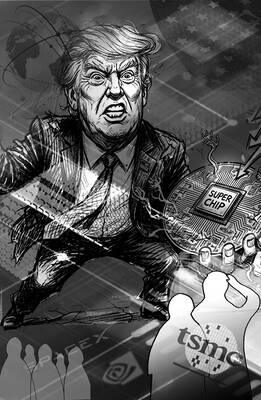
The White House’s decision to take a 9.9 percent stake in Intel Corp is looking like very shrewd business indeed. Since the government bought in at US$20.47 a share last August, the US chipmaker’s surging stock price has delivered the US a US$43 billion return. One of the reasons the investment has so far proved so sound is that the White House has made sure of it. According to The Wall Street Journal, Howard personally pushed deals on Intel’s behalf with some of the most lucrative clients imaginable. They include Nvidia Corp, the company at the heart of the AI
In a Taiwanese university classroom, a lecturer asks in English: “Can anyone give me an example from Taiwan?” Students look down. No one answers. After class, one student writes on the course platform in Mandarin: “I understood the concept, but I didn’t know how to answer in English.” That moment highlights a key issue in Taiwan’s English-medium instruction (EMI) reform: It is not just about more English-taught courses, but whether students can learn, participate and belong. EMI expansion is part of the Bilingual 2030 policy and the Ministry of Education’s BEST Program, aiming to improve English ability, support EMI teaching
A single photograph can cut through a lot of noise, but it can also be used to misrepresent the truth. At the very least, it can concentrate the mind on something that requires further investigation. On Monday last week, Ma Ying-jeou Foundation CEO Tai Hsia-ling (戴遐齡) and former National Security Council secretary-general King Pu-tsung (金溥聰) held a news conference in which they showed a photograph of former foundation CEO Hsiao Hsu-tsen (蕭旭岑), now Chinese Nationalist Party (KMT) deputy chairman. In the image Hsiao is seated next to Xiamen Taiwan Businessmen Association chairman Han Ying-huan (韓螢煥). The two men were holding
The Ministry of the Interior, working with the navy and coast guard, is organizing Taiwan’s first joint exercise simulating escort tankers carrying liquefied natural gas (LNG) and oil through a Chinese blockade. The drills simulate fuel transport along three maritime corridors leading toward Japan, the Philippines and the US. Deputy Minister of the Interior Sawyer Mars (馬士元) said that a blockade of the Taiwan Strait would amount to “almost a 100 percent blockade of the regional energy supply.” Minister of National Defense Wellington Koo said planning to counter a blockade is standard practice in Taipei. While the exercise is limited in


 RSS
RSS