


Lebanon was an afterthought when Israel and the US were bombing Iran, and remained one when they stopped. It still appears to be one even as Washington and Tehran speak of peace. The US has suggested that a deal is within reach, and Iran’s Revolutionary Guards said on Wednesday that a return to war was unlikely, though profound differences remain evident. Tehran says that Lebanon must be part of any agreement.
Yet this week, Lebanon’s supposed ceasefire looks more threadbare than ever, with Israel intensifying its offensive as Israeli Prime Minister Benjamin Netanyahu vowed to “crush” Hezbollah. Israeli strikes killed 31 people on Tuesday alone, and on Wednesday the military ordered the evacuation of the entire city of Tyre. Its troops have pushed out of the buffer zone that it established in the south, which far-right ministers want to annex. Israel might be intensifying attacks before the US reins it in, or in the hope of destabilizing the talks. War allows Netanyahu to dodge accountability at home. Domestic demands for continued attacks on Hezbollah are also growing, given the mounting threat from its drones to soldiers in Lebanon and residents of Israel’s north.
Israel has killed thousands in this war, including civilians and scores of medics, as well as striking bridges, essential water infrastructure and homes. An estimated 1.2 million have fled. Bellingcat reported that at least 46 of the 54 villages within the Israeli “yellow line” have been either demolished or heavily damaged using the same tactics seen in Gaza. Many displaced people have no homes to return to.
These developments appear largely unremarked by the world. The global repercussions of Iran’s war have commanded diplomatic and economic attention. Perhaps the annihilation in Gaza — where killings continue despite another purported ceasefire — and brutal conflicts worldwide have made flouting the laws of war seem almost commonplace. However, there is nothing normal about this destruction.
Under US pressure, Lebanon is now in direct negotiations with Israel. Hezbollah has undermined the Lebanese state over decades, but while many in Lebanon are furious with Hezbollah for triggering Israel’s offensive, others see a group birthed by Israeli occupation as offering defense or deterrence that the state cannot. This is not just about its military capacity. A new Lebanon, with a disarmed Hezbollah, would require Shia communities to believe that they would be protected and represented.
Instead, political rhetoric is sharpening. In part, the president, Joseph Aoun, the prime minister, Nawaf Salam, and Hezbollah-aligned politicians are playing to their bases. However, there are also signs of broader divisions, including people avoiding Shia communities seen as targets for Israeli strikes. In a fractured country scarred by years of war, economic and political turmoil, and the devastating Beirut port explosion in 2020, and with the population again competing for meagre resources, the risks of greater rifts and even the spectre of civil war loom large.
As Sami Halabi, the director of policy at the Lebanese thinktank the Alternative Policy Institute (Badil) observed, the country cannot be bombed into sovereignty. “Washington says it wants a stronger Lebanese state and a weaker Hezbollah,” he wrote. “But its actions increasingly suggest something else: not the construction of sovereignty, but the management of fracture under Israeli military primacy.” A better Lebanon is possible, but it cannot be born this way.
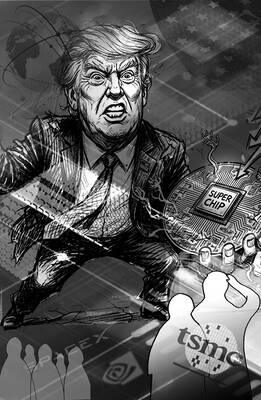
The White House’s decision to take a 9.9 percent stake in Intel Corp is looking like very shrewd business indeed. Since the government bought in at US$20.47 a share last August, the US chipmaker’s surging stock price has delivered the US a US$43 billion return. One of the reasons the investment has so far proved so sound is that the White House has made sure of it. According to The Wall Street Journal, Howard personally pushed deals on Intel’s behalf with some of the most lucrative clients imaginable. They include Nvidia Corp, the company at the heart of the AI
In a Taiwanese university classroom, a lecturer asks in English: “Can anyone give me an example from Taiwan?” Students look down. No one answers. After class, one student writes on the course platform in Mandarin: “I understood the concept, but I didn’t know how to answer in English.” That moment highlights a key issue in Taiwan’s English-medium instruction (EMI) reform: It is not just about more English-taught courses, but whether students can learn, participate and belong. EMI expansion is part of the Bilingual 2030 policy and the Ministry of Education’s BEST Program, aiming to improve English ability, support EMI teaching
A single photograph can cut through a lot of noise, but it can also be used to misrepresent the truth. At the very least, it can concentrate the mind on something that requires further investigation. On Monday last week, Ma Ying-jeou Foundation CEO Tai Hsia-ling (戴遐齡) and former National Security Council secretary-general King Pu-tsung (金溥聰) held a news conference in which they showed a photograph of former foundation CEO Hsiao Hsu-tsen (蕭旭岑), now Chinese Nationalist Party (KMT) deputy chairman. In the image Hsiao is seated next to Xiamen Taiwan Businessmen Association chairman Han Ying-huan (韓螢煥). The two men were holding
The Ministry of the Interior, working with the navy and coast guard, is organizing Taiwan’s first joint exercise simulating escort tankers carrying liquefied natural gas (LNG) and oil through a Chinese blockade. The drills simulate fuel transport along three maritime corridors leading toward Japan, the Philippines and the US. Deputy Minister of the Interior Sawyer Mars (馬士元) said that a blockade of the Taiwan Strait would amount to “almost a 100 percent blockade of the regional energy supply.” Minister of National Defense Wellington Koo said planning to counter a blockade is standard practice in Taipei. While the exercise is limited in


 RSS
RSS