

As scientists, we had the uneasy privilege of witnessing China’s rise earlier than most. Long before a country’s regional or global dominance shows up in macroeconomic aggregates and stock valuations, it can be inferred from the kinds of signals that scientists notice: scholarly publications, patents, talent formation, infrastructure investments, industrial coordination and the growth of capacity in strategic fields.
What many see as a sudden leap forward is really the predictable result of long-term planning and statecraft, all guided by the understanding that technological power rests on fundamental research and strong institutions. With five universities among the world’s top 40 and 35 in the top 500, Chinese institutions would almost certainly come to rival the likes of Oxford, MIT, Harvard and Cambridge. Their entry into the global top ten is a matter of when, not if.
China’s R&D prowess has been visible in research output, patents, PhDs and critical technologies for years, even as many investors, commentators and policymakers continued to dismiss it. The “DeepSeek moment” was a case in point. The launch of a Chinese large language model with capabilities similar to those from the leading US labs looked like a fluke, when in fact it was the downstream outcome of years of accumulated research capacity in China’s AI ecosystem.
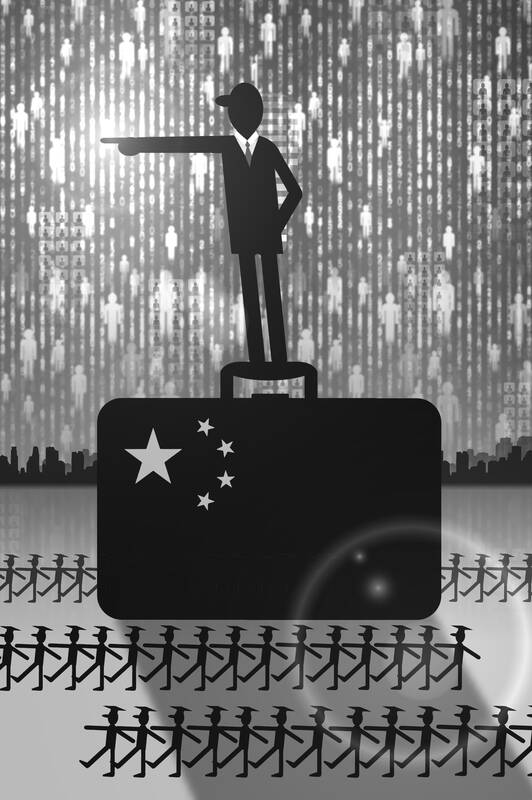
Illustration: Yusha
Of course, the market tends to react only after such capabilities crystallize into competitive products. However, when it does react, it can do so very quickly. The volatility of Nvidia’s stock price after DeepSeek was unveiled illustrates how radically expectations can change when a new player with a competitive advantage arrives. Whether any single model displaces an incumbent is a secondary issue. What matters more is that China’s growing strength in research increases the likelihood of such competitive challenges, with capabilities long evident to scientists suddenly translating into market-moving events.
A key battleground — where science and technology provide the edge in a much larger geopolitical rivalry — is energy. As the world leader in solar, wind and battery technologies, China is positioned to power the increasingly digital and data-center-heavy economy of the future with clean electricity. In 2025 alone, China expanded its power capacity by more than 500 gigawatts, 80 percent of which came from solar and wind. The capacity China has added since 2021 is larger than the entire power capacity of the US.
While China is anchoring its energy strategy to the scientific frontier, the US is going backward by promoting coal, oil and gas while gratuitously killing off clean-energy projects. This approach not only threatens US dominance in science and technology, but also accelerates global warming and diminishes the US economy’s long-term competitiveness. Research increasingly shows that economic development constrained by scientifically defined limits — such as the 1.5° Celsius global warming target set by the Paris climate agreement — leads to greater efficiencies and technological innovation.
Hence, China’s core goal of creating an “ecological civilization” is likely to accelerate its own scientific achievements. In 2024, scientists at Tsinghua surprised the climate-science community by publishing an analysis of the remaining global carbon budget six months earlier than expected, owing to their use of new big-data methodologies.
While liberal democracies lurch from quarter to quarter, China has steadily been building industrial and research capacities across strategic sectors such as batteries, electric vehicles, solar, telecommunications, advanced manufacturing and AI-enabling infrastructure. According to the Australian Strategic Policy Institute’s critical-technology tracker, China leads in 57 of 64 frontier technologies measured over the 2019-23 period, up from just three two decades earlier.
In short, China lays out a strategy and then acts accordingly. Its five-year plans are instruments for aligning finance, infrastructure, education, procurement and industrial investments over long time horizons. The 15th Five-Year Plan centers on scientific and technological self-reliance, with Chinese leaders framing technology as the backbone of national development and security. OECD data show that China’s R&D spending grew by 8.7 percent in 2023, far above the OECD average and that of both the US and the EU. No wonder the World Intellectual Property Organization now ranks China among the world’s most innovative economies — especially in terms of knowledge and technology outputs.
To be sure, China has benefited enormously from access to global markets, foreign capital, imported know-how, integration into international supply chains and access to existing scientific breakthroughs.
Combined with domestic investments in education and scientific research capacity, these made the country’s historic development possible. However, the geopolitical tide is shifting and, having gained from openness, China is pursuing technological independence, especially in strategically sensitive domains.
China successfully pursued a long-term strategy to dominate the technologies that would shape this century and it is unlikely to share the returns it generated from globalization. In this year of the Fire Horse, everyone ought to realize what has already been visible to the scientific community for quite some time: China has gone from a trot to a gallop.
Johan Rockstrom, director of the Potsdam Institute for Climate Impact Research and professor in Earth System Science at the University of Potsdam, is co-chair of the Global Commission on the Economics of Water. Inga Strumke is associate professor in Artificial Intelligence at the Norwegian University of Science and Technology and the author of Machines That Think: How Artificial Intelligence Works and What It Means for Us.
Copyright: Project Syndicate
In 40 years of watching politics, I have never seen anything quite like Taipei mayoral candidate Puma Shen’s (沈伯洋) breed of politician. He has a presence that commands attention, and a combination of qualities that appear to be the result of powerful political currents. What is it that makes Shen different? Throughout the past decades of local elections, I have not seen anyone seriously discuss a long-term vision for urban planning, let alone with the kind of clarity and insight that Shen possesses that compels people to keep listening. He is an exceptional storyteller, with an ability to present a vision
China prefers to win without firing a shot in its bid to strangle Taiwan’s strategic autonomy. Chinese military strategist Sun Tzu (孫子) would have approved. Its central tool at sea is the “cabbage strategy”: the Chinese People’s Liberation Army Navy (PLAN) layers fishing boats, maritime militia, coast guard cutters and warships around Taiwan’s contested waters in overlapping rings. Each layer normalizes daily coercion, narrows Taiwan’s freedom of movement and chips away at its maritime sovereignty — all while staying below the threshold of armed conflict. This is “gray zone” warfare at its most cost-effective — one of Beijing’s most promising
Taiwanese writer Chu Yu-hsun (朱宥勳) this month spoke out about the difficulties of judging literary competitions when nearly 40 percent of the novel submissions he reviews appear to be generated by artificial intelligence (AI). He said he would refuse to serve as a judge for any literary award that does not explicitly prohibit the use of AI in creative writing. The use of AI in creative and academic work has become increasingly common. My son, who attends National Chengchi University, says he is exasperated after working to complete assignments on his own, only to receive lower grades than classmates who used
Freedom of expression is a precious gift from the times, civilization and history, Hong Kong writer Hon Lai-chu (韓麗珠) said on Wednesday last week when she received the Golden Tripod Award, the highest honor in Taiwan’s publishing industry, for her novel Flesh Mountain (祼山). “As a Hong Konger these days, I deeply feel that the freedom to write and publish should not be taken for granted,” she said. She said that for a reason. Hon, who rarely speaks publicly or accept interviews in Hong Kong because it could result in serious consequences, resigned from her long-running columnist post at the Chinese-language Hong


 RSS
RSS