


As a student in the Department of International Affairs at Wenzao Ursuline University of Languages, discussing international situations and learning how to communicate with the world are essential.
When interacting with foreign exchange students, I have found that, although Taiwan currently faces diplomatic challenges, the pride of our younger generation in our identity as Taiwanese has increased rather than diminished.
With the explosion of artificial intelligence (AI), Taiwan has also become a highly watched core of technology strategy thanks to Nvidia Corp CEO Jensen Huang (黃仁勳).
Huang is very popular among young Taiwanese, not only because of AI and his personal style, but also because he made the world see Taiwan.
He is making the younger generation realize that the most powerful way to introduce Taiwan is not through political slogans, but through technological strength and cultural confidence.
Although I do not feel strongly about it, I have found that many Taiwanese dislike it when celebrities call themselves Chinese to advance their careers in China.
Even though Huang holds US citizenship, he maintains that he considers himself Taiwanese and has emphasized in many international public settings that the world relies on Taiwan. His actions not only improve Taiwan’s international visibility, but also give Taiwanese greater confidence on the international stage.
A survey from the Election Study Center at National Chengchi University carried out between 1992 and December last year showed the proportion of people who identify solely as Taiwanese has soared from less than 20 percent in the early 1990s to 60 percent last year.
This transformation is even more obvious in the younger generation. Our diplomacy is no longer limited to official channels, but happens on social media and in cultural exchanges.
Online content creator and influencer Ray, who has been called a “Taiwanese diplomat,” interacts with international influencers and stars to allow foreign audiences to recognize the passion and friendliness of Taiwan’s people. His example inspires me and resonates with me as a student.
He is not fluent in English, but he is able to use what English he has to break barriers and show confidence on the international stage.
It gives me a real sense of cultural exchange.
Ray helped me understand that we can truly strive for recognition and showcase ourselves through cultural exchange. It might be difficult for Taiwan to speak at the UN, but attention generated by every livestream interaction Ray has on YouTube or Twitch can sometimes be more infectious than official statements. Because of their inspiration, I no longer introduce bubble milk tea, stinky tofu or semiconductors when interacting with exchange students.
I can use AI technology and multiculturalism as new labels to introduce Taiwan.
Taiwan’s international positioning might be determined by politics, but our identity is in our own hands. In the past, whenever I saw international political news about Taiwan, I would feel a sense of powerlessness.
However, through the connections of social media in the past few years, the identity of my friends and me as Taiwanese has become very sharp and clear.
Although our positions might be different, this identity does not come from textbooks, but from our daily life experiences interwoven within social networks and real politics.
Tsai Ying-chi is a student in the Department of International Affairs at Wenzao Ursuline University of Languages.
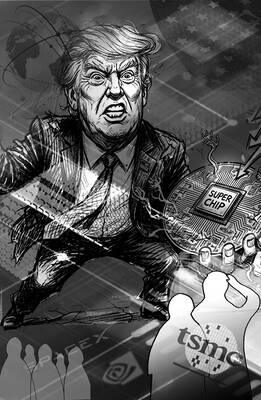
The White House’s decision to take a 9.9 percent stake in Intel Corp is looking like very shrewd business indeed. Since the government bought in at US$20.47 a share last August, the US chipmaker’s surging stock price has delivered the US a US$43 billion return. One of the reasons the investment has so far proved so sound is that the White House has made sure of it. According to The Wall Street Journal, Howard personally pushed deals on Intel’s behalf with some of the most lucrative clients imaginable. They include Nvidia Corp, the company at the heart of the AI
In a Taiwanese university classroom, a lecturer asks in English: “Can anyone give me an example from Taiwan?” Students look down. No one answers. After class, one student writes on the course platform in Mandarin: “I understood the concept, but I didn’t know how to answer in English.” That moment highlights a key issue in Taiwan’s English-medium instruction (EMI) reform: It is not just about more English-taught courses, but whether students can learn, participate and belong. EMI expansion is part of the Bilingual 2030 policy and the Ministry of Education’s BEST Program, aiming to improve English ability, support EMI teaching
A single photograph can cut through a lot of noise, but it can also be used to misrepresent the truth. At the very least, it can concentrate the mind on something that requires further investigation. On Monday last week, Ma Ying-jeou Foundation CEO Tai Hsia-ling (戴遐齡) and former National Security Council secretary-general King Pu-tsung (金溥聰) held a news conference in which they showed a photograph of former foundation CEO Hsiao Hsu-tsen (蕭旭岑), now Chinese Nationalist Party (KMT) deputy chairman. In the image Hsiao is seated next to Xiamen Taiwan Businessmen Association chairman Han Ying-huan (韓螢煥). The two men were holding
The Ministry of the Interior, working with the navy and coast guard, is organizing Taiwan’s first joint exercise simulating escort tankers carrying liquefied natural gas (LNG) and oil through a Chinese blockade. The drills simulate fuel transport along three maritime corridors leading toward Japan, the Philippines and the US. Deputy Minister of the Interior Sawyer Mars (馬士元) said that a blockade of the Taiwan Strait would amount to “almost a 100 percent blockade of the regional energy supply.” Minister of National Defense Wellington Koo said planning to counter a blockade is standard practice in Taipei. While the exercise is limited in


 RSS
RSS