


China’s worst mining disaster in decades feels like an echo of a past it has long sought to forget. The blast, which has killed at least 82 people at a pit in Liushenyu in the Shanxi coal belt, is the worst since 2009.
It is a reminder of the grim days of the 2000s, when thousands died every year in coal mines to provide a poorer, dirtier country with cheap energy. However, China has changed immeasurably since then. Continuing to veer away from a fossil-fuel-intensive industry and toward cleaner development would improve energy security as well as the safety of its miners.
This path has had ups and downs. Since a run of power cuts in 2021, Beijing has pushed coal miners to boost their output in ways that were always going to cause problems. As operations push their capacity limits, corners end up being cut, with often fatal consequences. If it is pursued rigorously, though, the fresh safety crackdown prompted by the Liushenyu disaster could help clean up China’s steel and coal mining industries, boost its renewables output and reduce dependence on imported gas — all at the same time.
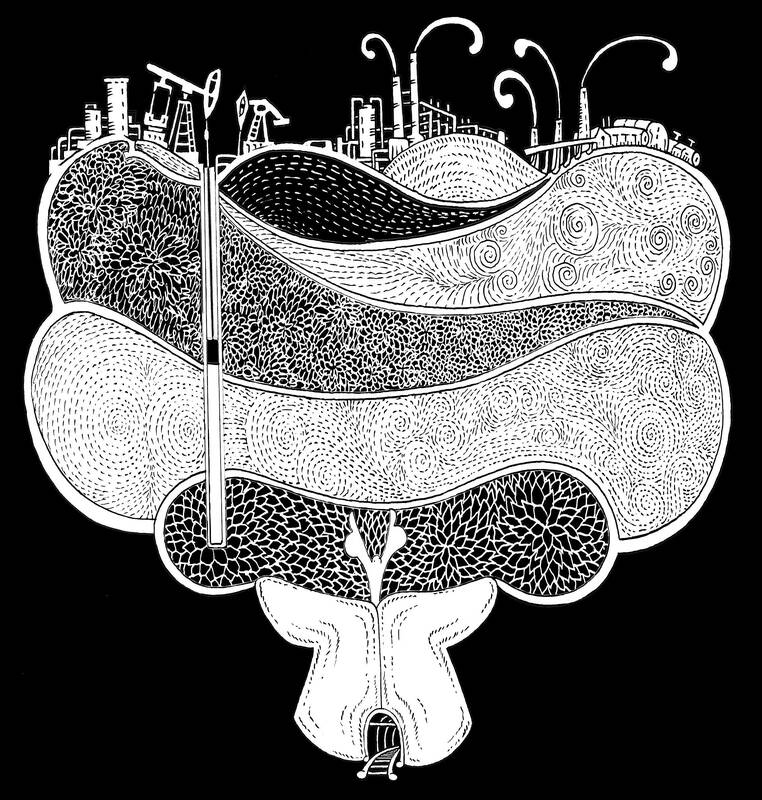
Illustration: Mountain People
To see why, it is worth looking at why mining disasters like this are so prevalent.
Almost all coal mines produce methane, as long-trapped hydrocarbons are liberated from the rock. Not all are created equal, though. Broadly speaking, gassiness increases with depth and coal quality. Near the surface, such light molecules could already have escaped millions of years ago. The open pits used to extract shallow coal deposits, meanwhile, make it easy for methane emanating from the seam to disperse without the risk of an explosion.
Liushenyu is an archetypal example of the more dangerous sort of mine. It produces coking coal, a high-quality variant used in steelmaking that is often associated with gassy seams. It also runs far below the surface, with the state-run China Daily reporting that the blast occurred in a network of tunnels 300m underground. At such depths, coal seams are often intrinsically more gassy. That risk is amplified by high pressure in the rock that makes collapses more likely, not to mention the logistical challenges of ventilating tunnels and carrying out rescues so far below the ground.
That suggests a three-part approach to the problem of China’s mining disasters. First, use less coking coal. Then improve the efficiency with which methane is extracted from pits. Finally, use that gas to reduce dependency on imported liquified natural gas (LNG).
The country appears to be going backward on the first part. Despite long-standing targets to increase the share of its steel production using cleaner electric furnaces to an unambitious 15 percent, Chinese government data suggests steel mills are instead growing yet more dependent on coal-fueled blast furnaces. That is possibly a side effect of the economy’s shift toward high-value manufacturing, which requires the sort of high-quality steel that electric furnaces do not easily produce. One proxy for this trend — pig iron production as a share of crude steel production — has been rising steadily for six years, to its highest level last year since 2013.
On the second front — extraction of methane — the scale of improvement is hard to measure. It is possible to evacuate most of the gas from a coal seam before a pit is even dug, a technology that is widely used in Appalachia and Australia. Recovery rates can be high: One project at a Glencore PLC mine north of Sydney managed to drain 80 percent of the gas from the deposit. China has released a flurry of policies in recent years to address this issue, but there are few formal targets and even less solid data about whether they are succeeding.
That is a shame because of the third issue: the sheer volumes billowing out of China’s coal mines. About 60 billion cubic meters are emitted from its pits every year. That is immense by the standards of the global LNG trade: China, the world’s biggest importer, and Qatar, the biggest exporter, each account for about 105 billion cubic meters a year in normal times. In climate terms, the pollution from all this fugitive methane is equivalent to more than 1 billion tonnes a year of carbon-equivalent emissions. That is more than is pumped out by all of China’s cars or the entire nation of Japan.
There is a reason for hope. Shanxi’s coal-bed gas production, which is often a precursor to digging in gassy seams, has increased faster than LNG imports. Output was up by about 7 billion cubic meters between 2020 and last year.
Unfortunately, it is impossible to tell whether this is being driven by emission controls or a hunger for yet more fossil energy. Until Beijing gives us the data to know for sure, the risk to China’s beleaguered coal miners will not diminish.
David Fickling is a Bloomberg Opinion columnist covering climate change and energy. Previously, he worked for Bloomberg News, the Wall Street Journal and the Financial Times. This column reflects the personal views of the author and does not necessarily reflect the opinion of the editorial board or Bloomberg LP and its owners.
KMT Chairwoman Cheng Li-wun’s (鄭麗文) recent visit to Beijing and her upcoming visit to Washington will serve as a high-level test of her diplomatic mettle. In Beijing, Cheng was received with symbolic gestures, a warm reception, and high-level access. In Washington, she will receive far less pomp and far sharper questions about the KMT’s vision for the future of Taiwan. Her challenge will be to persuade Washington that the KMT’s engagement with China can coexist with strong deterrence. Cheng’s April 7-12 visit to mainland China coincided with an intense period of conflict in Iran. Despite the strategic significance of Cheng’s trip,
The closure of the Strait of Hormuz has sent the vast Asian chemicals industry into a tailspin. Deprived of the likes of Qatari natural gas and Saudi Arabian oil, the region’s fertilizer and plastics plants are slowing production or even shutting down. Everywhere except China, that is. In petrochemicals, China is unique. As well as a traditional industry that uses oil and gas as feedstock, it has parallel output that relies on its abundant domestic coal. Unsurprisingly, India and other regional powers want to copy and paste the Chinese method. This would not be easy — or climate friendly. The
Indonesian President Prabowo Subianto says he knows how to fix the problems facing Indonesia. Yet his economic mismanagement and authoritarian tendencies are steering the nation toward a familiar mix of currency instability and political chaos. The world’s fourth-most populous nation risks reversing the hard-won democratic and business reforms that came after the Asian Financial Crisis in 1997. At that time, the rupiah collapsed and the political upheaval that followed forced former president Haji Mohamed Suharto from power. Prabowo’s administration is ignoring similar warning signs. That disconnect was apparent in a national address on Wednesday, when Prabowo projected the swagger that has
“Of course you can choose not to be Taiwanese, just do not stay here,” chairwoman of Taipei 101 operator Taipei Financial Center Corp Janet Chia (賈永婕) said in an online interview with local entertainer Tai Chih-yuan (邰智源), triggering intense discussion on social media, with politicians across party lines weighing in. In the interview, which was aired on May 14, Chia and Tai’s discussion over a meal in Taipei 101 covered Chia’s career change from entertainer to chairwoman and US climber Alex Honnold’s free solo climb up the Taipei 101 building. During the interview, Chia said, “Being on this land, we


 RSS
RSS