


The Legislative Yuan on Friday last week passed an amendment to the Medical Care Act (醫療法) incorporating a three-shift, nurse-to-patient ratio into law.
This landmark amendment not only marks a significant milestone in Taiwan’s effort to move away from an exploitative healthcare system and realize President William Lai’s (賴清德) vision of a “healthy Taiwan,” but also represents progress in protecting the labor rights of nurses nationwide. However, a proposed advisory committee, which many had hoped would be established to determine the nurse-to-patient ratio and provide a proportion of frontline nurses with representation in decisionmaking, was not included due to political maneuvering. This means that, although the nurse-to-patient ratio now has a legal basis and those who contravene face penalties, significant institutional gaps remain in the oversight mechanisms needed to prevent pressure by employers.
As a member of a committee for medical and nursing school accreditation and evaluation, I have observed — through handling disputes over rights and interests in the system — that any legal framework concerning labor rights that lacks a statutory platform for dialogue with genuine frontline representation can easily sacrifice the voices of the weaker party during implementation.
The failure to incorporate an advisory committee into law effectively delegates the authority to set future standards and conduct triennial reviews to hospital administrators. Without an open and transparent mechanism for grassroots participation, the safeguarding of healthcare quality might ultimately be compromised.
Taiwan’s globally renowned healthcare system was built by the selfless dedication and sacrifices of nurses. At present, as many as 120,000 licensed nurses in Taiwan are not practicing, a problem rooted in an unbalanced clinical environment.
Some medical institutions have become accustomed to using dayshift staff to “average out” shortages during evening and night shifts to create figures that appear compliant on paper. Now that a legal basis is in place, authorities must demonstrate the resolve needed to safeguard national resilience by strictly preventing treating nurses as disposable, and establishing a more comprehensive health and safety framework.
As the law explicitly provides room for administrative implementation, the Ministry of Health and Welfare should take the initiative to establish a permanent, transparent and substantive dialogue mechanism free from closed-door decisionmaking. In drafting enforcement details and conducting periodic reviewing standards, the ministry should use administrative orders to ensure the adequate representation of frontline nurses and relevant nursing labor organizations.
Only through procedural justice and the meaningful participation of grassroots voices in policymaking could undue interference from interest groups be prevented, thereby allowing the law to deal with medical institutions that contravene regulations.
A resilient healthcare system is the cornerstone of Taiwan’s national stability. In honor of International Nurses Day on Tuesday, I hope that the government would adopt the strongest possible implementation measures to support the frontline nurses who safeguard the health of all Taiwanese.
Establishing transparent and open mechanisms would serve as the strongest backing for frontline healthcare workers. That would be the most substantial form of dignity and respect the nation can bestow upon the nursing profession.
Yang Chih-chiang is a teacher.
Translated by Kyra Gustavsen
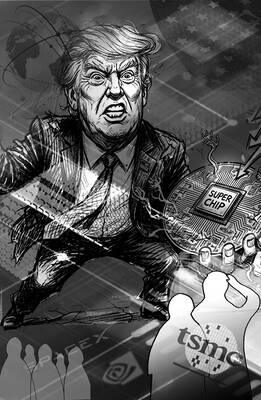
The White House’s decision to take a 9.9 percent stake in Intel Corp is looking like very shrewd business indeed. Since the government bought in at US$20.47 a share last August, the US chipmaker’s surging stock price has delivered the US a US$43 billion return. One of the reasons the investment has so far proved so sound is that the White House has made sure of it. According to The Wall Street Journal, Howard personally pushed deals on Intel’s behalf with some of the most lucrative clients imaginable. They include Nvidia Corp, the company at the heart of the AI
The Ministry of the Interior, working with the navy and coast guard, is organizing Taiwan’s first joint exercise simulating escort tankers carrying liquefied natural gas (LNG) and oil through a Chinese blockade. The drills simulate fuel transport along three maritime corridors leading toward Japan, the Philippines and the US. Deputy Minister of the Interior Sawyer Mars (馬士元) said that a blockade of the Taiwan Strait would amount to “almost a 100 percent blockade of the regional energy supply.” Minister of National Defense Wellington Koo said planning to counter a blockade is standard practice in Taipei. While the exercise is limited in
A single photograph can cut through a lot of noise, but it can also be used to misrepresent the truth. At the very least, it can concentrate the mind on something that requires further investigation. On Monday last week, Ma Ying-jeou Foundation CEO Tai Hsia-ling (戴遐齡) and former National Security Council secretary-general King Pu-tsung (金溥聰) held a news conference in which they showed a photograph of former foundation CEO Hsiao Hsu-tsen (蕭旭岑), now Chinese Nationalist Party (KMT) deputy chairman. In the image Hsiao is seated next to Xiamen Taiwan Businessmen Association chairman Han Ying-huan (韓螢煥). The two men were holding
I first met Professor Ray Jiing (井迎瑞) as a film and documentary student at Shih Hsin University’s (SHU) Department of Radio Television and Film in 1988. The following year, he went on to become the director of the Chinese Taipei Film Archive — forerunner of the Taiwan Film and Audiovisual Institute (TFAI). Over his eight-year tenure, Jiing rescued and restored over 200 classic Taiwanese films. In 1997, he established the Graduate Institute of Studies in Documentary and Film Archiving at Tainan National University of the Arts (TNNUA), and I joined the program in his third cohort of students. Beyond a


 RSS
RSS