


It is a familiar story. Extravagant claims are made on behalf of novel computerized tools. The public is told that this or that digital application or system is going to change the world for the better. Efficiencies would be unlocked, and problems solved as human limitations are overcome by networked devices plugged into vast stores of data. Anyone who questions the narrative is a pessimist or, perhaps, a criminal.
This appears to be the logic behind arguments put forward on behalf of one such tool — live facial recognition technology. Law-abiding citizens have “nothing to fear” from the police’s reliance on mounted cameras, British Minster of State for Policing and Crime Sarah Jones said last month after a high court challenge on human rights and privacy grounds failed. The use of AI-powered identification software made by Japanese company NEC “only locates wanted people,” she added. Last year Jones described the technology as “the biggest breakthrough for catching criminals since DNA.”
Metropolitan Police Commissioner Mark Rowley is equally enthusiastic and London’s Mayor Sadiq Khan gave his blessing to a pilot scheme. There is no doubt that policing is under pressure despite sharp falls in homicides and knife crime. Shoplifting has recently risen across England and Wales, as have religious and racial hate crimes. It is not hard to see why, from the police’s point of view, the ability to match the faces of passersby with those stored on a database of suspects is very handy.
The warnings carried in last weekend’s Guardian exclusive regarding weak oversight and misuse of these systems are a reminder of other priorities. The biometrics watchdog for England and Wales, professor William Webster, and his equivalent in Scotland Brian Plastow both believe that the Information Commissioner’s Office is not up to the job of monitoring this kind of data use and that a new regulator and rules are needed. An audit of the Metropolitan Police’s use of facial recognition was postponed and has not been rescheduled.
The UK government is reviewing the legal framework so some updating is expected. The Home Office has acknowledged issues with racial bias after tests showed higher numbers of false positive identifications of black and Asian faces. However, with this technology in widespread use by retailers as well as police forces, once again politicians are playing catch-up looking for ways to right wrongs that have already happened.
One thing that is needed urgently is an improved system of redress for people who have been misidentified whether by police or private security guards.
Ministers must also directly address the claims made by a whistleblower who said he knew of up to 15 instances of innocent people being added to watchlists maliciously by security employees with scores to settle. Race bias in the software must also be shown to have been eliminated.
Practicalities aside, surveillance tools raise political questions about civil liberties, privacy and state and corporate overreach. The rollout of these tools is a choice, not an inevitability and there are alternatives.
The policing minister could honestly believe that most people should not fear databases containing biometric data by which individuals can be identified. That does not make it true. The pattern whereby tech outpaces attempts to keep track of its impact, defying democratic checks and balances, needs to be broken.
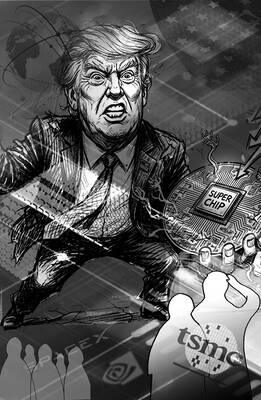
The White House’s decision to take a 9.9 percent stake in Intel Corp is looking like very shrewd business indeed. Since the government bought in at US$20.47 a share last August, the US chipmaker’s surging stock price has delivered the US a US$43 billion return. One of the reasons the investment has so far proved so sound is that the White House has made sure of it. According to The Wall Street Journal, Howard personally pushed deals on Intel’s behalf with some of the most lucrative clients imaginable. They include Nvidia Corp, the company at the heart of the AI
The Ministry of the Interior, working with the navy and coast guard, is organizing Taiwan’s first joint exercise simulating escort tankers carrying liquefied natural gas (LNG) and oil through a Chinese blockade. The drills simulate fuel transport along three maritime corridors leading toward Japan, the Philippines and the US. Deputy Minister of the Interior Sawyer Mars (馬士元) said that a blockade of the Taiwan Strait would amount to “almost a 100 percent blockade of the regional energy supply.” Minister of National Defense Wellington Koo said planning to counter a blockade is standard practice in Taipei. While the exercise is limited in
A single photograph can cut through a lot of noise, but it can also be used to misrepresent the truth. At the very least, it can concentrate the mind on something that requires further investigation. On Monday last week, Ma Ying-jeou Foundation CEO Tai Hsia-ling (戴遐齡) and former National Security Council secretary-general King Pu-tsung (金溥聰) held a news conference in which they showed a photograph of former foundation CEO Hsiao Hsu-tsen (蕭旭岑), now Chinese Nationalist Party (KMT) deputy chairman. In the image Hsiao is seated next to Xiamen Taiwan Businessmen Association chairman Han Ying-huan (韓螢煥). The two men were holding
In a Taiwanese university classroom, a lecturer asks in English: “Can anyone give me an example from Taiwan?” Students look down. No one answers. After class, one student writes on the course platform in Mandarin: “I understood the concept, but I didn’t know how to answer in English.” That moment highlights a key issue in Taiwan’s English-medium instruction (EMI) reform: It is not just about more English-taught courses, but whether students can learn, participate and belong. EMI expansion is part of the Bilingual 2030 policy and the Ministry of Education’s BEST Program, aiming to improve English ability, support EMI teaching


 RSS
RSS