


Indian businesses rarely do exactly what the government wants them to. For the past decade or so, for example, they have obdurately refused to invest as much in India as officials think they should.
Indian Chief Economic Advisor V. Anantha Nageswaran has said that profits for the 500 largest publicly traded companies had grown by more than 30 percent a year since the COVID-19 pandemic, “but still, our overall capital formation rates from the private sector have been disappointing.”
Nageswaran is not the only person complaining.
Indian Minister of Finance Nirmala Sitharaman publicly wonders every few months why corporations seem so unwilling to invest. She has repeatedly said that she has lowered taxes, cleaned up banks’ balance sheets, tried to support consumer demand and spent public money on infrastructure — yet is puzzled why companies have not responded.
The Indian government is right to be worried. After all, if companies do not invest, the economy would not grow.
It has correctly identified that low investment is the biggest roadblock to higher growth, even if it does not know the reason behind the trend. The numbers they are looking at are not a state secret: Back in the boom years more than a decade ago, capital expenditure was more than 40 percent of GDP; it has been down by about 10 percentage points on average since then.
That is despite ever-increasing amounts of public investment. New Delhi, lacking confidence in the corporate world’s appetite for expansion, has felt it necessary to pick up the slack. Consequently, total investment in productive assets fell in 2024 to one-third of the previous year’s level, a decade low.
Growth in recent quarters has been high — about 8 percent — but that has been largely thanks to big tax cuts for consumers as well as moderate inflation; both have run out of steam.
However, the Indian government still has not figured out why the private sector is not following its instructions to lift capital expenditure.
Nageswaran’s explanation has a certain satisfying, Gen Z-friendly punch: He blames nepo babies. The problem is second and third-generation owners who, he says, chose to accumulate cash profits and set up family offices elsewhere rather than investing in real assets at home.
He is reflecting the frustration that many in government feel.
Sitharaman last year also said India Inc was “sitting on passive investible funds” rather than trying to expand.
Certainly, the closely held, family-run character of many of the country’s largest companies means that they tend to prioritize safety rather than experimentation. In many other, more dynamic economies, family businesses worry about going — as an old saying has it — from shirtsleeves back to shirtsleeves in three generations. The grandparent might have climbed out of the sleeves-rolled-up, struggling middle class and built a corporate empire, but the grandchild might well take the family back down again. India’s far more closed, less entrepreneurial corporate culture might well mean that the younger generation does not feel there is a risk of losing a company — and would find it easy enough to delegate the unexciting task of management while setting up a family office in Dubai or elsewhere.
Taking on India Inc’s business traditions, dominated as they are by clan, caste, and family links, is not something that any government feels comfortable doing. The government must tread carefully to avoid making businesses feel more threatened and risk-averse.
Yet that is exactly what has been happening. The reason India’s richest do not want to invest domestically — and, possibly, why they take some of their cash abroad — is because they see local political risk as being too high. They might be hit by a hefty and unpredictable tax bill or fall afoul of mercurial politicians. If they earn money in India, their first instinct is to try to diversify assets across other geographies to escape New Delhi’s control.
Their skittishness has infected many foreign companies as well. In January, foreign direct investment in India was US$5.67 billion, but US$4.92 billion worth of profits were repatriated. Indian companies’ outward investment was US$2.14 billion. After all, if people who grew rich in India are not happy reinvesting there, why would multinationals?
Policymakers keep asking why companies are not expanding their domestic operations because they are not satisfied with the answers they are getting.
Tax cuts and fiscal stimulus are great, and nobody ever turns them down, but what corporate India really wants is administrative, judicial and political predictability. They want freedom from fear. They do not want to feel that their liberties and livelihoods are dependent on the whims of New Delhi.
Waiting for that breath of freedom, capital has gone on strike. To lure it back, the government would best consider finally granting businesses some autonomy.
Mihir Sharma is a Bloomberg Opinion columnist. A senior fellow at the Observer Research Foundation in New Delhi, he is author of Restart: The Last Chance for the Indian Economy. This column reflects the personal views of the author and does not necessarily reflect the opinion of the editorial board or Bloomberg LP and its owners.
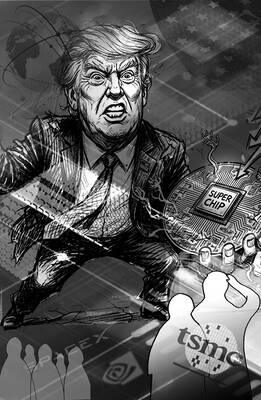
The White House’s decision to take a 9.9 percent stake in Intel Corp is looking like very shrewd business indeed. Since the government bought in at US$20.47 a share last August, the US chipmaker’s surging stock price has delivered the US a US$43 billion return. One of the reasons the investment has so far proved so sound is that the White House has made sure of it. According to The Wall Street Journal, Howard personally pushed deals on Intel’s behalf with some of the most lucrative clients imaginable. They include Nvidia Corp, the company at the heart of the AI
The Ministry of the Interior, working with the navy and coast guard, is organizing Taiwan’s first joint exercise simulating escort tankers carrying liquefied natural gas (LNG) and oil through a Chinese blockade. The drills simulate fuel transport along three maritime corridors leading toward Japan, the Philippines and the US. Deputy Minister of the Interior Sawyer Mars (馬士元) said that a blockade of the Taiwan Strait would amount to “almost a 100 percent blockade of the regional energy supply.” Minister of National Defense Wellington Koo said planning to counter a blockade is standard practice in Taipei. While the exercise is limited in
In a Taiwanese university classroom, a lecturer asks in English: “Can anyone give me an example from Taiwan?” Students look down. No one answers. After class, one student writes on the course platform in Mandarin: “I understood the concept, but I didn’t know how to answer in English.” That moment highlights a key issue in Taiwan’s English-medium instruction (EMI) reform: It is not just about more English-taught courses, but whether students can learn, participate and belong. EMI expansion is part of the Bilingual 2030 policy and the Ministry of Education’s BEST Program, aiming to improve English ability, support EMI teaching
A single photograph can cut through a lot of noise, but it can also be used to misrepresent the truth. At the very least, it can concentrate the mind on something that requires further investigation. On Monday last week, Ma Ying-jeou Foundation CEO Tai Hsia-ling (戴遐齡) and former National Security Council secretary-general King Pu-tsung (金溥聰) held a news conference in which they showed a photograph of former foundation CEO Hsiao Hsu-tsen (蕭旭岑), now Chinese Nationalist Party (KMT) deputy chairman. In the image Hsiao is seated next to Xiamen Taiwan Businessmen Association chairman Han Ying-huan (韓螢煥). The two men were holding


 RSS
RSS