


Ever since the Hungarian Revolution of 1956, the country has served as a cautionary tale about the dangers of political reform in one-party states. After Viktor Orban’s defeat in Hungary’s parliamentary elections last month, this lesson is being pondered again by the world’s autocratic powers — not least China.
The story starts 70 years ago with Nikita Khrushchev’s “Secret Speech,” delivered to a closed session of the 20th Congress of the Communist Party of the Soviet Union. In that speech, Khrushchev denounced Joseph Stalin, condemning his predecessor’s cult of personality, his brutal purges and his lack of preparedness for the Nazi invasion.
Supposedly delivered in secret, the speech nevertheless quickly leaked, sending shock waves through the Eastern Bloc countries then under the Kremlin’s thumb. The idea that Stalin, the emblem of absolute power, could come under attack from one of his own acolytes elevated hopes for new political possibilities.
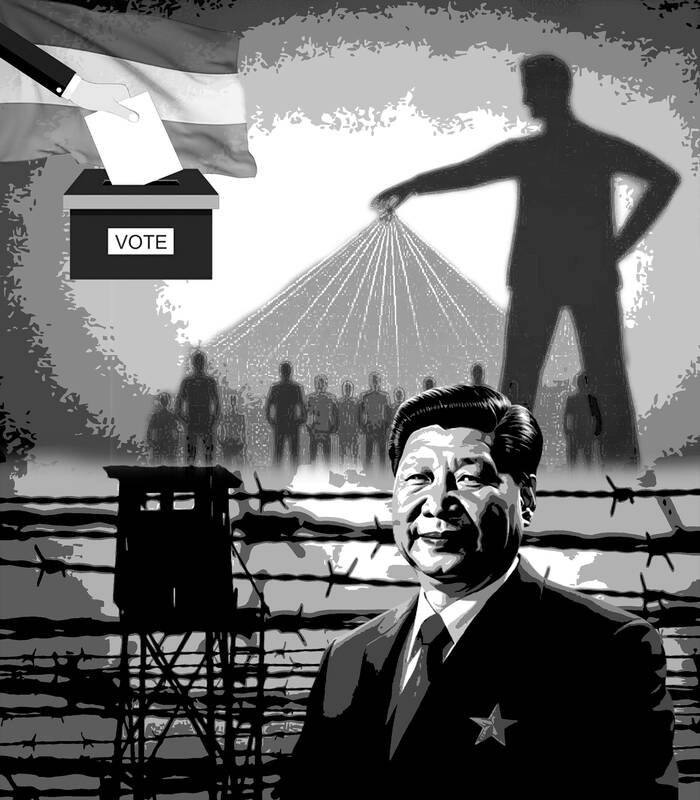
Illustration: Constance Chou
The effect was particularly dramatic in Hungary. A Budapest debate club called the Petofi Circle — named after the poet who helped inspire the Hungarian Revolution of 1848-49 against the Austro-Hungarian Empire — had been founded in 1955 by the Communist Youth League as a controlled outlet for tame discussions about reform. After Khrushchev’s speech, the group’s members began to ask more radical questions.
In debates that drew thousands of spectators, members criticized Hungary’s Stalinist leader, Matyas Rakosi, and called for press freedom, economic reform and political rehabilitation and restitution for purge victims. This helped ignite widespread opposition to Soviet rule. Within months, student protests had widened into the Hungarian Revolution of 1956, a national movement that sought effective independence from the Soviet Union. Khrushchev ultimately sent in troops to crush the uprising.
Chinese Communist Party (CCP) chairman Mao Zedong (毛澤東) watched the events in Budapest unfold with growing unease, given the uncomfortable parallels between himself and the version of Stalin that Khrushchev had renounced. Concerned that similar disillusionment might be brewing in China, Mao launched the Hundred Flowers Campaign in 1956, creating space for citizens to air grievances and suggest improvements without threatening the CCP’s legitimacy.
The campaign’s results shocked Mao. Instead of a well-controlled safety valve through which mild criticism and discontent could escape, a deluge of demands for press freedom, calls for the CCP to loosen its grip on economic and cultural life and accusations of entrenched privilege poured out.
By mid-1957, Mao concluded that the experiment could pose an existential risk to him and to the CCP’s rule. The result was the Anti-Rightist Campaign, which claimed that some of the criticisms were “poisonous weeds” rather than the “fragrant flowers” Mao supposedly welcomed. More than 550,000 intellectuals and professionals were caught in the campaign’s net; most were sent to labor camps and many committed suicide. Their families bore the stigmatizing “rightist” label for years.
Khrushchev’s repudiation of Stalin had led to a revolution in Hungary, and Mao’s experiment with liberalization had produced a legitimacy crisis that the chairman believed could be resolved only through mass repression.
The lesson Mao drew from these events was that under one-party rule, an opening for dissent can easily ignite rebellion. Autocratic leaders cannot permit intellectual freedom while guaranteeing that it would not undermine the system itself. This hardline view has informed the CCP’s thinking ever since, especially under President Xi Jinping’s (習近平) leadership.
Against this backdrop, Orban’s defeat is significant for the Chinese leadership. After taking power in 2010, Orban systematically hollowed out the country’s democratic institutions by undermining judicial independence, capturing public media and rewriting electoral rules to entrench his party’s advantages. Taking inspiration from Russian President Vladimir Putin, Orban sought to consolidate power through his model of “illiberal democracy,” which made genuine democratic competition increasingly difficult.
However, even under an illiberal democracy, remnants of an independent press survived, and a unified opposition party was able to contest elections and mobilize civil society. In the end, this was enough to remove Orban from power.
For Xi and his underlings, the takeaway is less about Orban’s missteps and more about the binary nature of autocratic power. A regime that permits genuine opposition has conceded something it cannot get back. Once citizens can vote out their rulers, or debate their leaders freely, or organize an independent press, the logic of accountability has been introduced into a system designed to exclude it; once legitimized, it tends to build its own momentum.
Armed with this understanding, Xi has spent more than a decade consolidating power and purging rivals with extraordinary resolve. Orban’s fall — the latest episode in a historical dialogue between Hungary and China that started in 1956 — would only reinforce Xi’s conviction that no amount of political liberalization is safe.
Sam Chetwin George is a senior fellow at the Asia Society’s Center on US-China Relations.

The White House’s decision to take a 9.9 percent stake in Intel Corp is looking like very shrewd business indeed. Since the government bought in at US$20.47 a share last August, the US chipmaker’s surging stock price has delivered the US a US$43 billion return. One of the reasons the investment has so far proved so sound is that the White House has made sure of it. According to The Wall Street Journal, Howard personally pushed deals on Intel’s behalf with some of the most lucrative clients imaginable. They include Nvidia Corp, the company at the heart of the AI
KMT Chairwoman Cheng Li-wun’s (鄭麗文) recent visit to Beijing and her upcoming visit to Washington will serve as a high-level test of her diplomatic mettle. In Beijing, Cheng was received with symbolic gestures, a warm reception, and high-level access. In Washington, she will receive far less pomp and far sharper questions about the KMT’s vision for the future of Taiwan. Her challenge will be to persuade Washington that the KMT’s engagement with China can coexist with strong deterrence. Cheng’s April 7-12 visit to mainland China coincided with an intense period of conflict in Iran. Despite the strategic significance of Cheng’s trip,

The closure of the Strait of Hormuz has sent the vast Asian chemicals industry into a tailspin. Deprived of the likes of Qatari natural gas and Saudi Arabian oil, the region’s fertilizer and plastics plants are slowing production or even shutting down. Everywhere except China, that is. In petrochemicals, China is unique. As well as a traditional industry that uses oil and gas as feedstock, it has parallel output that relies on its abundant domestic coal. Unsurprisingly, India and other regional powers want to copy and paste the Chinese method. This would not be easy — or climate friendly. The
Indonesian President Prabowo Subianto says he knows how to fix the problems facing Indonesia. Yet his economic mismanagement and authoritarian tendencies are steering the nation toward a familiar mix of currency instability and political chaos. The world’s fourth-most populous nation risks reversing the hard-won democratic and business reforms that came after the Asian Financial Crisis in 1997. At that time, the rupiah collapsed and the political upheaval that followed forced former president Haji Mohamed Suharto from power. Prabowo’s administration is ignoring similar warning signs. That disconnect was apparent in a national address on Wednesday, when Prabowo projected the swagger that has


 RSS
RSS