


Taiwan’s Special Defense Budget Act (軍購特別條例) debate should begin with a basic procedural distinction: A legal authorization ceiling is not the budget itself.
A special act does not immediately spend every dollar it authorizes; it only creates the legal basis, scope and upper limit for the Executive Yuan to later submit concrete budget proposals to the Legislative Yuan for review.
This distinction matters because the opposition has blurred legal authorization with budget review.
Legislators could cut items, freeze allocations and demand reports when examining specific programs, prices and procurement plans.
However, writing such restrictions into the legal source of the budget does not strengthen oversight; it pre-empts execution.
The Chinese Nationalist Party (KMT)-Taiwan People’s Party (TPP) version of the NT$780 billion (US$24.9 billion) act shows this problem clearly.
On paper, it appears to support national defense by authorizing a larger procurement amount. In practice, it divides the amount into rigid stages and imposes constraints before detailed budget items are even submitted.
The law would not merely supervise future procurement; it could block procurement before real review begins.
The first difficulty is the NT$300 billion ceiling for the first stage.
The act caps five US arms procurement items and only allows flexibility for exchange-rate fluctuations.
However, foreign military sales could also change because of package adjustments, support systems or delivery arrangements.
Taiwan has seen this gap before: Cases such as the M109A7 howitzer and HIMARS showed that US congressional notification figures are not always the same as final formal offers.
If the final offer exceeds the cap for reasons other than exchange rates, the law provides no clear solution.
The second difficulty is that the NT$480 billion second stage is locked by both time and category.
It could only be used for US-approved items within one year after the act takes effect, and only for listed categories such as counter-drone systems, air and ballistic missile defense and anti-armor missile stock replenishment.
If Washington approves an urgent sale later, or if the system falls outside these categories, the special budget could not be used.
Yet Taiwan urgently needs command, control, communications, cyber, intelligence, surveillance, and reconnaissance, electronic warfare or logistics integration.
The passed act should not assume that future threats would fit neatly into a one-year window or a short statutory list.
Moreover, the attached resolution reveals the same procedural confusion.
It requires the Executive Yuan to include Taiwan-US jointly developed or procured equipment and systems in the FY2027 budget, while the act itself mandates annual review.
In effect, a medium- to long-term program that should be implemented through a special budget is being divided into yearly approvals by the Legislative Yuan.
This weakens the long-term demand signal that defense industries need before expanding production.
Companies do not build new production lines, invest in equipment or reorganize supply chains based on commitments that could be renegotiated every year.
A one-year review model might appear cautious, but it cannot create the policy incentives needed to expand defense production capacity.
Alas, the core problem is not whether the Legislative Yuan should exercise oversight, but when and how.
Legislators should first establish a feasible legal framework, then scrutinize actual budget proposals by demanding explanations, freezing questionable allocations or reducing spending where necessary.
Oversight should improve execution, not paralyze it before implementation begins.
Taiwan’s security environment requires speed, flexibility and credibility, while still preserving the legislature’s full authority to review the actual budget.
In the end, a defense act that looks supportive but cannot be executed is not real support for national defense.
Taiwan needs legislation that enables capability-building and sends long-term demand signals, not legislation that pre-emptively freezes procurement.
The opposition should use its budget-review powers at the budget-review stage instead of turning the legal foundation for defense procurement into Taiwan’s first obstacle.
Gahon Chiang is a congressional staff member in the office of DPP Legislator Chen Kuan-ting, focusing on Taiwan’s national security policy.
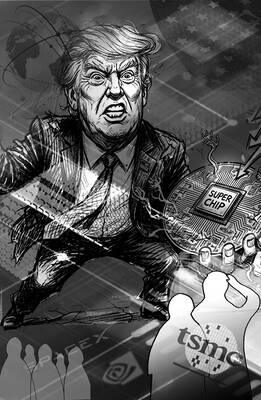
The White House’s decision to take a 9.9 percent stake in Intel Corp is looking like very shrewd business indeed. Since the government bought in at US$20.47 a share last August, the US chipmaker’s surging stock price has delivered the US a US$43 billion return. One of the reasons the investment has so far proved so sound is that the White House has made sure of it. According to The Wall Street Journal, Howard personally pushed deals on Intel’s behalf with some of the most lucrative clients imaginable. They include Nvidia Corp, the company at the heart of the AI
KMT Chairwoman Cheng Li-wun’s (鄭麗文) recent visit to Beijing and her upcoming visit to Washington will serve as a high-level test of her diplomatic mettle. In Beijing, Cheng was received with symbolic gestures, a warm reception, and high-level access. In Washington, she will receive far less pomp and far sharper questions about the KMT’s vision for the future of Taiwan. Her challenge will be to persuade Washington that the KMT’s engagement with China can coexist with strong deterrence. Cheng’s April 7-12 visit to mainland China coincided with an intense period of conflict in Iran. Despite the strategic significance of Cheng’s trip,

The closure of the Strait of Hormuz has sent the vast Asian chemicals industry into a tailspin. Deprived of the likes of Qatari natural gas and Saudi Arabian oil, the region’s fertilizer and plastics plants are slowing production or even shutting down. Everywhere except China, that is. In petrochemicals, China is unique. As well as a traditional industry that uses oil and gas as feedstock, it has parallel output that relies on its abundant domestic coal. Unsurprisingly, India and other regional powers want to copy and paste the Chinese method. This would not be easy — or climate friendly. The
Indonesian President Prabowo Subianto says he knows how to fix the problems facing Indonesia. Yet his economic mismanagement and authoritarian tendencies are steering the nation toward a familiar mix of currency instability and political chaos. The world’s fourth-most populous nation risks reversing the hard-won democratic and business reforms that came after the Asian Financial Crisis in 1997. At that time, the rupiah collapsed and the political upheaval that followed forced former president Haji Mohamed Suharto from power. Prabowo’s administration is ignoring similar warning signs. That disconnect was apparent in a national address on Wednesday, when Prabowo projected the swagger that has


 RSS
RSS