


A worrisome parallel between the 1930s and the 2020s is that in both decades the multilateral institutions of the international system resemble the walking dead.
Today, that applies to defensive alliances such as NATO as well as the bodies that regulate trade such as the World Trade Organization, limit nuclear proliferation (a treaty abbreviated as NPT) and prosecute war crimes (the International Criminal Court). The UN is no exception, which is meant to guarantee the sovereignty of all member states and to prevent war.
“We basically have a zombie multilateral system,” Rebecca Lissner told me. She was a top national security adviser in the administration of former US president Joe Biden and is now at the Council on Foreign Relations.
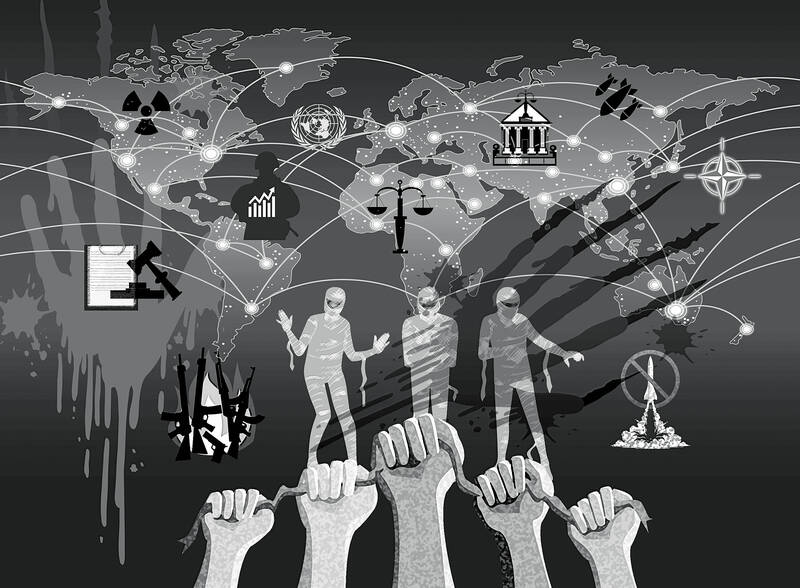
Illustration: Louise Ting
In the 1930s, the zombie was the League of Nations. It existed both on paper and inside grand digs in Geneva palaces but lacked support from major powers such as the US and became irrelevant amid the aggression of authoritarian Japan, Italy and Germany.
Formally, the League lingered on, with employees and delegates and meetings, until it was finally abolished. That happened only in 1946, after World War II and the Holocaust, and after a new organization, the UN, was founded to take its place, this time with the US’s leadership and muscular support.
Today’s crisis, like that of the 1930s, is not in the first instance about money. The secretary-general of the UN recently warned member states that the organization was near “imminent financial collapse,” as various contributors — notably the largest, the US — are cutting or delaying payments. However, NATO, for instance, is swimming in funds, with a recently expanded membership (of 32 countries now) that just pledged to allocate more money to defense.
The problem is instead one of hollowing out, as the system’s great powers ignore the spirit that once animated its institutions. Instead, they heap scorn on them to please domestic audiences while flouting their rules and norms. The effect is slow-motion euthanasia.
The main objective of NATO is to deter aggression from Russia. However, US President Donald Trump disdains many of his allies — threatening Denmark with the annexation of Greenland, for example, or ordering the pullout of thousands of American troops from Germany to “punish” it for not helping in Iran. He simultaneously appears to side more with his Russian counterpart, Vladimir Putin, than with Moscow’s pro-Western victim, Ukraine.
Above all, Trump is ambiguous about whether he would honor Article 5, NATO’s mutual-defense clause. “Who today thinks that Trump would fight a war with Putin over Kaliningrad or a slice of Estonia? I certainly do not,” Lissner told me. There goes deterrence. With its incessant hybrid warfare throughout Europe, Russia is already testing NATO’s vital signs.
A similar evisceration is happening at the Review Conference of the Treaty on the Non-Proliferation of Nuclear Weapons (NPT), which is under way at the UN in New York City until May 22. The last two RevCons, as the meetings are known, in 2015 and 2022, ended without a final document being agreed upon among the 191 parties. NPT watchers worry that this one would be the third, threatening the treaty’s “survival.”
TABOO DEBATES
The NPT, which entered into force in 1970, is the overarching framework meant to guarantee three things: First, the five “legitimate” nuclear powers (the US, Russia, China, France and the UK) must work “in good faith” toward “general and complete disarmament.” Second, all parties that do not have atomic weapons must forswear them. And third, all countries have the right to civilian nuclear technology (for power generation or medicine, say) under proper safeguards.
However, disarmament is no longer on the menu, which in turn makes proliferation likely. All the treaty’s nuclear powers, like the four atomic nations that are not party to the treaty, are upgrading their arsenals. The last arms control treaty between the two giants, the US and Russia, has expired. The direction points away from disarmament and toward arms races.
That leaves all the other countries feeling “betrayed,” said Kelsey Davenport at the Arms Control Association in Washington. Worse, the US’ allies in Europe and Asia no longer trust the deterrent nuclear “umbrella” that the US has long extended over them. Once-taboo debates are raging from Japan and South Korea to Poland and Germany about acquiring national atomic deterrents, which would mean quitting the NPT.
Tehran, which is now in an open-ended “phony war” with one nuclear power in the NPT (the US) and another outside of it (Israel), is permanently on the verge of quitting the treaty. If Iran does leave, as North Korea did in 2003 while watching the US prepare to attack Iraq, its neighbors in the Middle East would recalculate their own nuclear ambitions.
Just as the hollowing out of NATO and the NPT threatens the world’s security, the slow demise of the WTO is reducing its prosperity.
As one of the institutions created by an agreement signed during World War II in Bretton Woods, it was meant to guarantee relatively free and open trade and non-discrimination among trading partners. The idea was that countries whose exports face improper or arbitrary barriers could take their case to the WTO’s Appellate Body for adjudication.
However, the great powers have started ignoring such niceties. China, which joined the WTO in 2001, never fit snugly into the regime. The bigger blow, though, was the US’s turn against its own brainchild. Since the administration of former US president Barack Obama, the US has been blocking appointments to the Appellate Body, citing such reasons as “judicial overreach.”
Without a quorum of judges, the body has been unable to enforce its verdicts, leaving smaller trading nations unable to sue rapacious large countries. So much for the rules-based system.
Then Trump declared a full-fledged trade war on most of the world, in effect resurrecting the “beggar-thy-neighbor” protectionism of the 1930s, which the Bretton Woods system was created to prevent. The era of open and non-discriminatory commerce is history. Michael Froman, who was US trade representative in the Obama administration and now leads the Council on Foreign Relations, concluded that “the global trading system as we have known it is dead.”
It is a similar story with international efforts to prosecute people who commit atrocities or war crimes.
This tradition, which grew out of the US-led Nuremberg Trials, found expression in the International Criminal Court in The Hague, which the US helped create and which opened in 2002. However, the US, like Russia, China and Israel, never became a party to the Rome Statute and does not recognize the court. Instead, Trump has sanctioned its judges, prosecutors and other staff, hamstringing the tribunal’s efforts.
DYSFUNCTION
The outlook is just as bad for the mother of all post-war institutions, the one that was supposed to be a better and more resilient League of Nations. The UN has long been dysfunctional. According to Republicans such as Jim Risch, chairman of the US Senate Foreign Relations Committee, that is because the UN has been “focusing on politicized mandates and woke ideology.”
That diagnosis is not totally wrong, but it says more about US culture wars than the UN system, which simply reflects a messy world.
The real reason why the UN has been feckless in keeping or restoring peace is that three of the five veto-wielding great powers in the Security Council — the US, Russia and China — keep blocking resolutions that would settle the conflicts or dangers that matter most, notably those in Ukraine, the Gaza Strip or the Korean Peninsula.
The other two, France and the UK, have not cast their veto since 1989. They are also blocking any meaningful reforms of the UN system. The UN’s dysfunction is a symptom of the international system’s maladies, not their cause.
The slide into irrelevance of all these institutions, even as they continue to buzz with bureaucratic activity, amounts to a “great unraveling,” said Oona Hathaway, the president-elect of the American Society of International Law. It is demonstrated by less trade and dampened prosperity, and more death and suffering. From 1989 to 2014, fewer than 15,000 people a year died in battles between countries.
Since then, that average has risen to 100,000 a year. UN peacekeeping missions are down. Global arms sales are up.
The international system as the world has known it for eight decades was built by people who had seen a previous order fail and turn into purgatory.
Its institutions, as a famous quote says in a hallway at the UN, were “not created to take mankind to heaven, but to save humanity from hell.” If world leaders, and above all the people running the great powers, forget what happened when the League of Nations became a zombie, that might be where we are heading now.
Andreas Kluth is a Bloomberg Opinion columnist covering US diplomacy, national security and geopolitics. Previously, he was editor-in-chief of Handelsblatt Global and a writer for The Economist. This column reflects the personal views of the author and does not necessarily reflect the opinion of the editorial board or Bloomberg LP and its owners.

KMT Chairwoman Cheng Li-wun’s (鄭麗文) recent visit to Beijing and her upcoming visit to Washington will serve as a high-level test of her diplomatic mettle. In Beijing, Cheng was received with symbolic gestures, a warm reception, and high-level access. In Washington, she will receive far less pomp and far sharper questions about the KMT’s vision for the future of Taiwan. Her challenge will be to persuade Washington that the KMT’s engagement with China can coexist with strong deterrence. Cheng’s April 7-12 visit to mainland China coincided with an intense period of conflict in Iran. Despite the strategic significance of Cheng’s trip,

The closure of the Strait of Hormuz has sent the vast Asian chemicals industry into a tailspin. Deprived of the likes of Qatari natural gas and Saudi Arabian oil, the region’s fertilizer and plastics plants are slowing production or even shutting down. Everywhere except China, that is. In petrochemicals, China is unique. As well as a traditional industry that uses oil and gas as feedstock, it has parallel output that relies on its abundant domestic coal. Unsurprisingly, India and other regional powers want to copy and paste the Chinese method. This would not be easy — or climate friendly. The
Indonesian President Prabowo Subianto says he knows how to fix the problems facing Indonesia. Yet his economic mismanagement and authoritarian tendencies are steering the nation toward a familiar mix of currency instability and political chaos. The world’s fourth-most populous nation risks reversing the hard-won democratic and business reforms that came after the Asian Financial Crisis in 1997. At that time, the rupiah collapsed and the political upheaval that followed forced former president Haji Mohamed Suharto from power. Prabowo’s administration is ignoring similar warning signs. That disconnect was apparent in a national address on Wednesday, when Prabowo projected the swagger that has
“Of course you can choose not to be Taiwanese, just do not stay here,” chairwoman of Taipei 101 operator Taipei Financial Center Corp Janet Chia (賈永婕) said in an online interview with local entertainer Tai Chih-yuan (邰智源), triggering intense discussion on social media, with politicians across party lines weighing in. In the interview, which was aired on May 14, Chia and Tai’s discussion over a meal in Taipei 101 covered Chia’s career change from entertainer to chairwoman and US climber Alex Honnold’s free solo climb up the Taipei 101 building. During the interview, Chia said, “Being on this land, we


 RSS
RSS