


The news late last month that US President Donald Trump sounded out FIFA, the governing body of world soccer, about replacing Iran with Italy at this year’s World Cup jolted insiders and pundits on the beautiful game. It has also cast a fresh light on the unusual and evolving relationship between Trump and Italian Prime Minister Giorgia Meloni.
In the past few weeks, Meloni’s standing as the darling of the right-wing US has been imperiled by an unexpected rift with the Oval Office. Trump dramatically distanced himself from his Italian ally over her refusal to join US attacks on Iran in an interview.
“I’m shocked at her. I thought she had courage, but I was wrong,” the US president told the Italian newspaper Corriere della Sera.
The reported US approach to FIFA — since ruled out by Italian ministers — might have signaled a wish by Trump to mend fences with the Italian leader.
Meloni’s relationship with Trump has never been primarily about policy. It has been grounded instead in politics, ideology and geopolitics — a triad that has defined its strengths and its limits.
Politically, Meloni has leveraged her proximity to Trump while maintaining pragmatic ties with EU leaders. This dual track has enhanced her international reputation as a responsible rightwing leader and a go-to figure in Europe. She has sought to present herself as someone capable of bridging worlds — aligned with the nationalist conservative wave emanating from Washington, yet credible and constructive in the European mainstream.
Ideologically, Meloni and Trump subscribe to a civilizational vision of the West as a community of nations bound together by common history, religion and cultural — if not ethnic — homogeneity.
Geopolitically, her approach stems from the conviction that, in an era of great upheaval and competition between powers, European countries still have a strategic imperative to remain close to the US regardless of who sits in the Oval Office. Adaptation, rather than complaint, has been Meloni’s guiding principle. This explains why she consistently refrained from confrontation every time Trump lashed out at Europe.
The problem is that her proximity to Trump has yielded few tangible advantages for Italy — apart, perhaps, from some clemency on US imports of Italian pasta. Where Italy has conceded to Trump, on tariffs or higher defense spending, it has done so alongside the rest of Europe. Where it has resisted US pressure, on Ukraine or Greenland, it has done so through coordination with EU partners, not bilateral leverage with Washington.
The war with Iran has laid bare the strategic limitations of this approach. Its economic consequences have been felt directly by Italians at the petrol pump. The war has also reinforced a broader perception among Italians that not only is Trump seeking to subordinate European allies, but he is also making the international system structurally insecure.
Meloni’s balancing act has, therefore, become increasingly difficult, especially in the wake of last month’s domestic setback in the referendum on judicial reform, in which her association with Trump proved a liability. Having initially refused to condemn the war in the Middle East, she eventually stated publicly that it was not in Italy’s interest.
Then came the breaking point. Trump’s personal attack on Pope Leo XIV, after the pontiff’s criticism of the US administration’s war on Iran, left Meloni with little room for maneuver. For an Italian conservative and self-styled Catholic leader, silence was not an option.
Even then she avoided direct confrontation. Her response was measured: a defense of the dignity of the pope and a statement that the president’s words were “unacceptable.” Most likely she hoped she could create some distance without provoking a rupture, but Trump’s repeated personal insults toward her transformed the situation into a political headache.
In the short term, the rift might even offer her political benefits. Meloni has emerged as a defender of the Italian national interest and of the Catholic Church, even attracting a degree of solidarity from the opposition, which has so far failed to capitalize on her closeness to Trump.
In the longer term, it is not going to be so easy for Meloni. Her most viable course appears to be a renewed emphasis on pragmatic relations in Europe. Her participation in the Paris summit on the Strait of Hormuz — during which she made a point of physically embracing French President Emmanuel Macron, the bete noire of the Italian far right — signals as much.
At the same time, she would try to mend fences with Washington. Had Trump been less explicit in his displeasure, this recalibration might have proceeded quietly. The fact that the idea of Italy replacing Iran at the World Cup came from an Italian national working for Trump, US special envoy Paolo Zampolli, might be seen as an indirect olive branch to Meloni.
However, the lukewarm reaction in Italy shows the risk of trying to mend ties in such an unorthodox way. It could easily be seen as an undignified act of contrition by Meloni, costing her some of the domestic political capital she has gained by standing up to a US president who is deeply unpopular in Italy.
Meloni thus finds herself at a crossroads. She can lean more decisively toward Europe or seek to re-engage with the US on Trump’s terms. Her past suggests a reluctance to make such binary choices, but circumstances might soon force her hand. If Europe continues to be excluded from key decisions affecting its security — as with Ukraine — and its economic stability — as with Iran — the association with Trump could become an albatross around her neck at a critical moment in her career.
She would enter campaign season — the next general election in Italy is scheduled for December next year at the latest — with no major reform attached to her government, a sputtering economy and a deteriorating security environment for which Trump bears significant responsibility in the eyes of many Italians.
The tension between Meloni the party leader and Meloni the statesperson is no longer abstract. It might become untenable. The question is not whether she can continue to balance the two, but for how much longer.
Riccardo Alcaro is head of research at Istituto Affari Internazionali in Rome.

KMT Chairwoman Cheng Li-wun’s (鄭麗文) recent visit to Beijing and her upcoming visit to Washington will serve as a high-level test of her diplomatic mettle. In Beijing, Cheng was received with symbolic gestures, a warm reception, and high-level access. In Washington, she will receive far less pomp and far sharper questions about the KMT’s vision for the future of Taiwan. Her challenge will be to persuade Washington that the KMT’s engagement with China can coexist with strong deterrence. Cheng’s April 7-12 visit to mainland China coincided with an intense period of conflict in Iran. Despite the strategic significance of Cheng’s trip,
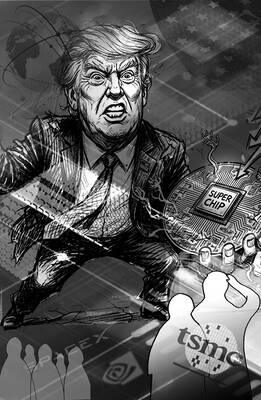
The White House’s decision to take a 9.9 percent stake in Intel Corp is looking like very shrewd business indeed. Since the government bought in at US$20.47 a share last August, the US chipmaker’s surging stock price has delivered the US a US$43 billion return. One of the reasons the investment has so far proved so sound is that the White House has made sure of it. According to The Wall Street Journal, Howard personally pushed deals on Intel’s behalf with some of the most lucrative clients imaginable. They include Nvidia Corp, the company at the heart of the AI

The closure of the Strait of Hormuz has sent the vast Asian chemicals industry into a tailspin. Deprived of the likes of Qatari natural gas and Saudi Arabian oil, the region’s fertilizer and plastics plants are slowing production or even shutting down. Everywhere except China, that is. In petrochemicals, China is unique. As well as a traditional industry that uses oil and gas as feedstock, it has parallel output that relies on its abundant domestic coal. Unsurprisingly, India and other regional powers want to copy and paste the Chinese method. This would not be easy — or climate friendly. The
Indonesian President Prabowo Subianto says he knows how to fix the problems facing Indonesia. Yet his economic mismanagement and authoritarian tendencies are steering the nation toward a familiar mix of currency instability and political chaos. The world’s fourth-most populous nation risks reversing the hard-won democratic and business reforms that came after the Asian Financial Crisis in 1997. At that time, the rupiah collapsed and the political upheaval that followed forced former president Haji Mohamed Suharto from power. Prabowo’s administration is ignoring similar warning signs. That disconnect was apparent in a national address on Wednesday, when Prabowo projected the swagger that has


 RSS
RSS