


Last week saw the passage in the UK of the Tobacco and Vapes Bill, which has a very ambitious aim: to create a “smoke-free generation” and eventually end smoking forever in the UK. Quite simply, anyone born on or after January 1, 2009, would never be legally able to buy tobacco products. From 2027, the minimum legal age for the sale of tobacco would increase by one year (from the current age of 18) every year.
There would be a permanent generational line: Everyone above it would still be allowed to buy cigarettes; everyone below it would not. Over time, the proportion of people allowed to smoke would become smaller and smaller as older citizens die — until one day no one in the UK would be able to legally buy cigarettes.
It is quite a clever piece of legislation: Rather than an outright ban that would result in conflict over rights with smokers now, it gradually reduces the number of those able to purchase tobacco products legally year by year, hopefully leading to further declines in smoking that happen invisibly.

Illustration: Yusha
Public health researchers would be studying the impact of this legislation (a policy experiment and one of the first of its kind) and whether it could be a model to introduce in other countries and areas.
The law also extends the regulation of vapes — including their advertising and marketing to young people, and banning their use in playgrounds, public and commercial buildings, cars carrying children, and outside hospitals and schools. Despite an increasingly politically polarized climate, this law enjoys remarkable cross-party consensus, with strong support from Conservative, Labour, and Liberal Democrat voters. Some of the strongest support for the legislation has come from smokers.
Research carried out by YouGov in 2024 found that 52 percent of smokers supported raising the age of sale by one year every year, and 78 percent of the public supported the idea of a smoke-free generation.
Before you jump forward a few decades to the idea of police arresting a 50-year-old lighting up a cigarette, it is worth clarifying that the law does not criminalize smoking itself. Instead, it only applies to those selling tobacco products, with the burden falling on retailers.
Over time, this would create a slightly odd situation: Two adults going into a shop could be treated differently based on their birth year. A 40-year-old would legally be able to purchase tobacco, while his 39-year-old friend would be refused service.
This is intentional: to move toward a steady decline in smoking that almost happens invisibly as years pass.
Why would smokers support this policy? Perhaps it is because they wish this legislation had been in place when they were younger: Most people who smoke became addicted at a young age, with 90 percent of people who smoke starting before the age of 21.
Many became addicted before they fully understood the health risks or how it would affect the quality of their daily lives.
Understandably, polls tend to show that the vast majority of smokers regret starting. However, quitting is notoriously difficult: It is estimated that 80 percent of people who smoke have tried to quit and struggled.
Many of these smokers now know it is killing them: Two-thirds of deaths of female smokers in their 50s, 60s, and 70s are linked to smoking, and smokers are estimated to die 10 years earlier than non-smokers.
However, there is a deeper philosophical question about rights for adults: Does this kind of generational ban infringe on individual freedom? It depends on your interpretation of freedom. Freedom is not only the ability to choose harmful products — it can also mean the freedom to grow without being systematically targeted by industries built on addiction.
In addition, smoking is ruinously expensive to the NHS: Smoking-related diseases and complications are estimated to cost our health system 2.6 billion pounds (about US$3.5 billion) a year and society more widely about 11 billion pouds a year.
In an overstretched service facing multiple demands and pressures, freedom can also mean being able to access timely, high-quality healthcare in an NHS that is not overstretched by preventable disease.
The profit from smoking is made by private companies and their shareholders, while the costs are paid by individuals in their health and well-being, and by taxpayers supporting health services.
Tobacco companies have long been aware of the same statistics that public health experts now cite on why this needs government regulation: If someone does not start smoking in their early 20s, they probably never would.
Other countries would be closely watching how the UK policy experiment goes and whether they should follow: It is a public health approach rooted in not banning a product immediately but quietly engineering its disappearance year by year. (The Maldives implemented a similar ban beginning late last year.)
Perhaps the biggest testament to why it is needed? Some of its loudest champions are the smokers who wonder what their own health and life would have looked like if this legislation had been introduced when they were young.
Devi Sridhar is chair of global public health at the University of Edinburgh, and the author of How Not to Die (Too Soon).
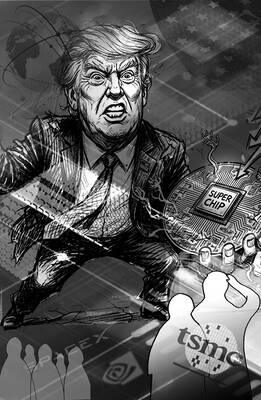
The White House’s decision to take a 9.9 percent stake in Intel Corp is looking like very shrewd business indeed. Since the government bought in at US$20.47 a share last August, the US chipmaker’s surging stock price has delivered the US a US$43 billion return. One of the reasons the investment has so far proved so sound is that the White House has made sure of it. According to The Wall Street Journal, Howard personally pushed deals on Intel’s behalf with some of the most lucrative clients imaginable. They include Nvidia Corp, the company at the heart of the AI
The Ministry of the Interior, working with the navy and coast guard, is organizing Taiwan’s first joint exercise simulating escort tankers carrying liquefied natural gas (LNG) and oil through a Chinese blockade. The drills simulate fuel transport along three maritime corridors leading toward Japan, the Philippines and the US. Deputy Minister of the Interior Sawyer Mars (馬士元) said that a blockade of the Taiwan Strait would amount to “almost a 100 percent blockade of the regional energy supply.” Minister of National Defense Wellington Koo said planning to counter a blockade is standard practice in Taipei. While the exercise is limited in
A single photograph can cut through a lot of noise, but it can also be used to misrepresent the truth. At the very least, it can concentrate the mind on something that requires further investigation. On Monday last week, Ma Ying-jeou Foundation CEO Tai Hsia-ling (戴遐齡) and former National Security Council secretary-general King Pu-tsung (金溥聰) held a news conference in which they showed a photograph of former foundation CEO Hsiao Hsu-tsen (蕭旭岑), now Chinese Nationalist Party (KMT) deputy chairman. In the image Hsiao is seated next to Xiamen Taiwan Businessmen Association chairman Han Ying-huan (韓螢煥). The two men were holding
I first met Professor Ray Jiing (井迎瑞) as a film and documentary student at Shih Hsin University’s (SHU) Department of Radio Television and Film in 1988. The following year, he went on to become the director of the Chinese Taipei Film Archive — forerunner of the Taiwan Film and Audiovisual Institute (TFAI). Over his eight-year tenure, Jiing rescued and restored over 200 classic Taiwanese films. In 1997, he established the Graduate Institute of Studies in Documentary and Film Archiving at Tainan National University of the Arts (TNNUA), and I joined the program in his third cohort of students. Beyond a


 RSS
RSS