


The dizzying changes wrought by energy shocks are only ever seen in the rearview mirror.
When the 1973 and 1979 oil crises swept the world, analysts assumed the future would be business as usual. Crude demand from Western Europe would remain broadly stable throughout the 1980s, according to a declassified 1982 analysis for the CIA. The Organization for Economic Co-operation and Development (OECD) forecast in 1978 that its imports would rise to 35 million barrels by 1985.
Things did not turn out that way. Faced with a sevenfold increase in the cost of crude, Europe began a radical shift. A vast fleet of nuclear reactors in France, home boilers powered by North Sea gas in England and a controversial pipeline connecting Germany to immense Siberian gas fields shredded earlier forecasts. By the mid-1980s, Europe’s gas consumption had more than doubled from its level in 1973, but oil fell 20 percent. Crude imports slumped 30 percent to barely more than half of what the OECD had expected.
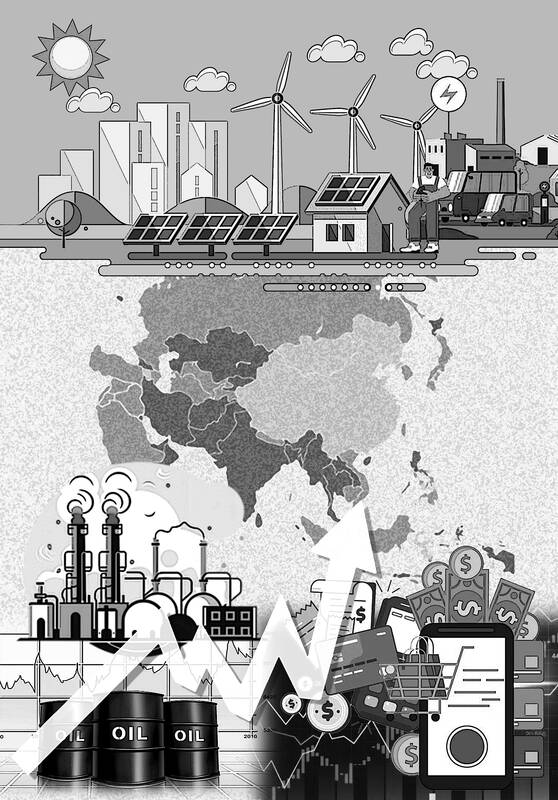
Illustration: Constance Chou
We are seeing the first tremors of a similar earthquake now in Asia. More than 80 percent of the oil and gas that passes through the Strait of Hormuz heads east. Like Europe, most of the region is fundamentally short of petroleum and getting more so with each passing year. Japan and South Korea have long been among the most import-dependent countries on the planet for their energy supplies, but the whole region is heading in the same direction.
Vietnam became a net importer of energy over the past decade, and even petroleum-rich Malaysia is now a net fuel importer. Indonesia still subsidizes fuel like the OPEC member it was for decades, but it has been reliant on imports for more than 20 years. Domestic gas fields that sustained growth in Bangladesh, Pakistan and Thailand in previous decades are now giving out, leaving the countries at the mercy of costly, faltering LNG imports.
Shortages and price rises for fossil fuels are already starting to hit consumers in a way that would upend previous forecasts as dramatically as the 1970s oil shocks.
In Seoul, the average price for kalguksu — a noodle soup that is a traditional homely comfort food — crossed 10,000 won (US$6.79) for the first time in March, as inflation climbed to 2.2 percent due in part to rising energy import costs.
In Japan, where food prices rose 6.8 percent last year, ramen bowls are drifting closer to a psychologically important ¥1,000 (US$6.27) threshold. Low-cost public bathhouses are facing tighter margins, squeezed between the rising cost of heating oil and government-regulated prices.
Such wealthy countries have significant tools to cushion the impact of this emergency. Energy prices in Japan actually fell 5.7 percent in March, as subsidies and the release of 80 million barrels of oil from strategic reserves dulled the effect of the war in Iran. The number of people booking overseas vacations for the Golden Week public holiday starting this week has risen strongly. A prolonged crisis that erodes emergency government support would dim such euphoria, though. Japanese consumer confidence last month had already fallen to its lowest level since last May.
Travel across the region would be particularly badly hit. With jet fuel prices in Singapore doubling to their highest levels on record, airlines in Southeast Asia have cut their May schedules by 10 percent to 15 percent, according to Cirium, an aviation consultancy. Thai Airways canceled two-thirds of its daily flights between Bangkok and Seoul. Cathay Pacific Airways Ltd is putting a US$200 surcharge on long-distance flights, sufficient to add US$800 to the price of a return ticket between Australia and Europe.
The effect on the roads is yet more dramatic. Pakistan, the Philippines and Sri Lanka have introduced four-day weeks to reduce the amount of gasoline and diesel used in commuting. Drivers of jeepney minibuses in Manila announced at least three strikes demanding cuts to fuel taxes, as rising costs threaten to wipe out their livelihoods. With some reporting an 80 percent drop in income thanks to the rising cost of fuel, one driver interviewed by local media was reduced to sleeping on the street to save on rent.
Further down the scale, farmers in India are having to decide whether they can afford to spare money for fertilizer, as prices rise due to halted exports of urea from the Persian Gulf. The hit to living standards can be brutally direct: Pakistan is cutting grid power for more than two hours during each daily peak after flows of LNG from Qatar dried up. That translates into insufferable conditions in places like Lahore, a city of 15 million people where daytime temperatures are topping 40°C.
All this is driving a rush for alternatives — and the winner each time is clean energy.
In India, shortages of LPG — widely used in cooking — have sparked lengthy queues, fights at retailers and a run on electric induction stoves that cost the same as roughly three gas bottle refills. Consumption of LPG in March fell 13 percent compared to a year earlier.
In Australia, auction sales of used electric vehicles doubled in March. At the Bangkok International Motor Show earlier this month, Chinese EV brands accounted for about two-thirds of bookings, overwhelming Japanese automakers used to dominating the local market. Vietnamese EV-maker Vinfast Auto Ltd plans to sell about five times more cars in overseas markets this year than last year.
Battery-only models have already reached around 50 percent market penetration in recent months in Singapore and Thailand and about a third in China, Indonesia, South Korea and Vietnam. Even before the war, billions of drivers in Asia were looking for an alternative to the cost and pollution of petrol power and in numerous markets electric models were already as cheap as conventional vehicles.
In the Philippines, imports of solar panels from China during March alone were sufficient to increase total solar capacity by half, relative to levels at the end of last year. In Cambodia, Indonesia, Malaysia and Pakistan, trade was sufficient to boost installations by a quarter or more. One Manila-based solar installer told local news site Rappler that they were signing as much as 10 times more contracts per month than they were before the war.
Hardly anyone predicted the conflict that is catalyzing this revolutionary shift. However, the direction of travel has been clear for years, as the costs of clean energy have slumped below those of fossil power almost everywhere and China’s solar, battery and electric vehicle industries have grown into world-beaters. In betting that trade barriers, institutional roadblocks and misinformation would hold back the tide of new technology, industrial companies elsewhere made a fatal wager on fading carbon-intensive technology.
As with Europe in the 1970s, Asia is a crucial region in forecasts for fossil fuel consumption growth. In BP Plc’s latest energy outlook, emerging Asian countries account for all the growth in LNG usage. About 70 percent of the global increase in oil demand out to 2035 would be in Southeast Asia and India, according to the International Energy Agency (based on the IEA’s Current Policies Scenario, which tends to significantly overstate oil consumption. Under its more accurate Stated Policies Scenario, declines in consumption elsewhere mean that increases in oil demand in India and Southeast Asia are more than seven times greater than the global total).
The global petroleum industry is counting on robust consumption growth in Asia to justify the investments it would make over the coming years. However, the crisis in the Strait of Hormuz is giving consumers and governments in the region compelling reasons to seek out alternatives. The decision of the United Arab Emirates this week to quit OPEC is yet another reason to defect since it is likely to erode the ability of the cartel to stabilize prices, leading to more volatility for importers. With China’s exports of solar panels, electric vehicles and lithium-ion batteries all surging in March, a superior energy system is waiting in the wings, ready to be adopted.
Europe’s oil demand never recovered from the shocks of the 1970s. If the crisis in the Strait of Hormuz does not end soon, a yet more dramatic transformation awaits in Asia.
David Fickling is a Bloomberg Opinion columnist covering climate change and energy. Previously, he worked for Bloomberg News, the Wall Street Journal and the Financial Times. This column reflects the personal views of the author and does not necessarily reflect the opinion of the editorial board or Bloomberg LP and its owners.
What began on Feb. 28 as a military campaign against Iran quickly became the largest energy-supply disruption in modern times. Unlike the oil crises of the 1970s, which stemmed from producer-led embargoes, US President Donald Trump is the first leader in modern history to trigger a cascading global energy crisis through direct military action. In the process, Trump has also laid bare Taiwan’s strategic and economic fragilities, offering Beijing a real-time tutorial in how to exploit them. Repairing the damage to Persian Gulf oil and gas infrastructure could take years, suggesting that elevated energy prices are likely to persist. But the most
Taiwan should reject two flawed answers to the Eswatini controversy: that diplomatic allies no longer matter, or that they must be preserved at any cost. The sustainable answer is to maintain formal diplomatic relations while redesigning development relationships around transparency, local ownership and democratic accountability. President William Lai’s (賴清德) canceled trip to Eswatini has elicited two predictable reactions in Taiwan. One camp has argued that the episode proves Taiwan must double down on support for every remaining diplomatic ally, because Beijing is tightening the screws, and formal recognition is too scarce to risk. The other says the opposite: If maintaining
Chinese Nationalist Party (KMT) Chairwoman Cheng Li-wun (鄭麗文), during an interview for the podcast Lanshuan Time (蘭萱時間) released on Monday, said that a US professor had said that she deserved to be nominated for the Nobel Peace Prize following her meeting earlier this month with Chinese President Xi Jinping (習近平). Cheng’s “journey of peace” has garnered attention from overseas and from within Taiwan. The latest My Formosa poll, conducted last week after the Cheng-Xi meeting, shows that Cheng’s approval rating is 31.5 percent, up 7.6 percentage points compared with the month before. The same poll showed that 44.5 percent of respondents
India’s semiconductor strategy is undergoing a quiet, but significant, recalibration. With the rollout of India Semiconductor Mission (ISM) 2.0, New Delhi is signaling a shift away from ambition-driven leaps toward a more grounded, capability-led approach rooted in industrial realities and institutional learning. Rather than attempting to enter the most advanced nodes immediately, India has chosen to prioritize mature technologies in the 28-nanometer to 65-nanometer range. That would not be a retreat, but a strategic alignment with domestic capabilities, market demand and global supply chain gaps. The shift carries the imprimatur of Indian Prime Minister Narendra Modi, indicating that the recalibration is


 RSS
RSS