


A police officer at Kaohsiung’s Sanmin Police Station on Wednesday was indicted under the Personal Data Protection Act (個人資料保護法) and the Criminal Code on suspicion of taking taking indecent photographs.
The officer, surnamed Tu, reportedly indecently photographed several women under the pretext of “collecting evidence,” and secretly filmed in the precinct bathroom.
He then fed the images he had taken of the six victims to an artificial intelligence (AI) image generator to create pornographic content.
News of Tu’s actions came less than one week after the Modern Women’s Foundation held an event urging the government to establish an integrated support system for victims of image-based sexual violence.
Unfortunately, cases like Tu’s are part of a broader and rapidly expanding pattern of digital sexual abuse in Taiwan.
Complaints of image-based sexual abuse rose by 46 percent last year compared with 2024, driven largely by an increase in covert filming cases. However, these figures only reflect reported incidents.
Given the hidden nature of such crimes, the actual numbers are almost certainly much higher.
A Ministry of Health and Welfare survey on digital and online gender-based violence last year found that at least one in every 15 people in Taiwan has unknowingly been photographed or filmed.
Known perpetrators of such crimes come from all corners of society.
Known cases including doctors, military personnel, teachers, engineers, tutoring center operators and police officers.
Like Tu, many exploit their positions, using official authority or professional cover to facilitate sexual abuse.
Popular methods range from using smartphones under pretense to installing concealed pinhole cameras in easily accessible areas such as bathrooms, offices, hospitals and department stores.
What makes these crimes particularly frightening is the ease with which non-consensual images can now be altered, replicated and circulated online.
Multiple investigations in the past few years have uncovered online platforms where illegally obtained sexual images are shared, traded and monetized. In several cases, victims only discovered the existence of the material after it had already been disseminated.
More than 95 percent of perpetrators in such cases are men, while victims are overwhelmingly women. This imbalance illustrates the undeniable gendered nature of digital sexual abuse, which must not be overlooked.
In response to previous cases, police have advised people to remain vigilant in public spaces, suggesting that they cover themselves more carefully on public transport and routinely check for hidden cameras in changing rooms and restrooms.
However, the responsibility should not fall on the public to prevent themselves from being victimized. More must be done to stop these crimes from occurring in the first place.
Regular sweeps of high-risk public spaces, particularly restrooms and changing facilities, should be standardized rather than left to discretion.
Without consistent enforcement, there is no reliable way to catch perpetrators early. Hidden cameras are often discovered only after victims notice they have been filmed, sometimes months later.
Additionally, the penalties for such crimes fail to reflect the harm they cause. Under the Criminal Code, a person who takes sexual images without consent could face a maximum prison sentence of three years. If they intend to profit from the images, the maximum sentence is raised to five years.
In practice, enforcement is inconsistent — according to a report last year by the Modern Women’s Foundation, of 1,393 cases handled in 2024, fewer than 200 led to convictions.
This reflects how difficult these crimes are to investigate and prosecute and highlights the need for more specialized investigative measures.

KMT Chairwoman Cheng Li-wun’s (鄭麗文) recent visit to Beijing and her upcoming visit to Washington will serve as a high-level test of her diplomatic mettle. In Beijing, Cheng was received with symbolic gestures, a warm reception, and high-level access. In Washington, she will receive far less pomp and far sharper questions about the KMT’s vision for the future of Taiwan. Her challenge will be to persuade Washington that the KMT’s engagement with China can coexist with strong deterrence. Cheng’s April 7-12 visit to mainland China coincided with an intense period of conflict in Iran. Despite the strategic significance of Cheng’s trip,
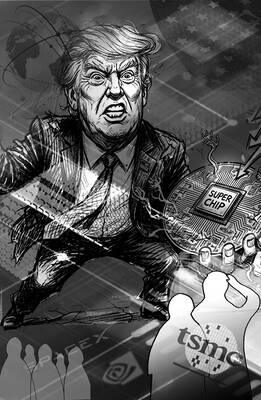
The White House’s decision to take a 9.9 percent stake in Intel Corp is looking like very shrewd business indeed. Since the government bought in at US$20.47 a share last August, the US chipmaker’s surging stock price has delivered the US a US$43 billion return. One of the reasons the investment has so far proved so sound is that the White House has made sure of it. According to The Wall Street Journal, Howard personally pushed deals on Intel’s behalf with some of the most lucrative clients imaginable. They include Nvidia Corp, the company at the heart of the AI

The closure of the Strait of Hormuz has sent the vast Asian chemicals industry into a tailspin. Deprived of the likes of Qatari natural gas and Saudi Arabian oil, the region’s fertilizer and plastics plants are slowing production or even shutting down. Everywhere except China, that is. In petrochemicals, China is unique. As well as a traditional industry that uses oil and gas as feedstock, it has parallel output that relies on its abundant domestic coal. Unsurprisingly, India and other regional powers want to copy and paste the Chinese method. This would not be easy — or climate friendly. The
Indonesian President Prabowo Subianto says he knows how to fix the problems facing Indonesia. Yet his economic mismanagement and authoritarian tendencies are steering the nation toward a familiar mix of currency instability and political chaos. The world’s fourth-most populous nation risks reversing the hard-won democratic and business reforms that came after the Asian Financial Crisis in 1997. At that time, the rupiah collapsed and the political upheaval that followed forced former president Haji Mohamed Suharto from power. Prabowo’s administration is ignoring similar warning signs. That disconnect was apparent in a national address on Wednesday, when Prabowo projected the swagger that has


 RSS
RSS