


With the workers’ Day holiday upon us, discussions about wages have once again intensified.
From a statistical perspective, Taiwan’s nominal wages have not stagnated; on the contrary, they have demonstrated a long-term and stable upward trend. The minimum wage has also increased year after year, gradually raising overall wage levels. However, there is an obvious disconnect in how these figures are applied in everyday life. Why is it that growth on paper rarely translates into people’s real-life experiences?
The key issue lies not in whether wages are increasing, but whether that wage growth can keep pace with rising prices. An increase in nominal wages means higher income, but what truly impacts quality of life are real wages — income after accounting for inflation. In the past few years, the cost of living has continued to rise — from dining and rent, to other everyday expenses. Even when salaries are adjusted, the increase often does little more than cover higher costs, leaving no room to accumulate savings. Once the gap between wage growth and inflation narrows or disappears, the real value of workers’ income declines and improving one’s standard of living becomes difficult.
Even more noteworthy is that, while wage growth has remained relatively modest, asset prices have risen at an entirely different pace. In the past few years, stock prices and real estate values have increased significantly, allowing asset holders to passively accumulate wealth through appreciating prices at a rate that often far exceeds wage growth.
As a result, the structure of income distribution has begun to shift — moving from a labor-based model to one where wealth is primarily determined by asset ownership.
These changes have created a dual burden on ordinary wage earners. On one hand, wages are failing to keep up with the rising cost of living, and everyday expenses continue to increase. On the other hand, soaring asset prices have raised barriers to entry, making the accumulation of capital — already difficult for many — even more unattainable. Rising housing prices not only make homeownership more difficult, but also increase rental burdens. Meanwhile, gains in the stock market leave those unable to participate increasingly excluded from the benefits of asset appreciation.
When asset appreciation consistently outpaces wage growth, the wealth gap gradually widens. Those who own assets are able to accumulate wealth through market fluctuations, while those without assets can rely only on wages — wages which are difficult to convert into capital. This is not a mere matter of income disparity; it also concerns the allocation of opportunity and prospects for future social mobility.
Against this backdrop, Workers’ Day should not merely serve as a symbolic holiday, but as an opportunity to re-examine wage structures and distribution mechanisms. The focus of the discussion should not be limited to whether the minimum wage should be raised, but should also address how wage growth can steadily outpace the cost of living, allowing hardworking people to not only make a living, but also accumulate savings.
Wages have never been a matter of individual income; they are also a measure of how a society values labor. When income from labor becomes increasingly insufficient to support a decent standard of living — and is even gradually marginalized — the impact extends beyond individual households to the stability of society as a whole.
Perhaps the real meaning of Workers’ Day lies in reminding us of what is truly needed, which — beyond impressive growth figures — are changes that more meaningfully impact our everyday lives.
Dino Wei is an engineer.
Translated by Kyra Gustavsen
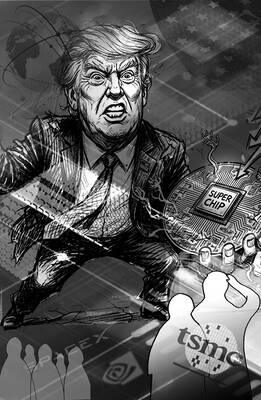
The White House’s decision to take a 9.9 percent stake in Intel Corp is looking like very shrewd business indeed. Since the government bought in at US$20.47 a share last August, the US chipmaker’s surging stock price has delivered the US a US$43 billion return. One of the reasons the investment has so far proved so sound is that the White House has made sure of it. According to The Wall Street Journal, Howard personally pushed deals on Intel’s behalf with some of the most lucrative clients imaginable. They include Nvidia Corp, the company at the heart of the AI

KMT Chairwoman Cheng Li-wun’s (鄭麗文) recent visit to Beijing and her upcoming visit to Washington will serve as a high-level test of her diplomatic mettle. In Beijing, Cheng was received with symbolic gestures, a warm reception, and high-level access. In Washington, she will receive far less pomp and far sharper questions about the KMT’s vision for the future of Taiwan. Her challenge will be to persuade Washington that the KMT’s engagement with China can coexist with strong deterrence. Cheng’s April 7-12 visit to mainland China coincided with an intense period of conflict in Iran. Despite the strategic significance of Cheng’s trip,

The closure of the Strait of Hormuz has sent the vast Asian chemicals industry into a tailspin. Deprived of the likes of Qatari natural gas and Saudi Arabian oil, the region’s fertilizer and plastics plants are slowing production or even shutting down. Everywhere except China, that is. In petrochemicals, China is unique. As well as a traditional industry that uses oil and gas as feedstock, it has parallel output that relies on its abundant domestic coal. Unsurprisingly, India and other regional powers want to copy and paste the Chinese method. This would not be easy — or climate friendly. The
Indonesian President Prabowo Subianto says he knows how to fix the problems facing Indonesia. Yet his economic mismanagement and authoritarian tendencies are steering the nation toward a familiar mix of currency instability and political chaos. The world’s fourth-most populous nation risks reversing the hard-won democratic and business reforms that came after the Asian Financial Crisis in 1997. At that time, the rupiah collapsed and the political upheaval that followed forced former president Haji Mohamed Suharto from power. Prabowo’s administration is ignoring similar warning signs. That disconnect was apparent in a national address on Wednesday, when Prabowo projected the swagger that has


 RSS
RSS