


Every September, Spain celebrates one of the most symbolic moments of its transition to democracy. This year would mark 45 years since an Iberia commercial flight from New York landed in Madrid with its pilot announcing to the surprised passengers that they had just traveled with one of the country’s most famous exiles: Pablo Picasso’s Guernica. After more than four decades on display at New York’s Museum of Modern Art (MoMA), the painting could finally return home after the end of former Spanish leader Francisco Franco’s dictatorship, in accordance with the wishes of Picasso.
Picasso’s most famous painting, which depicted the horrors inflicted on civilians during the bombing of the Basque town of Gernika in the Spanish civil war, was intended to be a cry for peace.
“If world peace prevails, the war I painted will be a thing of the past,” Picasso told Josep Lluis Sert, his friend and the architect of the Spanish Republic’s pavilion at the 1937 Paris international exhibition.
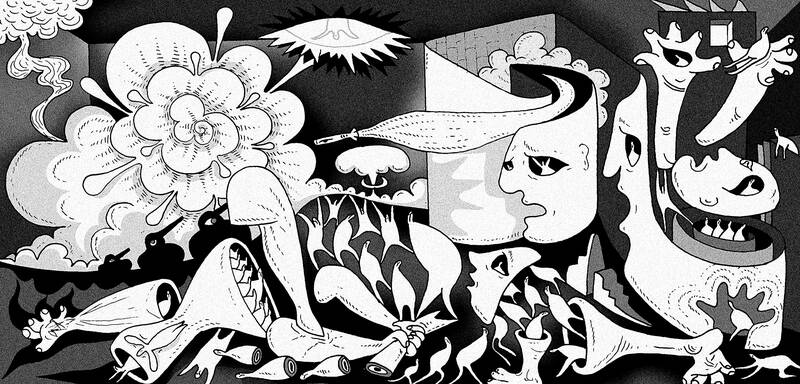
Illustration: Mountain People
In a period when the Middle East and Europe are once again being torn apart by war, Guernica is as relevant as ever and has become a global emblem of the horrors of aerial bombardment. However, in Spain, Picasso’s masterpiece has become another excuse for a petty political fight.
Basque Government President Imanol Pradales, who comes from the conservative Basque Nationalist party (PNV), has requested that Guernica be transferred for a few months from Madrid’s Reina Sofia museum, which has been its only home since 1992.
To see it hanging in Bilbao for the first time would be a form of “reparation for the Basque people,” he said.
Spanish Prime Minister Pedro Sanchez’s center-left government has rejected this call on conservation grounds, while conservative Spanish politicians have joined the battle, using the opportunity to attack Basque nationalism.
The PNV hopes to display Guernica in Bilbao’s Guggenheim Museum for a special exhibition next year, commemorating the 90th anniversary of the bombing of Gernika this month and telling the story of the painting itself.
Inspired by newspaper reports of the massive bombing of civilians by the Luftwaffe and Franco’s forces, Picasso painted Guernica in a little more than a month in Paris in 1937. In the late 1930s, Guernica served as a powerful political tool and traveled across Europe to drum up support for the fight against fascism and to raise funds for Spain’s republicans.
It arrived in the US in 1939 and quickly became a rallying symbol of the atrocities of war and the fight for peace. A tapestry reproduction still hangs at the entrance of the UN Security Council in New York City.
The painting was constantly traveling during the 1950s, on loan to special exhibitions across the world from Milan to Berlin and from Stockholm to Sao Paulo, Philadelphia and Chicago. This in-demand existence caused damage over the years, including discoloration, dents and fractures. The conservation of the painting became a prominent concern on its overdue return to Spain in 1981.
The risks for Guernica’s integrity were also political. The first time I saw it, during a school visit as a child, Guernica was behind bulletproof glass at the Cason del Buen Retiro, an annex to the Prado museum. In my memory the painting was suffused in dim light. Spain was still a fragile democracy then, with dozens of terrorist attacks every year, and the painting was surrounded by armed policemen. It was a very different scene when, a few days ago, I saw the painting hanging in an open, luminous space with no visible barriers at the Reina Sofia museum.
Visitors can even take pictures of Guernica now, something that was not allowed until 2023. The painting’s display perhaps reflects a more open and relaxed world.
Guernica has long served as a stark and global reminder of the atrocities of war.
Ukrainian President Volodymyr Zelenskiy went to see the painting with Sanchez during his trip to Madrid in November last year. The Ukrainian president requested the visit after referencing the painting in a speech. Guernica’s power has always come from its universality, extending beyond the massacre that inspired Picasso. It could also be considered a tribute to the free press, as the texture and monochrome black and white was a reminder that what Picasso knew of the bombing came from international newspaper reports. At MoMa, for years the painting’s description did not even reference the 1937 attack, only that it was a work positioned against “the war and its brutality.”
The message of Guernica might be universal, but it is also attached to the specific memory of the brutality of the bombing of the small town of Gernika — something that is appropriately highlighted in the way the painting is presented. Indeed, its universal power comes from the very particular suffering of those civilians on April 26, 1937.
Spanish Minister of Culture Ernest Urtasun, from the leftist governing coalition partner Sumar, said he understood “the feeling” behind the Basque president’s request, but stressed his duty “to safeguard” a vital piece of cultural heritage, citing the gallery conservation experts who have advised against any further moves.
“To celebrate the 90th anniversary of Gernika, we must ensure that this work can celebrate 90 more years,” he said.
What the Spanish government sees as a technical decision is viewed by conservatives as an opportunity to attack the Basque Country’s pro-independence parties.
The confrontational right-wing president of the Madrid region, Isabel Diaz Ayuso, dismissed the request to move the painting as cateto, a derogatory word that could be translated as “yokel” or “redneck.” Further angry exchanges followed.
Guernica is one of the most impressive paintings of the 20th century, and the last thing it needs is to become embroiled in yet another partisan dispute in Spain. Whether it is in Bilbao or Madrid, the painting still conveys the universal horrors of war and the suffering of civilians, and is, tragically, every bit as relevant today as it was when Picasso painted it.
Maria Ramirez is a journalist and deputy managing editor of elDiario.es, a news outlet in Spain.

What began on Feb. 28 as a military campaign against Iran quickly became the largest energy-supply disruption in modern times. Unlike the oil crises of the 1970s, which stemmed from producer-led embargoes, US President Donald Trump is the first leader in modern history to trigger a cascading global energy crisis through direct military action. In the process, Trump has also laid bare Taiwan’s strategic and economic fragilities, offering Beijing a real-time tutorial in how to exploit them. Repairing the damage to Persian Gulf oil and gas infrastructure could take years, suggesting that elevated energy prices are likely to persist. But the most
In late January, Taiwan’s first indigenous submarine, the Hai Kun (海鯤, or Narwhal), completed its first submerged dive, reaching a depth of roughly 50m during trials in the waters off Kaohsiung. By March, it had managed a fifth dive, still well short of the deep-water and endurance tests required before the navy could accept the vessel. The original delivery deadline of November last year passed months ago. CSBC Corp, Taiwan, the lead contractor, now targets June and the Ministry of National Defense is levying daily penalties for every day the submarine remains unfinished. The Hai Kun was supposed to be
The Legislative Yuan on Friday held another cross-party caucus negotiation on a special act for bolstering national defense that the Executive Yuan had proposed last year. The party caucuses failed to reach a consensus on several key provisions, so the next session is scheduled for today, where many believe substantial progress would finally be made. The plan for an eight-year NT$1.25 trillion (US$39.59 billion) special defense budget was first proposed by the Cabinet in November last year, but the opposition Chinese Nationalist Party (KMT) and Taiwan People’s Party (TPP) lawmakers have continuously blocked it from being listed on the agenda for
On Tuesday last week, the Presidential Office announced, less than 24 hours before he was scheduled to depart, that President William Lai’s (賴清德) planned official trip to Eswatini, Taiwan’s sole diplomatic ally in Africa, had been delayed. It said that the three island nations of Seychelles, Mauritius and Madagascar had, without prior notice, revoked the charter plane’s overflight permits following “intense pressure” from China. Lai, in his capacity as the Republic of China’s (ROC) president, was to attend the 40th anniversary of King Mswati III’s accession. King Mswati visited Taiwan to attend Lai’s inauguration in 2024. This is the first


 RSS
RSS