


It is not the first time Pakistanis are unsure whether they should celebrate their government’s achievements or berate it for its failures. The country seems to be at the center of attempts to bring peace to West Asia, and is likely to host another round of talks between the US and Iran this week. It is also sweltering under hours of power cuts — driven in large part by a shortage of liquefied natural gas from the Gulf, but also because of poor decisionmaking by officials.
The government has promised that power cuts would not last longer than two or three hours a day; but last week, at least, they seemed to have crossed that, with the country as a whole reporting a shortfall of 4.5 gigawatts of electricity during peak hours. Officials said that they needed at least four tankers of liquefied natural gas to arrive from the Gulf to fill tanks at Pakistan’s five gas-fired power plants.
However, they also admitted that a large part of the problem was that hydroelectric power — which provides 25 to 30 percent of the country’s electricity on average — was underperforming. That was because the water needed to turn the turbines had not been released from reservoirs by the Indus River System Authority. Water availability was being set by provinces’ demands for irrigation, and nobody in charge seemed to have noticed there was a power crisis on.
That sort of dysfunction is a familiar story in Pakistan, which is why its sudden re-emergence on the world stage as a trusted intermediary and mediator is gratifying for many of its people and deeply puzzling to most outsiders.
Its leaders have racked up the miles, meeting various parties to the conflict. Pakistani Field Marshal Asim Munir spent three days in Tehran, which Iranian Minister of Foreign Affairs Abbas Araghchi said reflected their “deep and great bilateral relationship.” Just two years ago, the two were attacking each other’s territory with missiles over the restive region of Baluchistan on their border.
Meanwhile, Pakistani Prime Minister Shehbaz Sharif traveled to Doha, the capital of Qatar, and to Riyadh, where he was photographed embracing Crown Prince Mohammed bin Salman. Saudi Arabia has a mutual defense agreement with Pakistan, which neither side seems to think has been triggered in any real sense by Iranian strikes on the kingdom: Jets and soldiers only arrived after a ceasefire was declared.
There has been no public grumbling about that from the Saudi Arabians, perhaps because Munir made it a point to visit Riyadh in solidarity when the crisis was at its hottest last month.
To top it all off, US President Donald Trump mentioned in passing to reporters that, if some sort of agreement had to be signed with Iran, he might go in person to Islamabad. A visit would be theatrical even by the standards of this administration; no US president has visited Pakistan in two decades, and when former US president George W. Bush did so in 2006 he landed in the dead of night with Air Force One flying dark, its blinds drawn to avoid missile fire. Pakistan has always been a country that produces more drama than its citizens can comfortably handle.
If Trump’s jet arrives, it would no doubt do so in a city that is already darkened by blackouts. Not that this is likely, yet. Nothing about this deal is done, but what is certain is that Pakistan is briefly living up to its founders’ hopes of being a bridge between South Asia, the Arab world, Iran and the West.
Too often, that hope has curdled instead into Islamabad desperately bartering its strategic position for enough money to keep the lights on. This time, the lights are already going out, and, for a change, Pakistan’s leaders are bargaining to end other people’s wars.
For now, everyone pretends to trust Sharif, Munir and the Pakistan military. Perhaps because it is clear that, for a change, the men in Islamabad are not playing a double game. They cannot afford to; they really need this war to end, or their people would remain in the dark for a long, hot, deadly summer. As they endure power cuts and price rises, Pakistanis are simply hoping that, for once, their state will rise above its usual incompetence and do something.
Mihir Sharma is a Bloomberg Opinion columnist. A senior fellow at the Observer Research Foundation in New Delhi, he is author of Restart: The Last Chance for the Indian Economy. This column reflects the personal views of the author and does not necessarily reflect the opinion of the editorial board or Bloomberg LP and its owners.
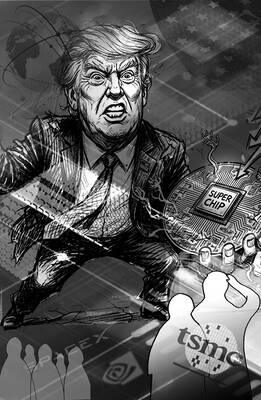
The White House’s decision to take a 9.9 percent stake in Intel Corp is looking like very shrewd business indeed. Since the government bought in at US$20.47 a share last August, the US chipmaker’s surging stock price has delivered the US a US$43 billion return. One of the reasons the investment has so far proved so sound is that the White House has made sure of it. According to The Wall Street Journal, Howard personally pushed deals on Intel’s behalf with some of the most lucrative clients imaginable. They include Nvidia Corp, the company at the heart of the AI
The Ministry of the Interior, working with the navy and coast guard, is organizing Taiwan’s first joint exercise simulating escort tankers carrying liquefied natural gas (LNG) and oil through a Chinese blockade. The drills simulate fuel transport along three maritime corridors leading toward Japan, the Philippines and the US. Deputy Minister of the Interior Sawyer Mars (馬士元) said that a blockade of the Taiwan Strait would amount to “almost a 100 percent blockade of the regional energy supply.” Minister of National Defense Wellington Koo said planning to counter a blockade is standard practice in Taipei. While the exercise is limited in
A single photograph can cut through a lot of noise, but it can also be used to misrepresent the truth. At the very least, it can concentrate the mind on something that requires further investigation. On Monday last week, Ma Ying-jeou Foundation CEO Tai Hsia-ling (戴遐齡) and former National Security Council secretary-general King Pu-tsung (金溥聰) held a news conference in which they showed a photograph of former foundation CEO Hsiao Hsu-tsen (蕭旭岑), now Chinese Nationalist Party (KMT) deputy chairman. In the image Hsiao is seated next to Xiamen Taiwan Businessmen Association chairman Han Ying-huan (韓螢煥). The two men were holding
In a Taiwanese university classroom, a lecturer asks in English: “Can anyone give me an example from Taiwan?” Students look down. No one answers. After class, one student writes on the course platform in Mandarin: “I understood the concept, but I didn’t know how to answer in English.” That moment highlights a key issue in Taiwan’s English-medium instruction (EMI) reform: It is not just about more English-taught courses, but whether students can learn, participate and belong. EMI expansion is part of the Bilingual 2030 policy and the Ministry of Education’s BEST Program, aiming to improve English ability, support EMI teaching


 RSS
RSS