


It has been China’s long-held dream to dethrone King Dollar. Beijing got its first break after Russian President Vladimir Putin invaded Ukraine and Russian lenders were deleted overnight from the system that moves the world’s money. However, back in 2022, the yuan was nowhere close to confronting the hegemon. It would take four more years of preparation — and another war — to make it a contender.
I said in early February that those looking for evidence of the challenge to the US currency in payment flows were searching in the wrong place and that for years to come, de-dollarization would remain hidden in alterations to financial infrastructure.
That was before the US-Israeli war on Iran. A lot has changed in the past six weeks. China is the largest buyer of Iran’s seaborne oil. The price its refineries pay stays in “controlled accounts” at small Chinese banks cut off from dollar trade. These funds are used to pay Chinese contractors or cover imports, an “oil-for-goods” swap, the Atlantic Council said. And now Tehran says that it could accept toll payments from ships crossing the Strait of Hormuz in cryptocurrencies or the yuan.
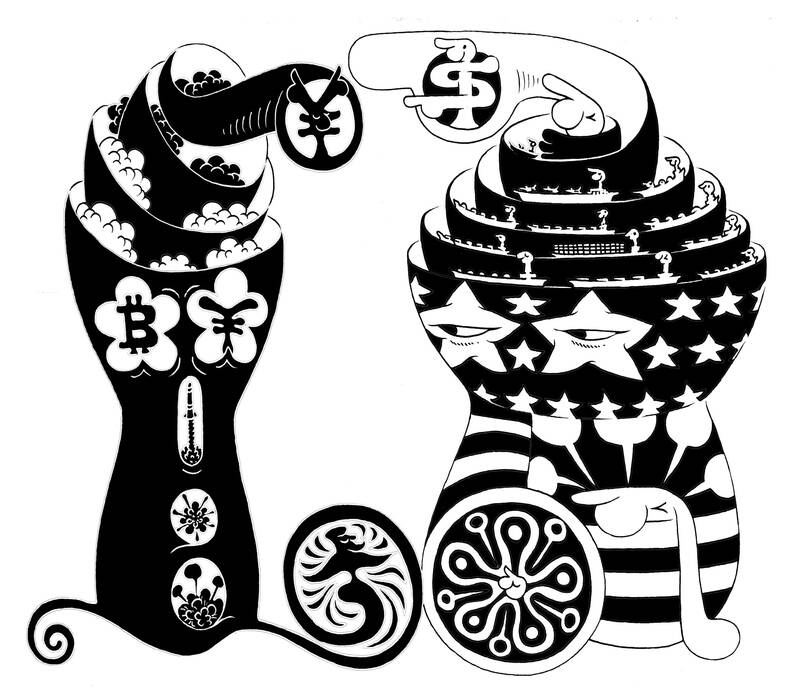
Illustration: Mountain People
THREE-PRONG THREAT
It is a rebellion against US financial hegemony on three fronts simultaneously: the payment currency, the messaging system and the settlement mechanism. Were a peace plan to remove US sanctions against Iran, the greenback might regain some of the trust it has lost. However, China’s currency is not going away. It would simply lie in wait for the next geopolitical crisis.
At about 50 percent of all international payments, the US dollar’s dominance is stark. The yuan’s share, according to the Society for Worldwide Interbank Financial Telecommunication (SWIFT), is just 2.7 percent, lower than in 2024. Yet China is serious about pitching its currency as an alternative. The digital version, e-yuan, moves over the blockchain. The technology integrates messaging, reconciliation and asset transfer into a single, seamless operation, bypassing SWIFT, the panopticon through which the US surveils global financial flows. Project mBridge, a digital platform shared by the central banks of China, Hong Kong, Thailand, the United Arab Emirates (UAE) and Saudi Arabia, has already processed more than US$55 billion in trade, with the e-yuan accounting for 95 percent of the volume.
However, the blockchain is still a small part of how claims get disposed of. Most international transfers gravitate to a New York private institution, the Clearing House Interbank Payments System (CHIPS). Its participants liquidate obligations using pre-funded accounts at the US Federal Reserve. They all maintain US offices and are subject to US law.
Beijing’s discomfort is about that particular. The US Department of Justice built its bank-fraud and wire-fraud case against Huawei Technologies Co chief financial officer Meng Wanzhou (孟晚舟) by finding US dollar transactions routed through CHIPS in New York. In US law, the moment a digit representing a dollar touches a server on US soil for even a millisecond, it grants the US government jurisdiction.
To bypass CHIPS, China has developed its own Cross-Border Interbank Payment System, or CIPS, which clears payments in yuan. Last month, when the Iran war flared up, CIPS handled a record 921 billion yuan (US$135.1 billion) in average daily volumes, nearly a 50 percent jump from the previous month.
INCREMENTAL CHANGE
Although that is a fraction of the US$2.2 trillion that passes through New York, the growth of the alternative network is worth noting. The data showed a remarkable transformation, galvanized by structural and geopolitical shifts. In 2021, CIPS was a quiet utility, averaging roughly 350 billion yuan in daily turnover. By early 2024, it had breached the 600 billion yuan ceiling.
The trigger was Washington’s December 2023 executive order authorizing secondary sanctions on foreign banks facilitating trade for Russia. Fearing a total disconnect from the US dollar, banks in the UAE, Turkey and Central Asia scrambled to migrate their settlement to the yuan. China’s weak domestic economy helped. Disinflation led to lower onshore interest rates just when the cost of borrowing US dollars was rising. That boosted the attractiveness of the Chinese currency in trade financing.
Hong Kong banks have doubled their permissioned access to onshore Chinese liquidity amid strong client demand for yuan-denominated loans. Last year, DBS Group Holdings Ltd’s Singapore unit became an overseas direct participant of CIPS. Banks connecting directly to CIPS using its internal messaging protocol — bypassing SWIFT entirely — have grown by about 40 percent since 2024, reaching 193 institutions. With just 42 members, CHIPS, the New York club, is a lot more elitist.
As analysts Benn Steil and Yuma Schuster said in a Council on Foreign Relations report last month, the decline in the yuan’s share in SWIFT payments data is misleading: It does not mean less usage; it means that trade messages have gone private and become less visible.
Back in 2020, Syracuse University professor Daniel McDowell said that the more the US wields its unmatched financial power, the less it might have left. Subsequent events have proved him right. After all, if payments accompanying 20 percent of the world’s oil and gas can move through a digital pipe that the US Department of the Treasury cannot see, then US dominance of global finance has been handed an expiration date.
Andy Mukherjee is a Bloomberg Opinion columnist covering industrial companies and financial services in Asia. Previously, he worked for Reuters, the Straits Times and Bloomberg News. This column reflects the personal views of the author and does not necessarily reflect the opinion of the editorial board or Bloomberg LP and its owners.
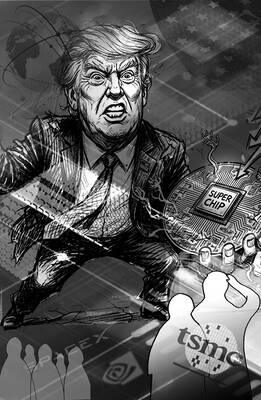
The White House’s decision to take a 9.9 percent stake in Intel Corp is looking like very shrewd business indeed. Since the government bought in at US$20.47 a share last August, the US chipmaker’s surging stock price has delivered the US a US$43 billion return. One of the reasons the investment has so far proved so sound is that the White House has made sure of it. According to The Wall Street Journal, Howard personally pushed deals on Intel’s behalf with some of the most lucrative clients imaginable. They include Nvidia Corp, the company at the heart of the AI
The Ministry of the Interior, working with the navy and coast guard, is organizing Taiwan’s first joint exercise simulating escort tankers carrying liquefied natural gas (LNG) and oil through a Chinese blockade. The drills simulate fuel transport along three maritime corridors leading toward Japan, the Philippines and the US. Deputy Minister of the Interior Sawyer Mars (馬士元) said that a blockade of the Taiwan Strait would amount to “almost a 100 percent blockade of the regional energy supply.” Minister of National Defense Wellington Koo said planning to counter a blockade is standard practice in Taipei. While the exercise is limited in
A single photograph can cut through a lot of noise, but it can also be used to misrepresent the truth. At the very least, it can concentrate the mind on something that requires further investigation. On Monday last week, Ma Ying-jeou Foundation CEO Tai Hsia-ling (戴遐齡) and former National Security Council secretary-general King Pu-tsung (金溥聰) held a news conference in which they showed a photograph of former foundation CEO Hsiao Hsu-tsen (蕭旭岑), now Chinese Nationalist Party (KMT) deputy chairman. In the image Hsiao is seated next to Xiamen Taiwan Businessmen Association chairman Han Ying-huan (韓螢煥). The two men were holding
In a Taiwanese university classroom, a lecturer asks in English: “Can anyone give me an example from Taiwan?” Students look down. No one answers. After class, one student writes on the course platform in Mandarin: “I understood the concept, but I didn’t know how to answer in English.” That moment highlights a key issue in Taiwan’s English-medium instruction (EMI) reform: It is not just about more English-taught courses, but whether students can learn, participate and belong. EMI expansion is part of the Bilingual 2030 policy and the Ministry of Education’s BEST Program, aiming to improve English ability, support EMI teaching


 RSS
RSS