


The Taiwan People’s Party (TPP) on Monday expelled China-born legislator-at-large Li Zhenxiu (李貞秀), stripping her of her seat in the legislature. TPP Chairman Huang Kuo-chang (黃國昌) has distanced himself from any responsibility over the matter, choosing simply to say that Li did not meet the standards required of a legislator-at-large. The question then naturally arises: Why was someone so far below the mark ever allowed into the nation’s highest representative body, thereby undermining overall legislative competence, in the first place?
Most likely is that her nomination was a bad-faith attempt to drum up votes from Chinese spouses for TPP founder Ko Wen-je’s (柯文哲) presidential run, to which end the TPP and the Chinese Communist Party (CCP) had their own agendas. Going back even further, the TPP’s special two-year clause for legislators-at-large introduced in 2024 had already sowed the seeds for a structural crisis.
Smaller parties typically struggle to win many party list-votes, leaving them with a surplus of candidates and a shortage of seats. By splitting the four-year legislative term in half, the TPP has been funneling two would-be legislators through a single seat as a way to supposedly amplify impact and cultivate political talent.
However, the downsides of this approach have become apparent well before any benefits. The legislature, after all, is not a cram school, and it is obvious to the public when green legislators are rushed into office. Being forced to make sense of their environment and learn on the fly, these legislators struggle to leave their mark or make any significant progress in their shortened two-year tenures.
Legislative work is extremely complex. From policy interpolation and budget reviews to voting for personnel appointments, mastering legislative rules of procedure and party negotiation tactics requires years of experience. In particular, participation in standing committees requires a level of professional maturity that cannot be achieved overnight, but must be accrued bit by bit.
Of the seven TPP legislators who stepped down in late January, most had only previously held positions as local representatives. Those who were not total newcomers to the legislature were, by and large, still novices, accustomed to hearing the crack of the party whip under the prevailing blue-white cooperation strategy.
Meanwhile, voters struggle to recall them or their legislative achievements. At most, all that comes to mind are unsavory incidents where a legislator is prosecuted for hurling insults at the head of state, or the more spectacularly incoherent questioning sessions. Even those coming from academic backgrounds in political science have become subject to ridicule.
Most absurd is that these legislators are unable to translate their fleeting tenures into even an ounce of personal or party political capital.
The idea of a two-year clause is not unique to the TPP: The Taiwan Solidarity Union implemented a similar policy as early as in 2012, with poor results. Something perhaps can be learnt from the party’s subsequent decline, with it failing to surpass the 5 percent threshold for party-list seats ever since. In reality, the two-year clause simply works to allow unqualified people to fill positions while crowding out genuinely capable talent — if any exists.
Having gone down this track, the TPP is suffering the consequences. Its public support has fallen to its lowest point in nearly three years. Even Li’s expulsion might not be enough to prevent its slide toward political irrelevance.
Chen Yung-chang is a freelance writer based in Taipei.
Translated by Gilda Knox Streader
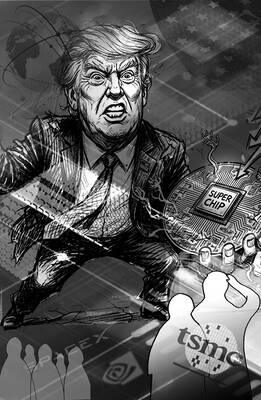
The White House’s decision to take a 9.9 percent stake in Intel Corp is looking like very shrewd business indeed. Since the government bought in at US$20.47 a share last August, the US chipmaker’s surging stock price has delivered the US a US$43 billion return. One of the reasons the investment has so far proved so sound is that the White House has made sure of it. According to The Wall Street Journal, Howard personally pushed deals on Intel’s behalf with some of the most lucrative clients imaginable. They include Nvidia Corp, the company at the heart of the AI
In a Taiwanese university classroom, a lecturer asks in English: “Can anyone give me an example from Taiwan?” Students look down. No one answers. After class, one student writes on the course platform in Mandarin: “I understood the concept, but I didn’t know how to answer in English.” That moment highlights a key issue in Taiwan’s English-medium instruction (EMI) reform: It is not just about more English-taught courses, but whether students can learn, participate and belong. EMI expansion is part of the Bilingual 2030 policy and the Ministry of Education’s BEST Program, aiming to improve English ability, support EMI teaching
The Ministry of the Interior, working with the navy and coast guard, is organizing Taiwan’s first joint exercise simulating escort tankers carrying liquefied natural gas (LNG) and oil through a Chinese blockade. The drills simulate fuel transport along three maritime corridors leading toward Japan, the Philippines and the US. Deputy Minister of the Interior Sawyer Mars (馬士元) said that a blockade of the Taiwan Strait would amount to “almost a 100 percent blockade of the regional energy supply.” Minister of National Defense Wellington Koo said planning to counter a blockade is standard practice in Taipei. While the exercise is limited in
A single photograph can cut through a lot of noise, but it can also be used to misrepresent the truth. At the very least, it can concentrate the mind on something that requires further investigation. On Monday last week, Ma Ying-jeou Foundation CEO Tai Hsia-ling (戴遐齡) and former National Security Council secretary-general King Pu-tsung (金溥聰) held a news conference in which they showed a photograph of former foundation CEO Hsiao Hsu-tsen (蕭旭岑), now Chinese Nationalist Party (KMT) deputy chairman. In the image Hsiao is seated next to Xiamen Taiwan Businessmen Association chairman Han Ying-huan (韓螢煥). The two men were holding


 RSS
RSS