


The opposition’s decisive victory over Hungarian Prime Minister Viktor Orban’s ruling Fidesz party has been greeted with relief across the democratic world. Armed with a constitutional majority, the center-right Tisza party and its leader, Peter Magyar, are now poised to dismantle Orban’s 16-year grip on state institutions.
However, what will be harder is confronting the public demand for illiberal rule that sustained it.
Tisza’s success shows that even a highly entrenched regime can be defeated at the polls, despite institutional capture, media dominance and electoral engineering.
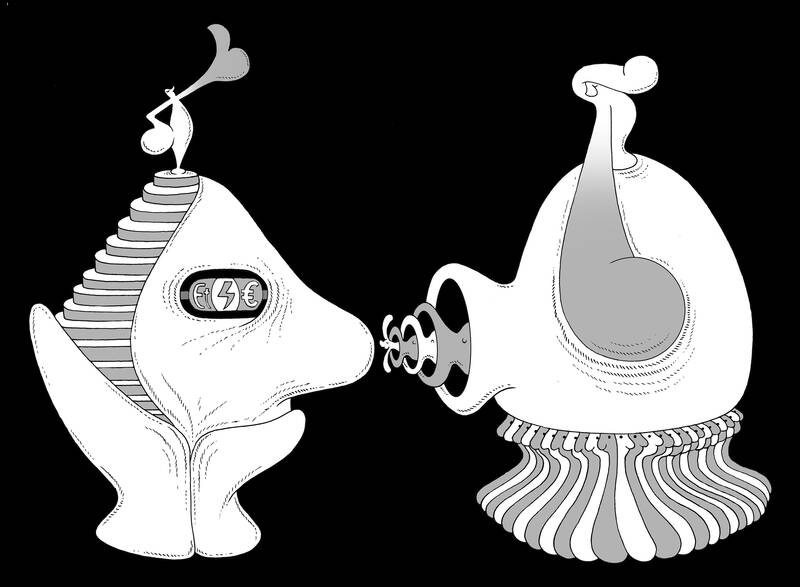
Illustration: Mountain People
This matters because Orban’s Hungary has long been more than a national story. It provided proof of concept for the global new right, demonstrating that a politics opposed to human rights and equality is viable in the West.
Orban was unusually explicit about this ambition. Educated at the University of Oxford on a scholarship funded by George Soros, he turned against the liberal order with a clarity and consistency that few of his counterparts could match. It is no coincidence that new-right figures like US Vice President J.D. Vance, who visited Hungary just days before the election to campaign for Orban, have drawn intellectual and political inspiration from his rule.
Magyar now enters office with the institutional advantages that once sustained Orban’s rule. Hungary’s majoritarian electoral law gives a significant advantage to the largest party. For years, Western observers rightly criticized this system. Tisza should now be credited for using the system to its advantage. By consolidating virtually all support across the opposition spectrum, it secured roughly 53 percent of the vote — nearly matching Orban’s result four years ago — and translated that into a constitutional supermajority.
Orban’s swift concession and personal congratulations to Magyar suggest that fears of institutional obstruction in the transition of power might not materialize. Taken together, these developments represent a genuine victory for European democracy.
However, the danger is once again to declare “the end of history.” Hungary’s illiberal system endured for 16 years not only because of brinkmanship and repression, but also because it met a durable social demand — for xenophobia, hierarchy and a politics of division.
That demand has not disappeared. By most conventional policy measures, Orban’s record has long been disastrous, with the economy lagging and public services in disarray, but Hungarian voters elected him four times. Even now, in defeat, Fidesz and Our Homeland Movement, a more extreme far-right party, command the loyalty of about 43 percent of the electorate. This is hardly a fringe.
There is ample experience of liberal governments returning to power after new-right rule, from former US president Joe Biden to former British prime minister Keir Starmer and Brazilian President Luiz Inacio Lula da Silva. In none of those cases did electoral victory produce systemic catharsis. Swing voters changed sides, but the core electorate that sustained these regimes did not.
Nowhere is this clearer than in Poland. In 2023, after two terms of new-right rule, the broad coalition led by Polish Prime Minister Donald Tusk won a result marginally stronger than Tisza’s. Yet this did not produce a lasting political realignment. Less than two years later, Poles elected hard-right Karol Nawrocki as the country’s semi-executive president. Electoral victory changed the government — but not the electorate.
Faced with that reality, Tusk adjusted. His government has shifted rightward on issues such as immigration and LGBTQ+ rights. Magyar is already decidedly following the same path. A longtime Fidesz insider, he has never been a committed liberal. Determined to defeat Orban, liberal and left-wing voters showed unprecedented discipline by rallying behind Tisza, leaving their own parties without representation in the new parliament. As a result, much of Orban’s conservative policy agenda might continue.
This political calculus need not constrain liberal actors outside government, including civil-society groups, academics, educators and journalists. As illiberal democracy endured because of popular demand, its defeat will require confronting that demand directly. Liberals must treat Hungary not as a system to repair, but as a society to persuade.
The current disillusion with Orban creates a rare opening. Domestic and international experts can help a post-Orban government deliver tangible gains, including better schools, more reliable healthcare and a less corrupt state, but liberals should not fall into the trap of regarding such improvements as “non-political” and expecting them to speak for themselves. They must be framed and defended as the product of an open society — one that can deliver effective government, and a broader sense of dignity and social cohesion.
Hungary stands to gain politically and economically from moving closer to countries like Switzerland and the Netherlands. Those societies accommodate their more conservative elements while remaining open and globally engaged. It makes far more sense for Hungary to embrace such a model, rather than the authoritarian playbook of Russia or Turkey.
Reversing a decade and a half of normative change will not be easy, but unless addressed head-on, the myths, resentments and paranoia fueling Orban’s brand of illiberalism will remain intact and available to be reactivated.
Maciej Kisilowski, an associate professor of law and strategy at Central European University, is a 2025-2026 Europe’s Future Fellow at the Institut fur die Wissenschaften vom Menschen.
Copyright: Project Syndicate

The White House’s decision to take a 9.9 percent stake in Intel Corp is looking like very shrewd business indeed. Since the government bought in at US$20.47 a share last August, the US chipmaker’s surging stock price has delivered the US a US$43 billion return. One of the reasons the investment has so far proved so sound is that the White House has made sure of it. According to The Wall Street Journal, Howard personally pushed deals on Intel’s behalf with some of the most lucrative clients imaginable. They include Nvidia Corp, the company at the heart of the AI

KMT Chairwoman Cheng Li-wun’s (鄭麗文) recent visit to Beijing and her upcoming visit to Washington will serve as a high-level test of her diplomatic mettle. In Beijing, Cheng was received with symbolic gestures, a warm reception, and high-level access. In Washington, she will receive far less pomp and far sharper questions about the KMT’s vision for the future of Taiwan. Her challenge will be to persuade Washington that the KMT’s engagement with China can coexist with strong deterrence. Cheng’s April 7-12 visit to mainland China coincided with an intense period of conflict in Iran. Despite the strategic significance of Cheng’s trip,

The closure of the Strait of Hormuz has sent the vast Asian chemicals industry into a tailspin. Deprived of the likes of Qatari natural gas and Saudi Arabian oil, the region’s fertilizer and plastics plants are slowing production or even shutting down. Everywhere except China, that is. In petrochemicals, China is unique. As well as a traditional industry that uses oil and gas as feedstock, it has parallel output that relies on its abundant domestic coal. Unsurprisingly, India and other regional powers want to copy and paste the Chinese method. This would not be easy — or climate friendly. The
Indonesian President Prabowo Subianto says he knows how to fix the problems facing Indonesia. Yet his economic mismanagement and authoritarian tendencies are steering the nation toward a familiar mix of currency instability and political chaos. The world’s fourth-most populous nation risks reversing the hard-won democratic and business reforms that came after the Asian Financial Crisis in 1997. At that time, the rupiah collapsed and the political upheaval that followed forced former president Haji Mohamed Suharto from power. Prabowo’s administration is ignoring similar warning signs. That disconnect was apparent in a national address on Wednesday, when Prabowo projected the swagger that has


 RSS
RSS