


Following last week’s meeting between Chinese Nationalist Party (KMT) Chairwoman Cheng Li-wun (鄭麗文) and Chinese President Xi Jinping (習近平), the Chinese Communist Party (CCP) announced 10 incentive measures for Taiwan, including imports of agricultural, fishery and food products, but tied them to the political preconditions of accepting the so-called “1992 consensus” and opposing Taiwanese independence.
That design clearly goes beyond the scope of normal economic and trade arrangements, and should be identified as a conditional market access mechanism, the essence of which is the exchange of economic benefits for a specific political stance.
When export eligibility comes at the cost of a political commitment, the so-called “benefits” for Taiwan not only erode the legal principles of free trade, but constitute economic coercion. Further examination of the CCP’s operational logic makes it clear that its policies toward Taiwan’s agricultural and fishery products are not grounded in risk management, but are highly selective and politically driven tools of its “united front” operations.
Such measures — beginning in 2021 with China’s suspension of imports of Taiwanese pineapples on administrative grounds, followed by the 2022 suspension of imports on Taiwanese citrus fruits and extending to the successive exclusion of Taiwan-grown custard apples, wax apples and some processed food products — exhibit three consistent characteristics:
First, they failed to provide a designated period for improvement or opportunities for technical consultation in accordance with international practices; second, their inspection standards lacked consistency and predictability; and third, the timing of the decisions corresponded with developments in cross-strait political interactions.
China went even further in 2024, directly revoking preferential tariffs for Taiwanese imports, blaming Taiwan’s “refusal to acknowledge the 1992 consensus” and claiming that the administration of President William Lai (賴清德) had “blatantly spread fallacies to promote Taiwanese independence and separatism, and incited division and economic decoupling across the Taiwan Strait” — effectively escalating trade measures into political sanctions.
Following the recent political interactions, China has restored the preferential measures. Taken together, the developments are sufficient to conclude that the goal of the measures is not food safety management, but to use market access as a means of political pressure.
The effects on Taiwan’s farmers and fishers should not be viewed solely in terms of short-term price fluctuations, but rather as a structural risk. When market access lacks predictability, production decisions lose their basis and investment risks are improperly shifted onto the production end. In other words, farmers are not bearing competitive risks under normal market mechanisms, but are instead passively suffering losses caused by political uncertainty.
More importantly, Taiwan’s agricultural and fishery sectors have demonstrated through tangible results that such a structure of dependency is unnecessary. As exports have shifted toward mature markets such as Japan, South Korea, the US and Canada, not only has overall exports reached new highs, but reliance on the Chinese market has significantly declined. Taiwan’s policy choices for its agricultural and fishery sectors must not return to the old path of dependence on a single market, but should instead deepen a diversified and predictable market strategy.
Market openings that come with political preconditions constitute a high-risk source — not a genuine benefit.
Yeh Yu-cheng is a secretary at the Pingtung County Public Health Bureau.
Translated by Kyra Gustavsen
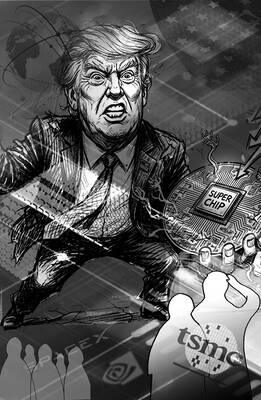
The White House’s decision to take a 9.9 percent stake in Intel Corp is looking like very shrewd business indeed. Since the government bought in at US$20.47 a share last August, the US chipmaker’s surging stock price has delivered the US a US$43 billion return. One of the reasons the investment has so far proved so sound is that the White House has made sure of it. According to The Wall Street Journal, Howard personally pushed deals on Intel’s behalf with some of the most lucrative clients imaginable. They include Nvidia Corp, the company at the heart of the AI
The Ministry of the Interior, working with the navy and coast guard, is organizing Taiwan’s first joint exercise simulating escort tankers carrying liquefied natural gas (LNG) and oil through a Chinese blockade. The drills simulate fuel transport along three maritime corridors leading toward Japan, the Philippines and the US. Deputy Minister of the Interior Sawyer Mars (馬士元) said that a blockade of the Taiwan Strait would amount to “almost a 100 percent blockade of the regional energy supply.” Minister of National Defense Wellington Koo said planning to counter a blockade is standard practice in Taipei. While the exercise is limited in
A single photograph can cut through a lot of noise, but it can also be used to misrepresent the truth. At the very least, it can concentrate the mind on something that requires further investigation. On Monday last week, Ma Ying-jeou Foundation CEO Tai Hsia-ling (戴遐齡) and former National Security Council secretary-general King Pu-tsung (金溥聰) held a news conference in which they showed a photograph of former foundation CEO Hsiao Hsu-tsen (蕭旭岑), now Chinese Nationalist Party (KMT) deputy chairman. In the image Hsiao is seated next to Xiamen Taiwan Businessmen Association chairman Han Ying-huan (韓螢煥). The two men were holding
In a Taiwanese university classroom, a lecturer asks in English: “Can anyone give me an example from Taiwan?” Students look down. No one answers. After class, one student writes on the course platform in Mandarin: “I understood the concept, but I didn’t know how to answer in English.” That moment highlights a key issue in Taiwan’s English-medium instruction (EMI) reform: It is not just about more English-taught courses, but whether students can learn, participate and belong. EMI expansion is part of the Bilingual 2030 policy and the Ministry of Education’s BEST Program, aiming to improve English ability, support EMI teaching


 RSS
RSS