


Recent energy crises, particularly the war in Iran, have exposed how vulnerable many countries are to conflict, disruption and coercion. Not surprisingly, governments worldwide are scrambling to reassess their energy-diversification and transition strategies.
The strategic logic is straightforward. The less a country depends on imported oil and gas moving through chokepoints like the Strait of Hormuz, the more secure it becomes. Last year, about 34 percent of global trade in crude oil passed through the strait (with China and India alone accounting for 44 percent of that flow), along with roughly one-fifth of the world’s liquefied natural gas exports.
However, contrary to popular belief, the clean-energy transition would not eliminate geopolitical risk, but rather redistribute it. While a world powered by renewables, batteries and clean electricity would rely less on tanker routes and fossil-fuel exporters, it would depend on critical minerals, processing chains, technical standards, grid equipment and transmission networks. That raises its own vulnerabilities.
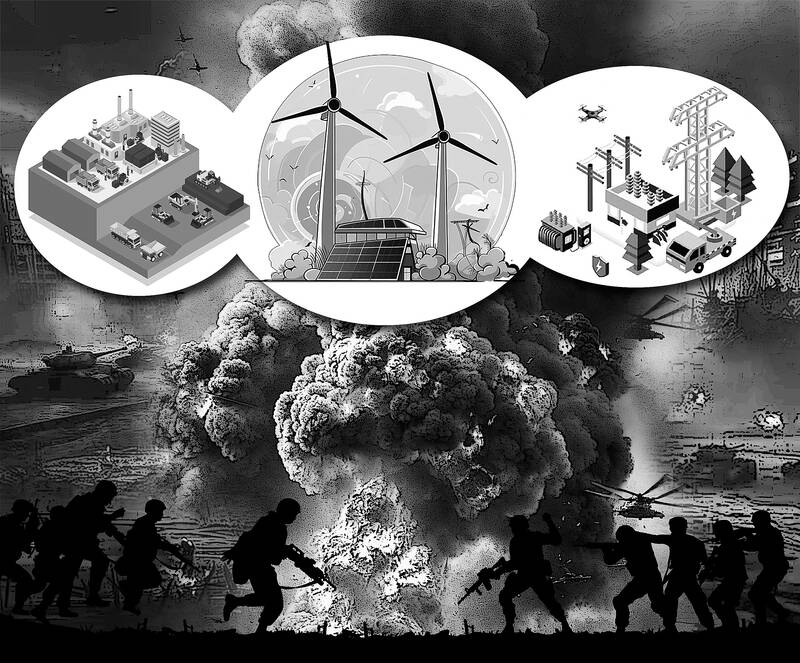
Illustration: Constance Chou
Three stand out: the concentration of critical-mineral refining and processing, the growing fragmentation of trade and standards, and the fragility of existing power grids. Together, these vulnerabilities make clear that the energy transition is not just a climate or industrial project. Above all, it is a coordination challenge, and great-power rivalries are making it harder to achieve.
Raw materials are a case in point. While much of the public debate focuses on control over mineral reserves, the real chokepoint lies further downstream. The average market share of the top three mineral-refining countries rose from about 82 percent in 2020 to 86 percent in 2024, with supply growth concentrated in a handful of dominant suppliers: Indonesia for nickel and China for cobalt, graphite, and rare earths.
This is the clean-energy equivalent of the Strait of Hormuz. The strategic bottleneck is not in mining itself, but in the later stages of production: refining hubs, chemical plants, rare-earth separation facilities and export-control regimes. When tensions rise in countries supplying lithium, cobalt, nickel, graphite or rare earths — or when major powers restrict certain exports — the effects ripple through a wide range of industries, including batteries, electric vehicles (EVs), wind turbines and grid infrastructure.
The imbalance is structural, not cyclical, as refining is expected to remain highly concentrated well into the next decade. By 2035, China is projected to supply more than 60 percent of refined lithium and cobalt, and around 80 percent of battery-grade graphite and rare-earth elements. Rapid demand growth intensifies the risk: Lithium demand rose by nearly 30 percent in 2024, while demand for nickel, cobalt, graphite and rare earths grew by about 6 to 8 percent.
The US has responded with a multi-layered strategy that includes launching the Forum on Resource Geostrategic Engagement, an international effort to ensure a reliable supply of critical minerals for the US and its allies; devising a joint mineral action plan with Japan; and pushing for a new trade bloc involving dozens of countries to counter China’s mineral dominance (among other measures).
Yet, restrictions on processing equipment, technical expertise and intermediate products continue to impede progress. These constraints are largely geopolitical: China has imposed export controls on rare-earth materials, processing technologies and technical expertise, while the US and its allies have restricted access to advanced manufacturing equipment and related technologies. Together, these reciprocal controls have fragmented supply chains and slowed diversification.
That helps explain why diversification remains costly and politically fraught. To reduce dependence on Chinese imports, the US and its allies have turned to industrial policy, long-term offtake agreements, government-backed financing and tighter coordination. However, building a supply chain that does not rely on China requires a wide range of processing capabilities, along with sustained price support until commercial viability is achieved.
At its core, this is a problem of industrial capacity. Abundant resources alone are not enough. What matters is the time, capital and coordination needed to build an integrated system around them, especially in the face of a dominant incumbent with deep industrial networks and formidable pricing power.
The absence of common standards is another source of vulnerability. Clean-energy technologies do not spread globally simply because they exist or become cheaper. They scale only when markets can recognize, certify, finance, insure and connect them across borders. Fragmented and incompatible standards, contested certification systems, local-content requirements and shifting industrial-policy regimes all act as barriers to coordination.
Moreover, the clean-energy economy is inherently transnational. A battery might depend on minerals mined in one country, processed in another, used for assembly in a third, financed in a fourth and subsidized in a fifth. Similarly, a wind turbine must often satisfy multiple technical and regulatory requirements before it can be financed, shipped, installed and connected.
When interoperability breaks down, diffusion slows sharply. Technologies might be available and even cost-competitive, yet still fail to scale across markets. Under stable geopolitical conditions, these frictions can be managed through technical harmonization and mutual recognition. In times of heightened geopolitical tensions, they become instruments of economic statecraft, enabling governments to undermine competitors through certification rules, subsidy design, local-content provisions, procurement preferences and export restrictions.
As a result, clean technologies risk fragmenting along geopolitical lines rather than scaling globally. Such an outcome would impose disproportionate costs on middle-income and developing countries, which are least able to absorb duplicated compliance systems and forced technological alignment.
Because clean power is only as useful as the networks that deliver it, fragile grids and infrastructure pose a growing strategic risk. Whereas the fossil-fuel system depends on tankers, ports and pipelines, the clean-energy system depends on well-integrated transmission lines, transformers and cross-border interconnectors.
Here, the gap between ambition and capacity is most acute. To meet global climate targets, grid investment must increase 50 percent to US$600 billion a year by 2030, but outlays have stagnated, even as investment in generation has surged. In emerging and developing economies outside China, grid investment has declined, despite robust demand and rising energy-access needs.
Europe’s experience offers a cautionary tale. The EU has spent years promoting electricity-market integration as a pillar of energy security, competitiveness and decarbonization, yet many member states are not on track to meet the bloc’s 2030 target of connecting 15 percent of domestic generation across borders. Translating regional initiatives into national action has proved difficult. Permitting is slow, and cost allocation is politically contentious. Infrastructure often delivers regional benefits while imposing environmental and political costs on local communities, fueling public resistance. Grid planning remains fragmented, and network operators’ incentives are not always aligned.
At the same time, aging infrastructure is colliding with growing demand from EVs, heat pumps, data centers and renewables. About half of Europe’s transmission lines are at least 40 years old, requiring more than US$2 trillion in upgrades by mid-century to prevent large-scale failures.
The Iberian Peninsula illustrates the scale of the challenge. Spain and Portugal remain poorly connected to the rest of Europe, with interconnection levels well below the EU’s stated goals. Major projects, such as the Bay of Biscay interconnector, would take years to complete.
Europe’s experience points to a broader lesson: It is far easier to set renewable targets than to build the cross-border networks needed to achieve them. While the technical case for interconnection has long been clear, the political and administrative capacity to facilitate it has failed to keep pace.
The ASEAN Power Grid, a collaborative effort aimed at connecting Southeast Asia’s electricity networks by 2045, brings these challenges into sharp focus. Often framed as a future-looking integration project, it is effectively a test of whether clean-energy interdependence can work in a region with diverse political systems, uneven regulatory capacity and fragmented power markets.
Few doubt the strategic logic. Regional transmission and cross-border electricity trading are essential to integrating renewables, improving resilience and lowering costs, but progress has been slow, with only half of the 18 planned interconnection projects completed and operational.
The main obstacles are not technological but institutional and financial. ASEAN still lacks common technical standards, transparent trading rules, workable pricing arrangements, clear rules for allocating grid capacity, reliable dispute-resolution frameworks and the legal frameworks needed for regional investment. Trust is also a major constraint, as interconnection depends on confidence that rules would hold across jurisdictions over time.
Geopolitical shifts add another layer of uncertainty. When US President Donald Trump and Chinese President Xi Jinping (習近平) meet next month, rare earths and industrial leverage would likely be at the top of their agenda. Tensions have intensified in recent months as the US has sought to offset China’s dominance in mineral processing by securing access to oil from Venezuela and, to a lesser extent, sanctioned Iranian and Russian producers.
Venezuela, which holds about 303 billion barrels of proven reserves — about 17 percent of the global total — is central to this effort. Following the capture of former president Nicolas Maduro in January, the Trump administration has moved to reopen the country’s energy sector, authorizing transactions with the state oil company PDVSA, and easing sanctions to allow major firms to resume operations and negotiate new investments.
The US has also shown flexibility in its use of sanctions, especially after the outbreak of the war in Iran and the resulting surge in oil prices. In an effort to curb market volatility, for example, the Trump administration has waived sanctions on purchases of Iranian and Russian oil already at sea for 30 days.
This flexibility gives the US some leverage over China. By boosting Venezuelan output and selectively easing pressure on Iranian or Russian exporters, the US can curb price spikes, contain inflation and reduce industrial-cost pressures that would otherwise impede reindustrialization. Because China remains a major oil importer, these measures could also factor into negotiations over rare-earth access, export controls and magnet shipments.
However, buying time is not the same as solving the problem. Additional oil supply cannot substitute for rare-earth separation, metal refining, alloy and magnet production, or diversified mineral-processing capacity outside China. At best, it provides the US and its partners macroeconomic breathing room while they expand these capabilities. True energy resilience requires building a new industrial ecosystem from the ground up, not doubling down on oil.
The broader lesson is that policymakers can no longer treat the clean-energy transition and energy security as separate agendas. To integrate, they should focus on five priorities:
First, governments must accelerate diversification efforts. This means reducing exposure to chokepoints like the Strait of Hormuz and diversifying the entire supply chain, including refining, processing, manufacturing and logistics. Diversification is no longer just about having more fuel suppliers; it now means reducing dependence on midstream and infrastructure bottlenecks.
Second, markets remain indispensable, but private firms alone cannot be relied upon to deliver energy resilience amid geopolitical upheavals. Governments would have to play a larger role in mobilizing private capital by leveraging strategic procurement, storage, stockpiling, domestic-capability development, supply-chain diversification and risk-sharing.
Third, countries must take steps to accelerate the adoption of EVs, not only for climate reasons, but also to reduce dependence on oil exporters. Electrified transport minimizes direct exposure to maritime fuel chokepoints and price volatility, even as it increases reliance on minerals and batteries.
Fourth, governments should expand nuclear power where politically and institutionally feasible. Nuclear energy can reduce dependence on imported hydrocarbons and provide stable low-carbon electricity alongside renewables. It might also become a new arena of geopolitical competition, with governments vying for control over reactor technologies, fuel-cycle services and uranium enrichment.
Above all, policymakers must confront the geopolitical realities of today’s emerging energy systems. The clean-energy transition is often framed as an escape from geopolitics, and in one sense, it is: A less oil-dependent world would be less vulnerable to maritime chokepoints and petrostate coercion.
However, escaping one form of geopolitical vulnerability does not eliminate geopolitics. Processed minerals, industrial ecosystems, standards regimes and electricity infrastructure are just as politically fraught as the Strait of Hormuz. There is still time to avoid repeating the mistakes of the fossil-fuel era, but the window will not be open for long.
Dianne Araral is an independent green finance and energy-policy analyst in Singapore. Eduardo Araral is professor of public policy at the National University of Singapore’s Lee Kuan Yew School of Public Policy.
Copyright: Project Syndicate

The White House’s decision to take a 9.9 percent stake in Intel Corp is looking like very shrewd business indeed. Since the government bought in at US$20.47 a share last August, the US chipmaker’s surging stock price has delivered the US a US$43 billion return. One of the reasons the investment has so far proved so sound is that the White House has made sure of it. According to The Wall Street Journal, Howard personally pushed deals on Intel’s behalf with some of the most lucrative clients imaginable. They include Nvidia Corp, the company at the heart of the AI
The Ministry of the Interior, working with the navy and coast guard, is organizing Taiwan’s first joint exercise simulating escort tankers carrying liquefied natural gas (LNG) and oil through a Chinese blockade. The drills simulate fuel transport along three maritime corridors leading toward Japan, the Philippines and the US. Deputy Minister of the Interior Sawyer Mars (馬士元) said that a blockade of the Taiwan Strait would amount to “almost a 100 percent blockade of the regional energy supply.” Minister of National Defense Wellington Koo said planning to counter a blockade is standard practice in Taipei. While the exercise is limited in
A single photograph can cut through a lot of noise, but it can also be used to misrepresent the truth. At the very least, it can concentrate the mind on something that requires further investigation. On Monday last week, Ma Ying-jeou Foundation CEO Tai Hsia-ling (戴遐齡) and former National Security Council secretary-general King Pu-tsung (金溥聰) held a news conference in which they showed a photograph of former foundation CEO Hsiao Hsu-tsen (蕭旭岑), now Chinese Nationalist Party (KMT) deputy chairman. In the image Hsiao is seated next to Xiamen Taiwan Businessmen Association chairman Han Ying-huan (韓螢煥). The two men were holding
In a Taiwanese university classroom, a lecturer asks in English: “Can anyone give me an example from Taiwan?” Students look down. No one answers. After class, one student writes on the course platform in Mandarin: “I understood the concept, but I didn’t know how to answer in English.” That moment highlights a key issue in Taiwan’s English-medium instruction (EMI) reform: It is not just about more English-taught courses, but whether students can learn, participate and belong. EMI expansion is part of the Bilingual 2030 policy and the Ministry of Education’s BEST Program, aiming to improve English ability, support EMI teaching


 RSS
RSS