


By declaring that it would not be recommending candidates and effectively blocking appointments to the Control Yuan, the Chinese Nationalist Party (KMT) is attacking Taiwan’s institutions.
At first glance, this appears to be an expression of dissatisfaction with the Control Yuan’s long-standing shortcomings. In practice, it is the leveraging of institutional disputes to push the supervisory authority toward a breaking point.
The nomination process for a new term of Control Yuan members is already underway, with the six-year terms of current members set to expire on July 31. Taking this approach now is not an attempt at reform but a move that could cripple the constitutional body, with the resulting dysfunction only to be later blamed on the institution itself. Whether the Control Yuan should be reformed is, of course, open to debate. From its nomination mechanisms and allocation of powers to its controversies over the past few years, there is plenty of room for review.
If genuine reform is the goal, the proper course would be constitutional amendment, legal revision and the reorganization of its powers. It should not involve taking the existing constitutional framework, blocking the appointment of personnel and framing the resulting paralysis as a necessary, principled stance.
One might openly advocate for the body’s abolition or indeed oppose specific nominees through the Legislative Yuan’s confirmation powers, but one cannot reframe neglect as reform or make procedural obstruction appear to be politically principled.
Constitutional Interpretation No. 632 makes it clear that the President should make timely nominations and the Legislative Yuan should likewise exercise its confirmation powers to ensure the normal functioning of the Control Yuan. In other words, individual nominees might be rejected, but the overall process must not be brought to a halt; decisions can be made within the system, but one cannot first weaken the system and then criticize it for being ineffective. To do so would not be oversight but political maneuvering under the guise of constitutional responsibility.
It should also be noted that the Control Yuan is not entirely without practical function. During its current sixth and final term, members issued 481 corrective measures, impeached 205 individuals and received 82,182 public petitions. This might not fully vindicate the institution but it does demonstrate that the Control Yuan is not an entirely useless or symbolic body.
A responsible opposition party should lay its reform proposals on the table and clearly explain how to adjust supervisory powers, redistribute responsibilities and manage the transition.
The KMT’s approach of blocking personnel to damage the institution is, ultimately, not about reforming the Control Yuan but about turning supervisory power into a political tool to the detriment of the nation’s constitutional order.
Steve Ho is a retired engineer.
Translated by Gilda Knox Streader
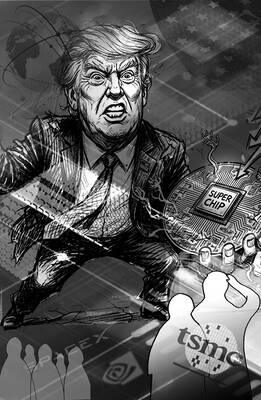
The White House’s decision to take a 9.9 percent stake in Intel Corp is looking like very shrewd business indeed. Since the government bought in at US$20.47 a share last August, the US chipmaker’s surging stock price has delivered the US a US$43 billion return. One of the reasons the investment has so far proved so sound is that the White House has made sure of it. According to The Wall Street Journal, Howard personally pushed deals on Intel’s behalf with some of the most lucrative clients imaginable. They include Nvidia Corp, the company at the heart of the AI
The Ministry of the Interior, working with the navy and coast guard, is organizing Taiwan’s first joint exercise simulating escort tankers carrying liquefied natural gas (LNG) and oil through a Chinese blockade. The drills simulate fuel transport along three maritime corridors leading toward Japan, the Philippines and the US. Deputy Minister of the Interior Sawyer Mars (馬士元) said that a blockade of the Taiwan Strait would amount to “almost a 100 percent blockade of the regional energy supply.” Minister of National Defense Wellington Koo said planning to counter a blockade is standard practice in Taipei. While the exercise is limited in
A single photograph can cut through a lot of noise, but it can also be used to misrepresent the truth. At the very least, it can concentrate the mind on something that requires further investigation. On Monday last week, Ma Ying-jeou Foundation CEO Tai Hsia-ling (戴遐齡) and former National Security Council secretary-general King Pu-tsung (金溥聰) held a news conference in which they showed a photograph of former foundation CEO Hsiao Hsu-tsen (蕭旭岑), now Chinese Nationalist Party (KMT) deputy chairman. In the image Hsiao is seated next to Xiamen Taiwan Businessmen Association chairman Han Ying-huan (韓螢煥). The two men were holding
In a Taiwanese university classroom, a lecturer asks in English: “Can anyone give me an example from Taiwan?” Students look down. No one answers. After class, one student writes on the course platform in Mandarin: “I understood the concept, but I didn’t know how to answer in English.” That moment highlights a key issue in Taiwan’s English-medium instruction (EMI) reform: It is not just about more English-taught courses, but whether students can learn, participate and belong. EMI expansion is part of the Bilingual 2030 policy and the Ministry of Education’s BEST Program, aiming to improve English ability, support EMI teaching


 RSS
RSS