


The White House’s struggles to negotiate an off-ramp in Iran are a reminder of how crucial skilled diplomacy can be. Yet the US Department of State appears intent on purging and politicizing the ranks of the nation’s top envoys. US Congress has a duty to push back.
Out of 195 ambassadorial postings around the world, more than 110 sat empty as of early last month — including in countries as vital to US interests as Germany and South Korea. About three dozen of those openings were created after US President Donald Trump’s administration abruptly recalled a slew of career diplomats at the end of last year. Traditionally, career foreign-service officers have occupied about two-thirds of available positions, with the rest handed out to political appointees. That proportion has now reversed. Worse: Only six out of the 75 ambassadors nominated by Trump in his second term have been trained diplomats.
The risks of ignoring diplomatic expertise should be self-evident. Nuclear analysts have questioned whether war with Iran might have been averted if the administration had properly understood its initial offer and negotiating strategy. Meanwhile, recent political appointees have offended host governments from Poland to Chile with attacks on local politicians. In an interview with Tucker Carlson, US Ambassador to Israel Mike Huckabee outraged the US’ Arab allies by implying Israel should annex a huge swath of the Middle East. French authorities have summoned US Ambassador to France Charles Kushner not once but twice to complain about interference in their domestic affairs.
Even if allies and adversaries understand that Trump is liable to upend policy at any moment, experienced ambassadors still serve an essential function. They can relay local knowledge and insight to inform policymaking in Washington. They can interpret administration actions and calm nerves in foreign capitals, cultivating support for US policies and forestalling resistance. Above all, they can protect Americans abroad: Only four of the 12 US embassies bordering or near Iran had ambassadors in place when war broke out, which helps explain the lack of an evacuation plan for civilians in the region.
If the White House continues down this path, the US’ once-respected diplomatic corps could lose invaluable institutional knowledge and credibility. Boorish behavior would undermine US partnerships and soft power, as happened to China after its “wolf warrior” diplomats provoked a global backlash. Partisanship might start to infect the professional diplomatic corps — which for decades has promoted US policies regardless of party — as officials angle for promotion. The more positions that are left vacant or assigned to donors and flatterers, the more gaps each new administration would have to fill when there is a change in power.
The US president has the right to appoint officials he trusts, but US Congress also has an obligation to ensure the nation’s diplomatic service remains strong and capable. Legislators should press the White House to start nominating career diplomats to fill as many ambassadorships as possible, without asking for their partisan bona fides. Oversight committees should speed along the nominations of experienced diplomats while demanding that political appointees at least demonstrate a modicum of knowledge about their destination and due respect for local cultures and priorities. The career-versus-political balance should be shifted back toward the historical norm.
As long as the US has global interests, it would need skilled diplomats to promote and protect them. US Congress should ensure that network is not crippled from abuse or neglect.
KMT Chairwoman Cheng Li-wun’s (鄭麗文) recent visit to Beijing and her upcoming visit to Washington will serve as a high-level test of her diplomatic mettle. In Beijing, Cheng was received with symbolic gestures, a warm reception, and high-level access. In Washington, she will receive far less pomp and far sharper questions about the KMT’s vision for the future of Taiwan. Her challenge will be to persuade Washington that the KMT’s engagement with China can coexist with strong deterrence. Cheng’s April 7-12 visit to mainland China coincided with an intense period of conflict in Iran. Despite the strategic significance of Cheng’s trip,
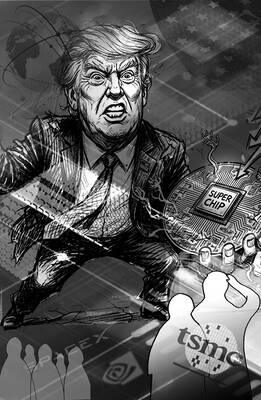
The White House’s decision to take a 9.9 percent stake in Intel Corp is looking like very shrewd business indeed. Since the government bought in at US$20.47 a share last August, the US chipmaker’s surging stock price has delivered the US a US$43 billion return. One of the reasons the investment has so far proved so sound is that the White House has made sure of it. According to The Wall Street Journal, Howard personally pushed deals on Intel’s behalf with some of the most lucrative clients imaginable. They include Nvidia Corp, the company at the heart of the AI

The closure of the Strait of Hormuz has sent the vast Asian chemicals industry into a tailspin. Deprived of the likes of Qatari natural gas and Saudi Arabian oil, the region’s fertilizer and plastics plants are slowing production or even shutting down. Everywhere except China, that is. In petrochemicals, China is unique. As well as a traditional industry that uses oil and gas as feedstock, it has parallel output that relies on its abundant domestic coal. Unsurprisingly, India and other regional powers want to copy and paste the Chinese method. This would not be easy — or climate friendly. The
Indonesian President Prabowo Subianto says he knows how to fix the problems facing Indonesia. Yet his economic mismanagement and authoritarian tendencies are steering the nation toward a familiar mix of currency instability and political chaos. The world’s fourth-most populous nation risks reversing the hard-won democratic and business reforms that came after the Asian Financial Crisis in 1997. At that time, the rupiah collapsed and the political upheaval that followed forced former president Haji Mohamed Suharto from power. Prabowo’s administration is ignoring similar warning signs. That disconnect was apparent in a national address on Wednesday, when Prabowo projected the swagger that has


 RSS
RSS