


Last week, Israel passed a law that institutionalizes the execution of Palestinians. The country’s courts can now impose death sentences on Palestinians “convicted of fatal attacks,” expanding a legal system designed to target them, strip them of rights, subject them to systematic abuse and ultimately, shield Israeli perpetrators of crimes against Palestinians from accountability. While this legislation does not create a wholly new reality, it marks the beginning of a troubling new phase of Israel’s oppression of Palestinians by enshrining into law a longstanding policy of using lethal force against them. Disturbingly, this reality is already normalized in Israel.
Long before this law, Palestinians were being systematically killed. In Gaza, mass killing has continued even after the declaration of a “ceasefire.” In the West Bank, Palestinians are killed on a daily basis by the Israeli military in raids, shootings and increasingly, by violent settler militias aimed at driving them from their land and out of their communities. For some time, Israeli soldiers and settlers have been able to act with near-total impunity.
The same reality has been starkly visible in Israel’s prison network. In the months since October 2023, Israel has increased the number of Palestinians in its detention system to more than 10,000, many of them without trial, with no meaningful opportunity to defend themselves. They are held in conditions that, in effect, turn Israel’s prison system into a network of torture camps, where Palestinians are subjected to systematic violence, abuse and deliberate starvation.
More than 80 Palestinians have died in Israeli custody during this period amid documented abuse, inhumane conditions and denial of medical treatment. The new law does not break from this system; it extends it, embedding its logic more deeply in the legal framework. Now, many more Palestinians would legally die in detention. This law emerges under a political leadership that openly embraces violence and dehumanization, led by senior government ministers who have built their power on incitement and the normalization of harm against Palestinians. Its promotion in the media has featured rhetoric that glorifies killing, including discussions that veered into graphic and disturbingly callous descriptions of executions, reflecting a broader societal shift in which Palestinian lives are increasingly seen as expendable.
As B’Tselem showed last year in its report Our Genocide, the dehumanization of Palestinians is a long-term process. That process helps explain how a law such as this becomes both imaginable and acceptable to large parts of Israeli society. The legislation faces virtually no political opposition and hardly provokes public debate in Israel.
Globally, democratic states have been moving away from the death penalty, recognizing it as a violation of fundamental human rights both domestically and internationally. At a time when international law itself is under growing attack, Israel is not an exception but a central driver of this erosion, maintaining systems of lethal violence and oppression against Palestinians and embedding them more deeply within its legal framework. Israel still presents itself as a democracy, but a state that institutionalizes the execution of one population under its control while subjecting it to systemic violence and discrimination is not democratic; it is a system of lethal control.
All of this is already plainly visible. The debate is not about facts. It is about recognizing Israel for what it is: a state that systematically kills Palestinians with impunity and erodes international law and basic moral norms. What is happening to Palestinians is already reshaping political and moral boundaries beyond Palestine, including in the US. As this is tolerated, it spreads. Once the dismantling of international law and basic protections for human life is accepted in one place, it becomes far easier to justify everywhere.
Yuli Novak is the executive director of B’Tselem.

KMT Chairwoman Cheng Li-wun’s (鄭麗文) recent visit to Beijing and her upcoming visit to Washington will serve as a high-level test of her diplomatic mettle. In Beijing, Cheng was received with symbolic gestures, a warm reception, and high-level access. In Washington, she will receive far less pomp and far sharper questions about the KMT’s vision for the future of Taiwan. Her challenge will be to persuade Washington that the KMT’s engagement with China can coexist with strong deterrence. Cheng’s April 7-12 visit to mainland China coincided with an intense period of conflict in Iran. Despite the strategic significance of Cheng’s trip,
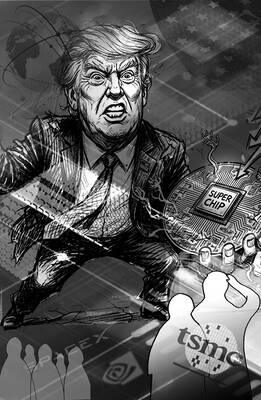
The White House’s decision to take a 9.9 percent stake in Intel Corp is looking like very shrewd business indeed. Since the government bought in at US$20.47 a share last August, the US chipmaker’s surging stock price has delivered the US a US$43 billion return. One of the reasons the investment has so far proved so sound is that the White House has made sure of it. According to The Wall Street Journal, Howard personally pushed deals on Intel’s behalf with some of the most lucrative clients imaginable. They include Nvidia Corp, the company at the heart of the AI

The closure of the Strait of Hormuz has sent the vast Asian chemicals industry into a tailspin. Deprived of the likes of Qatari natural gas and Saudi Arabian oil, the region’s fertilizer and plastics plants are slowing production or even shutting down. Everywhere except China, that is. In petrochemicals, China is unique. As well as a traditional industry that uses oil and gas as feedstock, it has parallel output that relies on its abundant domestic coal. Unsurprisingly, India and other regional powers want to copy and paste the Chinese method. This would not be easy — or climate friendly. The
Indonesian President Prabowo Subianto says he knows how to fix the problems facing Indonesia. Yet his economic mismanagement and authoritarian tendencies are steering the nation toward a familiar mix of currency instability and political chaos. The world’s fourth-most populous nation risks reversing the hard-won democratic and business reforms that came after the Asian Financial Crisis in 1997. At that time, the rupiah collapsed and the political upheaval that followed forced former president Haji Mohamed Suharto from power. Prabowo’s administration is ignoring similar warning signs. That disconnect was apparent in a national address on Wednesday, when Prabowo projected the swagger that has


 RSS
RSS