


Last month’s Nvidia GPU Technology Conference (GTC) set the tone with a three-minute opening film focused on a single concept: the token. The video portrayed tokens as the fundamental unit that transforms raw data into knowledge — linking scientific discovery, humanoid robots, healthcare breakthroughs and visions of a better future. However, the most striking moment came at the end, with the appearance of Starcloud, a start-up that designs and builds data centers for use in orbit.
Starcloud, backed by Nvidia through its Inception start-up program, launched its “Starcloud-1” satellite in November last year. It was equipped with an H100 graphics processing unit (GPU) with 80GB of memory to test in-orbit computing. Its bold proposition: Use the continuous solar energy of space and natural radiation-based heat dissipation to solve the severe power and cooling bottlenecks facing terrestrial artificial intelligence (AI) data centers.
The inclusion of Starcloud in the GTC introduction video, neatly packaged for a broad audience to intuitively grasp, was Nvidia’s way of signaling a strategic shift — that computing power is national power, and that computing itself is moving into space.
Nvidia founder and chief executive officer Jensen Huang (黃仁勳) later took the stage to deliver a two-hour keynote speech, the real highlights of which came in the final minutes.
One moment stood out: Huang sharing the stage with Olaf from the movie Frozen. On the surface, it was playful. In reality, it was deeply symbolic.
Olaf was no longer just an animated character, but a robot capable of interacting in the real world. The message was clear: AI is evolving beyond generating text, images and video on screens. It is entering the physical world, perceiving environments, understanding tasks and taking actions.
In short, AI is no longer just generative — it is becoming embodied.
The closing four-minute montage reinforced that shift. Humanoid robots played musical instruments. A digital avatar of Huang appeared alongside a quadruped robot dog. Scenes blended AI inference, AI factories, OpenClaw systems, agentic AI, open-source ecosystems and robotics into a single narrative thread.
What looked like performance art was a road map: AI is moving from generating answers to generating actions. Agentic AI would take over knowledge work. Robots would enter factories, transportation and logistics. Digital twins and machines would redefine the human–machine interface.
Those final minutes were not an ending; they were a synthesis of everything that came before, and a preview of what comes next.
Three concepts stood out from Huang’s keynote.
The first is tokens. Huang framed them as the fundamental unit of modern AI, effectively resetting the industry’s coordinates. Future competition would not simply hinge on model size, but on who can process tokens more efficiently and at lower cost, extending that capability into inference and AI factories.
Huang invoked Nvidia’s Compute Unified Device Architecture’s 20-year evolution as a “flywheel” of accelerated computing, underscoring the company’s ambition to dominate all layers of the AI stack, from chips and systems to software and applications.
The second is agentic AI. Platforms such as OpenClaw — and Nvidia’s NemoClaw agent that adds privacy and security controls to OpenClaw — signal a shift beyond chatbots toward autonomous digital workers, systems capable of planning, using tools and operating over long periods, and that would be subject to governance constraints.
The third is physical AI. From Cosmos and Isaac GR00T model families to robotaxis, industrial robots, edge infrastructure and orbital computing, Huang’s message was unmistakable: AI is transitioning from linguistic intelligence to physical intelligence.
For Taiwan, the shift carries particular significance.
Nvidia’s message at GTC was not just about incremental growth. The next wave of AI expansion would not be confined to areas where Taiwan already excels, such as semiconductors and AI server manufacturing. It would extend into sensors, edge computing, digital twins, industrial software, robotics integration and space-based data infrastructure.
Understanding that transition — from “generating content” to “driving the physical world” — is key to grasping the true meaning of Huang’s speech.
Notably, he announced Nvidia’s ambitions to expand into space. Systems such as “Nvidia Space-1 Vera Rubin” are envisioned to bring large-scale AI data center capabilities into orbit, extending accelerated computing beyond Earth.
For Taiwan, this is a strategic signal that cannot be ignored.
Maintaining leadership in terrestrial data centers is no longer enough. Taiwan must begin building capabilities in orbital thermal management, radiation-hardened certification and mission-grade system integration. By combining advanced cooling modules, radiation testing and space-qualified standards, Taiwan has the opportunity to move beyond being a component supplier and become a key player in the emerging infrastructure of space-based computing.
The future of AI would not just be written in code. It would be built — in factories, in cities and in orbit.
Liao Ming-hui is an assistant researcher at the Chung-Hua Institution for Economic Research.
Translated by Lin Lee-kai
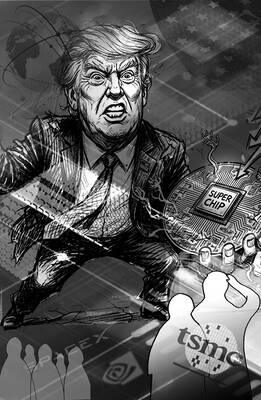
The White House’s decision to take a 9.9 percent stake in Intel Corp is looking like very shrewd business indeed. Since the government bought in at US$20.47 a share last August, the US chipmaker’s surging stock price has delivered the US a US$43 billion return. One of the reasons the investment has so far proved so sound is that the White House has made sure of it. According to The Wall Street Journal, Howard personally pushed deals on Intel’s behalf with some of the most lucrative clients imaginable. They include Nvidia Corp, the company at the heart of the AI

KMT Chairwoman Cheng Li-wun’s (鄭麗文) recent visit to Beijing and her upcoming visit to Washington will serve as a high-level test of her diplomatic mettle. In Beijing, Cheng was received with symbolic gestures, a warm reception, and high-level access. In Washington, she will receive far less pomp and far sharper questions about the KMT’s vision for the future of Taiwan. Her challenge will be to persuade Washington that the KMT’s engagement with China can coexist with strong deterrence. Cheng’s April 7-12 visit to mainland China coincided with an intense period of conflict in Iran. Despite the strategic significance of Cheng’s trip,

The closure of the Strait of Hormuz has sent the vast Asian chemicals industry into a tailspin. Deprived of the likes of Qatari natural gas and Saudi Arabian oil, the region’s fertilizer and plastics plants are slowing production or even shutting down. Everywhere except China, that is. In petrochemicals, China is unique. As well as a traditional industry that uses oil and gas as feedstock, it has parallel output that relies on its abundant domestic coal. Unsurprisingly, India and other regional powers want to copy and paste the Chinese method. This would not be easy — or climate friendly. The
Indonesian President Prabowo Subianto says he knows how to fix the problems facing Indonesia. Yet his economic mismanagement and authoritarian tendencies are steering the nation toward a familiar mix of currency instability and political chaos. The world’s fourth-most populous nation risks reversing the hard-won democratic and business reforms that came after the Asian Financial Crisis in 1997. At that time, the rupiah collapsed and the political upheaval that followed forced former president Haji Mohamed Suharto from power. Prabowo’s administration is ignoring similar warning signs. That disconnect was apparent in a national address on Wednesday, when Prabowo projected the swagger that has


 RSS
RSS