


Taiwanese media are not only ignoring the suffering of civilians in conflicts in Iran, Lebanon and the West Bank, they are treating it as irrelevant.
On a typical political talk show, the pattern is unmistakable. Familiar commentators — former Broadcasting Corp of China chairman Jaw Shaw-kong (趙少康), former Democratic Progressive Party (DPP) legislator Julian Kuo (郭正亮), former Chinese Nationalist Party (KMT) legislator and host Alex Tsai (蔡正元) — circle the same themes: Is the US distracted? Does China benefit from conflict in the Middle East? Does war in the Middle East raise risks for Taiwan?
What is largely missing is the most basic fact of war: civilians dying.
When mentioned at all, it is often reduced to a passing phrase — “collateral damage” — before the discussion quickly returns to strategy. Civilian suffering is not denied; it is simply downgraded to background noise.
That reflects a deeper habit in Taiwanese meia of filtering global events through a single question: Does this help or harm Taiwan?
Taiwan is not a distant observer of geopolitics. It lives under the shadow of an immediate and growing existential threat from China. In such a context, it is neither surprising nor unreasonable that public discourse prioritizes survival over distant humanitarian concerns.
The problem is when strategy becomes the only lens.
Taiwan’s commentariat often treats the US as a stable, rational, strategic actor that can allocate military resources across regions at will. Some pro-US President Donald Trump or pro-strongman narratives go further, implying that US foreign policy is driven primarily by the will of a single leader.
That is a serious misreading.
In the US, civilian suffering is not a side issue; it is a political force. Media coverage, congressional debates and public protests revolve around whether wars are justified, whether force is proportional and whether the US is complicit in civilian harm.
Supporters of military action must defend these questions; critics weaponize them. Either way, civilian deaths shape the debate.
In the US, strategy does not override morality — it is constrained by it.
The US is a democracy with built-in volatility. Midterm elections can swiftly shift congressional control and undercut ongoing military commitments. Courts can impose meaningful limits on executive power. Media scrutiny and public opinion can intensify rapidly when civilian casualties rise.
When humanitarian concerns escalate, the political space for strategic action can shrink just as quickly.
What Taipei sees as “US distraction” is often not a matter of capability, but of legitimacy.
Ignoring this dynamic leads to flawed conclusions. Analysts who focus solely on carrier deployments and force posture, while overlooking domestic political pressure, are working with an incomplete model of US power.
Taiwan has long grounded its international identity in democracy and human rights. Yet when civilian suffering elsewhere is consistently treated as irrelevant, that moral narrative risks becoming hollow.
A society that understands its own vulnerability should also understand the suffering of others — not as a distraction, but as part of the same moral universe it seeks support from.
None of that means Taiwan should abandon strategic thinking. On the contrary, it means taking strategy more seriously.
Power defines what is possible, but in a democracy like the US, politics defines what is sustainable. Civilian deaths are not background noise. They are variables that can reshape policy.
If Taiwan’s media continue to filter global conflicts solely through the question of “what does this mean for us?” they will not only misread distant wars, but also misread the very ally the nation depends on.
That misreading could carry consequences far beyond the Middle East.
Simon Tang is an adjunct professor at California State University, Fullerton, who lectures on international relations.
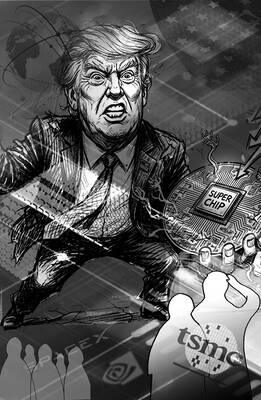
The White House’s decision to take a 9.9 percent stake in Intel Corp is looking like very shrewd business indeed. Since the government bought in at US$20.47 a share last August, the US chipmaker’s surging stock price has delivered the US a US$43 billion return. One of the reasons the investment has so far proved so sound is that the White House has made sure of it. According to The Wall Street Journal, Howard personally pushed deals on Intel’s behalf with some of the most lucrative clients imaginable. They include Nvidia Corp, the company at the heart of the AI
In a Taiwanese university classroom, a lecturer asks in English: “Can anyone give me an example from Taiwan?” Students look down. No one answers. After class, one student writes on the course platform in Mandarin: “I understood the concept, but I didn’t know how to answer in English.” That moment highlights a key issue in Taiwan’s English-medium instruction (EMI) reform: It is not just about more English-taught courses, but whether students can learn, participate and belong. EMI expansion is part of the Bilingual 2030 policy and the Ministry of Education’s BEST Program, aiming to improve English ability, support EMI teaching
The Ministry of the Interior, working with the navy and coast guard, is organizing Taiwan’s first joint exercise simulating escort tankers carrying liquefied natural gas (LNG) and oil through a Chinese blockade. The drills simulate fuel transport along three maritime corridors leading toward Japan, the Philippines and the US. Deputy Minister of the Interior Sawyer Mars (馬士元) said that a blockade of the Taiwan Strait would amount to “almost a 100 percent blockade of the regional energy supply.” Minister of National Defense Wellington Koo said planning to counter a blockade is standard practice in Taipei. While the exercise is limited in
A single photograph can cut through a lot of noise, but it can also be used to misrepresent the truth. At the very least, it can concentrate the mind on something that requires further investigation. On Monday last week, Ma Ying-jeou Foundation CEO Tai Hsia-ling (戴遐齡) and former National Security Council secretary-general King Pu-tsung (金溥聰) held a news conference in which they showed a photograph of former foundation CEO Hsiao Hsu-tsen (蕭旭岑), now Chinese Nationalist Party (KMT) deputy chairman. In the image Hsiao is seated next to Xiamen Taiwan Businessmen Association chairman Han Ying-huan (韓螢煥). The two men were holding


 RSS
RSS