


More than a month into the Middle East conflict, which started on Feb. 28 with US-Israeli strikes on Iran, surging energy prices are fueling inflation worldwide, with economists warning of increased imported inflation risks as long as the Strait of Hormuz remains shut. With no off-ramp in sight, energy prices are not expected to return to prewar levels soon. Even with a ceasefire, oil supply would not increase rapidly due to widespread damage to production facilities in the region. Even if the US eases sanctions on Russian oil or increases its own production, output is unlikely to rise sharply in a short period.
The Directorate-General of Budget, Accounting and Statistics is tomorrow to release the nation’s inflation data for last month, while the Ministry of Finance is on Friday to give an update on foreign trade data. The National Development Council (NDC) on Thursday last week said that the consumer price index (CPI) might have risen 1.5 percent last month, while headline inflation rose 1.33 percent in the first two months after seasonal adjustments. The increase likely stemmed from higher transportation costs, although CPC Corp, Taiwan said it has absorbed at least 60 percent of increases in fuel prices.
Rising fuel costs have not just affected drivers, but also logistics, production and other activities. The Chung-Hua Institution for Economic Research on Wednesday last week reported that the raw material price subindex in the latest purchasing managers’ index (PMI) for Taiwan’s manufacturing sector surged to 80 last month, the highest level since 2022 when oil prices rose following Russia’s invasion of Ukraine. The new surge points to mounting cost pressures among upstream producers. The impacts have spread from crude oil and naphtha downstream to key petrochemical products, the institute said.
The government still expects CPI to remain below the 2 percent alert level for the year, as authorities would adopt price stabilization measures to keep headline inflation from spiraling further, the NDC said. However, of potentially greater concern are the second-round effects on downstream industries — including transportation, aviation, shipping, manufacturing and logistics — as well as on supplies of key raw materials — such as fertilizers, sulfur, ethylene and helium. Ethylene and helium are critical components for production in local petrochemical and semiconductor industries. If this situation worsens, the ripple effects could turn into a severe supply chain crisis for the nation’s major exporters.
Taiwan’s export growth for last month is expected to show a strong double-digit percentage expansion of about 30 percent year-on-year, supported by ongoing robust demand for semiconductor and artificial intelligence-related products, after exports grew 44.5 percent annually in the first two months, market consensus estimates showed. Last week’s manufacturing PMI data showed that despite the conflict in the Middle East, the economy remained resilient, with firms reporting improved operating conditions. The gauge held comfortably above the neutral 50 mark for the sixth consecutive month last month, with strength seen in the new orders, employment, suppliers’ delivery time, inventories and six-month outlook subindices.
Nevertheless, the Middle East conflict is on everyone’s mind, and oil prices are unlikely to stabilize soon. While the PMI data suggested that the local manufacturing sector delivered a solid performance in the first quarter, the Middle East war would continue to weigh on firms’ operating conditions in the second quarter. Prolonged uncertainty about the war, as well as its broader impact on global supply chains and energy markets, could dampen producers’ momentum, especially if raw material shortages and price pressures intensify, potentially making consumer goods more expensive, too.
It would take months to get a clearer picture of price and growth impacts from the war, as energy-driven price pressures typically take at least three months to filter through to consumers. Given the limits of monetary policy in responding to external shocks such as energy price spikes or supply shortages during the Middle East conflict, the central bank has not made any drastic policy changes so far. Yet, policymakers must closely monitor the potential downside risks and continue efforts to cushion the blow to households and businesses. Elevated energy prices test not only the public’s inflation expectations and the government’s policy tools, but also the nation’s economic and energy resilience.

KMT Chairwoman Cheng Li-wun’s (鄭麗文) recent visit to Beijing and her upcoming visit to Washington will serve as a high-level test of her diplomatic mettle. In Beijing, Cheng was received with symbolic gestures, a warm reception, and high-level access. In Washington, she will receive far less pomp and far sharper questions about the KMT’s vision for the future of Taiwan. Her challenge will be to persuade Washington that the KMT’s engagement with China can coexist with strong deterrence. Cheng’s April 7-12 visit to mainland China coincided with an intense period of conflict in Iran. Despite the strategic significance of Cheng’s trip,
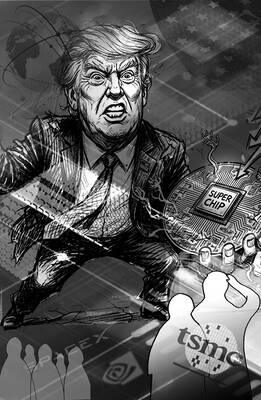
The White House’s decision to take a 9.9 percent stake in Intel Corp is looking like very shrewd business indeed. Since the government bought in at US$20.47 a share last August, the US chipmaker’s surging stock price has delivered the US a US$43 billion return. One of the reasons the investment has so far proved so sound is that the White House has made sure of it. According to The Wall Street Journal, Howard personally pushed deals on Intel’s behalf with some of the most lucrative clients imaginable. They include Nvidia Corp, the company at the heart of the AI

The closure of the Strait of Hormuz has sent the vast Asian chemicals industry into a tailspin. Deprived of the likes of Qatari natural gas and Saudi Arabian oil, the region’s fertilizer and plastics plants are slowing production or even shutting down. Everywhere except China, that is. In petrochemicals, China is unique. As well as a traditional industry that uses oil and gas as feedstock, it has parallel output that relies on its abundant domestic coal. Unsurprisingly, India and other regional powers want to copy and paste the Chinese method. This would not be easy — or climate friendly. The
Indonesian President Prabowo Subianto says he knows how to fix the problems facing Indonesia. Yet his economic mismanagement and authoritarian tendencies are steering the nation toward a familiar mix of currency instability and political chaos. The world’s fourth-most populous nation risks reversing the hard-won democratic and business reforms that came after the Asian Financial Crisis in 1997. At that time, the rupiah collapsed and the political upheaval that followed forced former president Haji Mohamed Suharto from power. Prabowo’s administration is ignoring similar warning signs. That disconnect was apparent in a national address on Wednesday, when Prabowo projected the swagger that has


 RSS
RSS