


For more than a millennium, the lines from the Tang Dynasty poet Du Mu (杜牧) — “pure brightness, dual souls” — have defined the emotional architecture of Qingming (清明). Arriving around April 5 as the fifth of the 24 solar terms, Qingming is a dual entity: A celestial marker of late spring and one of our “Big Four” traditional festivals — a day when the living pause to tend to the literal and metaphorical ghosts of the past.
The term Qingming translates literally to “pure brightness.” Wu Cheng (吳澄), the Yuan Dynasty polymath, captured its essence in his phenological classic, Yueling Qishier Hou Jijie (月令七十二候集解, Collected Explanations of the 72 Micro-seasons): “At this time, all things are clean and tidy, pure and bright.”
It is a moment of environmental lucidity, where the landscape feels scrubbed clean by the abrasive spring rains.
My own connection to this season is anchored in a masterpiece of ancient Chinese art. My office at Soochow University was dominated by a replica of the Song Dynasty painter Zhang Zeduan’s (張擇端) handscroll, Along the River During the Qingming Festival, which captures the daily lives of people and the landscape of the capital, Bianjing (present-day Kaifeng).
Because the original silk scroll spans more than 5m, my father helped me cut and mount it into three distinct movements: the pastoral tranquility of the countryside, the bustling drama of the Rainbow Bridge and the vibrant chaos of the city gate. In these scenes, the social fabric of a millennium ago — merchants, scholars and laborers — is caught in the same seasonal pulse. I would often be transported to the Song capital, finding a strange comfort in the timelessness of the Qingming atmosphere.
Under the entry Ch’ing Ming (the older Wade-Giles romanization), Webster’s Third New International Dictionary provides a clinical definition: “A spring festival in China when graves are put in order and special offerings are made to the dead.”
While Merriam-Webster’s etymology references the literal “clear and bright,” the translation of Qingming as a solar term has ignited a fascinating semantic debate. The Beijing 2022 Winter Olympics opening ceremony introduced the world to “pure brightness,” while Encyclopedia Britannica favors “clear and bright.”
To a linguist, the distinction between adjective and noun is paramount. A solar term is a temporal milestone — a noun. I propose a hybrid approach for the 24 terms: Lead with the transliteration to preserve cultural identity and follow with the poetic essence. Thus: Qingming (pure brightness).
Qingming is unique for its bifocal identity: it is both a solemn duty and a vibrant embrace of nature. Its core lies in the dynamic balance between honoring the dead and welcoming the new.
On the somber side, the ritual of “tomb sweeping” remains a communal anchor, the connective tissue of time-honored filial piety. Families visit the tombs of their ancestors to clean the gravesites, lay out food offerings, and burn joss sticks and paper, thereby expressing the traditional reverence for ancestors in our culture.
Yet Qingming also has a spirited side, known as taqing (踏青) — literally “treading on the green.” As spring reaches its peak, people head to the countryside for leisure; some fly kites and often snip the strings to let their ailments drift into the clouds — a symbolic purging of misfortune. Even the palate matters. Local people savor runbing (潤餅) — the Taiwanese spring roll — also called popiah (薄餅) or lumpia (潤餅) in Southeast Asian cookery. This specialty, often served cold, resonates with the ancient Hanshi (Cold Food) Festival (寒食節), a nod to the transition from a cold past to a verdant future.
Ultimately, Qingming is a day of profound human synchronicity. It is the moment when we tidy the graves of the past so that we can more clearly see the “pure brightness” of the world ahead.
Hugo Tseng holds a doctorate in linguistics. He is a lexicographer and a former chair of Soochow University’s Department of English.
A gap appears to be emerging between Washington’s foreign policy elites and the broader American public on how the United States should respond to China’s rise. From my vantage working at a think tank in Washington, DC, and through regular travel around the United States, I increasingly experience two distinct discussions. This divergence — between America’s elite hawkishness and public caution — may become one of the least appreciated and most consequential external factors influencing Taiwan’s security environment in the years ahead. Within the American policy community, the dominant view of China has grown unmistakably tough. Many members of Congress, as
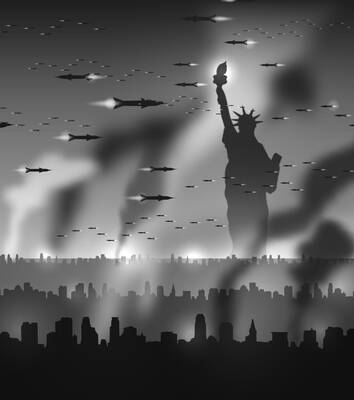
After declaring Iran’s military “gone,” US President Donald Trump appealed to the UK, France, Japan and South Korea — as well as China, Iran’s strategic partner — to send minesweepers and naval forces to reopen the Strait of Hormuz. When allies balked, the request turned into a warning: NATO would face “a very bad” future if it refused. The prevailing wisdom is that Trump faces a credibility problem: having spent years insulting allies, he finds they would not rally when he needs them. That is true, but superficial, as though a structural collapse could be caused by wounded feelings. Something
Former Taipei mayor and Taiwan People’s Party (TPP) founding chairman Ko Wen-je (柯文哲) was sentenced to 17 years in prison on Thursday, making headlines across major media. However, another case linked to the TPP — the indictment of Chinese immigrant Xu Chunying (徐春鶯) for alleged violations of the Anti-Infiltration Act (反滲透法) on Tuesday — has also stirred up heated discussions. Born in Shanghai, Xu became a resident of Taiwan through marriage in 1993. Currently the director of the Taiwan New Immigrant Development Association, she was elected to serve as legislator-at-large for the TPP in 2023, but was later charged with involvement
Out of 64 participating universities in this year’s Stars Program — through which schools directly recommend their top students to universities for admission — only 19 filled their admissions quotas. There were 922 vacancies, down more than 200 from last year; top universities had 37 unfilled places, 40 fewer than last year. The original purpose of the Stars Program was to expand admissions to a wider range of students. However, certain departments at elite universities that failed to meet their admissions quotas are not improving. Vacancies at top universities are linked to students’ program preferences on their applications, but inappropriate admission


 RSS
RSS