


The National Security Strategy (NSS) that US President Donald Trump’s administration published in November last year was remarkable, far-reaching and unlike any other NSS that has appeared since former US president George H.W. Bush “kicked the Vietnam syndrome” in the early 1990s. In the cover letter that bears his signature, Trump said the document was a “roadmap to ensure that America remains the greatest and most successful nation in human history.”
Trump’s NSS anchors the US’ greatness and success in its founding ideals. “In the Declaration of Independence, America’s founders laid down a clear preference for non-interventionism in the affairs of other nations,” it said. Alas, “our elites badly miscalculated the US’ willingness to shoulder forever global burdens to which the American people saw no connection to the national interest,” it added. They “allowed allies and partners to offload the cost of their defense onto the American people,” and “sometimes to suck us into conflicts and controversies central to their interests but peripheral or irrelevant to our own,” it said.
Until last month, Trump’s policies seemed to be working toward disengagement from the Middle East. The NSS had laid this out clearly: “As this administration rescinds or eases restrictive energy policies and American energy production ramps up, America’s historic reason for focusing on the Middle East will recede.”
There were, of course, qualifications: “America will always have core interests in ensuring that Gulf energy supplies do not fall into the hands of an outright enemy, that the Strait of Hormuz remain open, said,” adding that “we can and must address this threat ideologically and militarily without decades of fruitless ‘nation-building’ wars.”
Moreover, the era when the “Middle East dominated American foreign policy in both long-term planning and day-to-day execution” has ended, in part because the region “is no longer the constant irritant, and potential source of imminent catastrophe, that it once was,” the NSS said. Israel’s security was mentioned, but only in passing. Instead, the report’s authors said the Middle East is “emerging as a place of partnership, friendship, and investment — a trend that should be welcomed and encouraged.”
Despite these stirring words, the US on Feb. 28 attacked Iran, a country 4.6 times the size of Germany, with more than 90 million people. The two Iraq wars might have been larger (so far), but they were against a rather puny opponent. Iran, by contrast, is a civilization-state with a deep reserve of missiles, drones and patriotic and religious commitment. To attack it is to launch the mother of all forever wars.
Of course, one could dismiss Trump’s NSS as another dishonest statement cooked up to mislead the US public — and many commentators did exactly that. However, what purpose would this have served? If the goal was to get through this year’s midterm elections by reaffirming Trump’s commitment to the promises he made during his last campaign, it makes no sense to expose the fraud just three months after the document’s release and eight months before Americans head to the polls.
Moreover, the quality of the document suggests that those who composed it were serious people. This is no typical Trump campaign speech or press gaggle. Since such documents must be crafted and reviewed, written and rewritten, their importance lies precisely in the fact that they must overcome internal opposition before a president’s signature is added. This NSS was a largely coherent articulation of a distinct and important worldview: It set out a new direction for the US, renouncing the NATO-centric, global policeman, Pax Americana rhetoric of every administration since the collapse of the Soviet Union.
However, here we are, at war again in the Middle East. It is not going according to plan, if there even was one. The Strait of Hormuz is closed to US, European, Japanese, South Korean and Israeli shipping. World oil supplies have fallen, and there would be severe shortages of gas, fertilizer, and, in due course, food. US bases in the Persian Gulf region have been partly destroyed or rendered unusable.
The US would never be able to return to those bases, because Iran shows no sign of bending before the bombs, nor would it run short of drones and missiles. Nor is there any chance that a few thousand marines would turn the tide. To put it more bluntly, the US has already been expelled, once and for all, from the Gulf — though this might not yet have dawned on US officials or the public.
How can we explain the vast gap between strategy and policy? One possibility is that the US government is no longer really a government, being unable to devise, announce, implement and execute a strategy — something that real governments are supposed to do. A second interpretation is that the government the US did have, until three months ago, has since been replaced, through a silent coup d’etat, with a different regime that is using Trump as a figurehead — something like Venezuela, without the helicopters.
The third possibility is that the US would eventually end up where the NSS from November last year wanted it to go. That is, it would be forced out of the Middle East, obliged to recognize the limits and obsolescence of US power and made to respect the sovereignty and autonomy of other nation states.
This would not be the worst result. However, it would have been much easier to arrive at it directly, without the humiliation of a brutal military defeat, the elimination of allies and the lasting damage to the global economy.
James K. Galbraith, professor at The University of Texas at Austin, is the co-author (with Jing Chen), most recently, of Entropy Economics: The Living
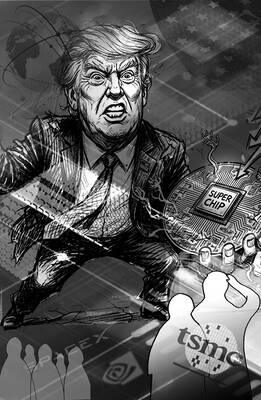
The White House’s decision to take a 9.9 percent stake in Intel Corp is looking like very shrewd business indeed. Since the government bought in at US$20.47 a share last August, the US chipmaker’s surging stock price has delivered the US a US$43 billion return. One of the reasons the investment has so far proved so sound is that the White House has made sure of it. According to The Wall Street Journal, Howard personally pushed deals on Intel’s behalf with some of the most lucrative clients imaginable. They include Nvidia Corp, the company at the heart of the AI
A single photograph can cut through a lot of noise, but it can also be used to misrepresent the truth. At the very least, it can concentrate the mind on something that requires further investigation. On Monday last week, Ma Ying-jeou Foundation CEO Tai Hsia-ling (戴遐齡) and former National Security Council secretary-general King Pu-tsung (金溥聰) held a news conference in which they showed a photograph of former foundation CEO Hsiao Hsu-tsen (蕭旭岑), now Chinese Nationalist Party (KMT) deputy chairman. In the image Hsiao is seated next to Xiamen Taiwan Businessmen Association chairman Han Ying-huan (韓螢煥). The two men were holding
I first met Professor Ray Jiing (井迎瑞) as a film and documentary student at Shih Hsin University’s (SHU) Department of Radio Television and Film in 1988. The following year, he went on to become the director of the Chinese Taipei Film Archive — forerunner of the Taiwan Film and Audiovisual Institute (TFAI). Over his eight-year tenure, Jiing rescued and restored over 200 classic Taiwanese films. In 1997, he established the Graduate Institute of Studies in Documentary and Film Archiving at Tainan National University of the Arts (TNNUA), and I joined the program in his third cohort of students. Beyond a

President William Lai Ching-te’s (賴清德) May 20 second-anniversary address was not just a routine policy review; it was damage control. US President Donald Trump’s remarks — that he did not want to see anyone move toward independence and that the delivery of a major Taiwan arms package could depend on the progress of US-China relations — unsettled Taiwan’s public and created an opening for opposition parties to question whether Taiwan was being treated as a bargaining chip in Washington’s dealings with Beijing. Lai’s speech was designed to close that opening. The address covered the expected ground: sovereignty, cross-strait relations, defense spending,


 RSS
RSS