


To think about how the Iran war affects China, you might take a look at Yiwu (義烏), a global trading hub in the eastern Zhejiang province that hosts sprawling wholesale markets selling goods from hair clips to toys.
Exporters are eager for business. At the entrance is a prominent display that reads: “The world’s capital of small commodities eagerly embraces your gracious presence.” Buyers from Gulf States are the city’s most prized guests, as Middle Eastern restaurants — the best in China according to social media influencers — spread across the main shopping districts. After all, these customers bring big business. Exports to the region doubled in five years, exceeding US$120 billion last year. In the first two months of the year, China’s exports to the United Arab Emirates and Saudi Arabia alone grew 23 percent.
With the Iran war entering its fourth week, the much-anticipated visitors from the region have practically disappeared as air traffic disruptions continue. Those in town are rushing to find flights home, while local vendors worry about the safety of their Iranian customers, having not heard from them as the country experiences a near-total Internet blackout. Some have reportedly applied to join the army to defend their country’s sovereignty.
Even if Middle Eastern buyers are still able to place orders via WeChat, their Chinese suppliers in Yiwu, especially electronics makers, are pulling the plug. Their math no longer works.
Take air conditioners, for example. Last year, China shipped more than 17 million units to the Middle East, or about 20 percent of the country’s total exports. Overseas sales might tumble by 12 percent this month, readings from online orders show.
Transportation costs have become prohibitively expensive. Freight for a standard container to the Persian Gulf has risen 35 percent this month, while insurance premiums have jumped 143 percent. Sellers also have to pay insurers war surcharges of up to US$4,000 per container.
Manufacturers are also concerned about procurements of raw materials from copper to aluminum, not wanting to be caught at the wrong end of the cycle. The price of aluminum soared at the start of the war as commodities traders worried about supply disruptions. The region accounted for 9 percent of global production last year, but as the conflict drags on, prices of industrial metals have plunged in recent days over fears of a global recession. A 10 percent rise in raw materials costs can shave gross margins for home appliances makers Midea Group Co (美的集團), Haier Smart Home Co (海爾智家) and Gree Electric Appliances Inc of Zhuhai (珠海格力電器) by as much as 6 percent.
Yiwu provides a small glimpse of the existential threat a prolonged war might pose to China. A collapse of global demand would dent the economy’s only bright spot — exports that the government has counted on to help meet its annual growth targets. This pillar is now looking wobbly as elevated energy costs drain consumers’ wallets around the world.
A slowdown in exports would likely create more overcapacity, trigger fiercer price wars at home and trim corporate profits. This perhaps explains why China’s stock market is finally pricing in the Iran war after weeks of calm.
There is now a debate in mainland China over what the war means for the country. In the near-term, the government needs to handle an energy crisis that has already erupted. To be sure, almost everyone agrees that the formidable strategic oil reserves Beijing has built buffers the economy better than its north Asian neighbors. It is the long-term impact that has investors at odds. Some argue that the war is good for China because US military resources would be diverted away from the Pacific, and that Beijing would win the AI arms race because it has a superior energy infrastructure.
I disagree with this bullish view. In the past two years, China caught a lucky break because of robust global demand, allowing it to sell into Europe and the global south even as US President Donald Trump raised US tariffs. This gives his counterpart Xi Jinping (習近平) the policy space to let a weak economy bottom out on its own. Indeed, the government has dialed down fiscal support, while sounding unfazed by the continued housing market decline.
This rug of policy comfort could be pulled from under China’s feet if we enter a global recession. Unlike Trump’s claims, wars have no winners.
Shuli Ren is a Bloomberg Opinion columnist covering Asian markets. A former investment banker, she was a markets reporter for Barron’s. She is a CFA charterholder. This column reflects the personal views of the author and does not necessarily reflect the opinion of the editorial board or Bloomberg LP and its owners.
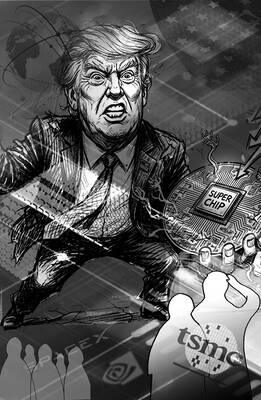
The White House’s decision to take a 9.9 percent stake in Intel Corp is looking like very shrewd business indeed. Since the government bought in at US$20.47 a share last August, the US chipmaker’s surging stock price has delivered the US a US$43 billion return. One of the reasons the investment has so far proved so sound is that the White House has made sure of it. According to The Wall Street Journal, Howard personally pushed deals on Intel’s behalf with some of the most lucrative clients imaginable. They include Nvidia Corp, the company at the heart of the AI
The Ministry of the Interior, working with the navy and coast guard, is organizing Taiwan’s first joint exercise simulating escort tankers carrying liquefied natural gas (LNG) and oil through a Chinese blockade. The drills simulate fuel transport along three maritime corridors leading toward Japan, the Philippines and the US. Deputy Minister of the Interior Sawyer Mars (馬士元) said that a blockade of the Taiwan Strait would amount to “almost a 100 percent blockade of the regional energy supply.” Minister of National Defense Wellington Koo said planning to counter a blockade is standard practice in Taipei. While the exercise is limited in
A single photograph can cut through a lot of noise, but it can also be used to misrepresent the truth. At the very least, it can concentrate the mind on something that requires further investigation. On Monday last week, Ma Ying-jeou Foundation CEO Tai Hsia-ling (戴遐齡) and former National Security Council secretary-general King Pu-tsung (金溥聰) held a news conference in which they showed a photograph of former foundation CEO Hsiao Hsu-tsen (蕭旭岑), now Chinese Nationalist Party (KMT) deputy chairman. In the image Hsiao is seated next to Xiamen Taiwan Businessmen Association chairman Han Ying-huan (韓螢煥). The two men were holding
In a Taiwanese university classroom, a lecturer asks in English: “Can anyone give me an example from Taiwan?” Students look down. No one answers. After class, one student writes on the course platform in Mandarin: “I understood the concept, but I didn’t know how to answer in English.” That moment highlights a key issue in Taiwan’s English-medium instruction (EMI) reform: It is not just about more English-taught courses, but whether students can learn, participate and belong. EMI expansion is part of the Bilingual 2030 policy and the Ministry of Education’s BEST Program, aiming to improve English ability, support EMI teaching


 RSS
RSS