


It seems increasingly evident that the White House rushed into war with Iran without fully considering the potential consequences. That is all the more reason to hasten the conflict’s end.
After nearly three weeks of fighting, the US is reaching the limits of what air power can accomplish. Although US and Israeli strikes have destroyed thousands of military targets and killed dozens of top officials, including Iranian supreme leader Ayatollah Ali Khamenei, the regime remains unbowed. Its drone and missile attacks on neighboring countries and on container ships hoping to transit the Strait of Hormuz have paralyzed the Gulf region. Oil prices are surging; industries from agriculture to semiconductors fear shortages of key inputs. Inflation worries are spreading.
Expanding airstrikes seems more likely to increase collateral damage and turn the population against the West than to break the regime. Replacing the government — now said to be led by Khamenei’s equally hard-line son, Mojtaba — would require tens if not hundreds of thousands of US troops. Even narrower ground missions such as seizing the more than 440 kilograms of near-weapons-grade uranium thought to be buried under Iranian nuclear facilities, capturing the Kharg Island oil export hub or occupying swathes of the coastline in order to protect shipping would dramatically raise the odds of another Middle East quagmire. Worryingly, a Marine expeditionary unit is reportedly now headed for the region.
The White House has a better option: Declare victory and de-escalate. It has already laid the groundwork for such a pivot. After the president demanded “UNCONDITIONAL SURRENDER!” and veto power over Iran’s new leaders on March 6, his administration has mostly emphasized more achievable goals: degrading Iran’s ballistic missile stockpiles, launchers and production capacity; sinking its regular navy; and setting back its nuclear program. By those criteria, the president is not entirely crazy to claim: “We’ve won.”
Critics argue the US cannot afford to leave the job half done. Iran retains enough highly enriched uranium to make at least 10 bombs, although the state of the rest of its nuclear infrastructure is unclear. Security forces, although weakened, remain strong enough to suppress dissent. The regime could rebuild its drone arsenal at relatively low cost. Most important, the Islamic Revolutionary Guard Corps (IRGC) likely retains enough anti-ship missiles, drones and sea mines to close off the strait when it chooses, effectively holding its Gulf neighbors and the global economy hostage.
Yet those risks must be weighed against the alternatives. The US and Israel are unlikely to find and hit every last mobile missile launcher, nuclear centrifuge or IRGC commander even with several more weeks of bombing. Meanwhile, the costs of continued airstrikes are not negligible. The Pentagon spent more than US$11 billion in just the first six days of the campaign. Ships, planes, troops and air-defense batteries have been diverted from other theaters, alarming allies. The fighting is depleting supplies of hard-to-replace interceptors and long-range missiles, which are critical to deterring China.
More to the point, the threat has arguably been contained. Although Iran’s leaders would no doubt declare victory when the US ceases hostilities, the regime has been gravely wounded. It would need time and money to rebuild its military capabilities, let alone its devastated proxy network. Meanwhile, it would face abiding hostility from its neighbors and from its own citizens. Sanctions would continue to strangle Iran’s economy while its skies would remain exposed to US or Israeli strikes.
Unless the US has more high-value targets to hit that would further degrade Iran’s nuclear program, the White House should bring this campaign to a close, making sure the regime knows that conflict could resume if Iran interferes with shipping or initiates any attacks, and that any sanctions relief would have to await a credible nuclear deal. In its own Mideast misadventure, a previous US administration declared “mission accomplished” too quickly. This one would be wise not to delay too long.
The Editorial Board publishes the views of the editors across a range of national and global affairs.
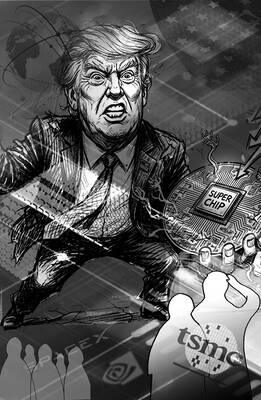
The White House’s decision to take a 9.9 percent stake in Intel Corp is looking like very shrewd business indeed. Since the government bought in at US$20.47 a share last August, the US chipmaker’s surging stock price has delivered the US a US$43 billion return. One of the reasons the investment has so far proved so sound is that the White House has made sure of it. According to The Wall Street Journal, Howard personally pushed deals on Intel’s behalf with some of the most lucrative clients imaginable. They include Nvidia Corp, the company at the heart of the AI
The Ministry of the Interior, working with the navy and coast guard, is organizing Taiwan’s first joint exercise simulating escort tankers carrying liquefied natural gas (LNG) and oil through a Chinese blockade. The drills simulate fuel transport along three maritime corridors leading toward Japan, the Philippines and the US. Deputy Minister of the Interior Sawyer Mars (馬士元) said that a blockade of the Taiwan Strait would amount to “almost a 100 percent blockade of the regional energy supply.” Minister of National Defense Wellington Koo said planning to counter a blockade is standard practice in Taipei. While the exercise is limited in
A single photograph can cut through a lot of noise, but it can also be used to misrepresent the truth. At the very least, it can concentrate the mind on something that requires further investigation. On Monday last week, Ma Ying-jeou Foundation CEO Tai Hsia-ling (戴遐齡) and former National Security Council secretary-general King Pu-tsung (金溥聰) held a news conference in which they showed a photograph of former foundation CEO Hsiao Hsu-tsen (蕭旭岑), now Chinese Nationalist Party (KMT) deputy chairman. In the image Hsiao is seated next to Xiamen Taiwan Businessmen Association chairman Han Ying-huan (韓螢煥). The two men were holding
In a Taiwanese university classroom, a lecturer asks in English: “Can anyone give me an example from Taiwan?” Students look down. No one answers. After class, one student writes on the course platform in Mandarin: “I understood the concept, but I didn’t know how to answer in English.” That moment highlights a key issue in Taiwan’s English-medium instruction (EMI) reform: It is not just about more English-taught courses, but whether students can learn, participate and belong. EMI expansion is part of the Bilingual 2030 policy and the Ministry of Education’s BEST Program, aiming to improve English ability, support EMI teaching


 RSS
RSS