


The debate over restarting the Ma-anshan Nuclear Power Plant in Pingtung County has been amplified by certain groups amid rising tensions in the Middle East, creating the impression that Taiwan is on the verge of an energy crisis and acting as if all energy-related issues could be solved by bringing the plant back online.
For the government to rush a restart on this basis would be a rash decision. However, if a restart is pursued, the following conditions must met to satisfy the most basic requirements.
The Ma-anshan plant was built when Taiwan did not yet have environmental impact assessment regulations. Therefore, the environmental conditions of the plant were not subject to thorough study or review. If a decision is made to grant the plant a typical 20-year license extension, a new environmental impact assessment should be conducted to ensure that the site is safe.
The Tsuruga nuclear power plant in Japan’s Fukui Prefecture is a representative example. When Japan moved to promote the restart of nuclear power, assessments revealed the presence of an active tectonic fault beneath the plant site. As a result, the decision was made to decommission the plant rather than to extend its operation. While the Japanese government has strong demand for nuclear energy, it still adhered to the safety first principle.
Although restarting the Ma-anshan plant would be easier than doing the same for the Kuosheng nuclear power plant in New Taipei City — where spent fuel pools are already full — necessary refurbishment and inspection remain fundamental requirements for any license extension. Cutting corners would be detrimental to public safety and the stability of the nation’s power supply.
The Ministry of Economic Affairs has said that if equipment conditions are good and limited replacements are required, the restart timeline could be shortened. Some have misinterpreted this to mean that operations could resume in as little as two years. This is a grave misunderstanding. The restart of the plant must be approached with rigor — a predetermined timeline should not be imposed simply to justify an extension. After all, the entire overhaul and inspection process for an operation extension would likely require substantial upgrades to equipment and piping to ensure safe and stable power generation in the long-term.
Lastly, there is the issue of gas supply disruptions and power outages. In operating a power grid, the possibility of any given energy source being interrupted should already be taken into account. In the short term, coal-fired power can still be used to support energy demand — it is not necessarily the case that restarting the Ma-anshan plant is the only option. In fact, coal-fired generation is a much more flexible method in wartime conditions. It differs from natural gas, which has limited storage capacity, and nuclear power plants, which carry the risk of being seized or targeted during an armed conflict.
Any restart of the Ma-anshan nuclear power plant should prioritize overall safety, rather than being driven by temporary fuel shortages or emotional blackmail and intimidation from those with particular interests. Only by truly upholding nuclear safety considerations could a restart effectively dispel public doubts — a point that even proponents of nuclear energy would likely agree on.
Chen Kuan-lin is a research manager from Taipei.
Translated by Kyra Gustavsen
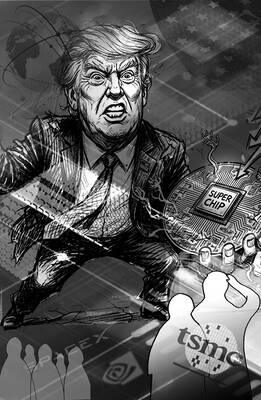
The White House’s decision to take a 9.9 percent stake in Intel Corp is looking like very shrewd business indeed. Since the government bought in at US$20.47 a share last August, the US chipmaker’s surging stock price has delivered the US a US$43 billion return. One of the reasons the investment has so far proved so sound is that the White House has made sure of it. According to The Wall Street Journal, Howard personally pushed deals on Intel’s behalf with some of the most lucrative clients imaginable. They include Nvidia Corp, the company at the heart of the AI
The Ministry of the Interior, working with the navy and coast guard, is organizing Taiwan’s first joint exercise simulating escort tankers carrying liquefied natural gas (LNG) and oil through a Chinese blockade. The drills simulate fuel transport along three maritime corridors leading toward Japan, the Philippines and the US. Deputy Minister of the Interior Sawyer Mars (馬士元) said that a blockade of the Taiwan Strait would amount to “almost a 100 percent blockade of the regional energy supply.” Minister of National Defense Wellington Koo said planning to counter a blockade is standard practice in Taipei. While the exercise is limited in
A single photograph can cut through a lot of noise, but it can also be used to misrepresent the truth. At the very least, it can concentrate the mind on something that requires further investigation. On Monday last week, Ma Ying-jeou Foundation CEO Tai Hsia-ling (戴遐齡) and former National Security Council secretary-general King Pu-tsung (金溥聰) held a news conference in which they showed a photograph of former foundation CEO Hsiao Hsu-tsen (蕭旭岑), now Chinese Nationalist Party (KMT) deputy chairman. In the image Hsiao is seated next to Xiamen Taiwan Businessmen Association chairman Han Ying-huan (韓螢煥). The two men were holding
In a Taiwanese university classroom, a lecturer asks in English: “Can anyone give me an example from Taiwan?” Students look down. No one answers. After class, one student writes on the course platform in Mandarin: “I understood the concept, but I didn’t know how to answer in English.” That moment highlights a key issue in Taiwan’s English-medium instruction (EMI) reform: It is not just about more English-taught courses, but whether students can learn, participate and belong. EMI expansion is part of the Bilingual 2030 policy and the Ministry of Education’s BEST Program, aiming to improve English ability, support EMI teaching


 RSS
RSS