


Just a few hours after a nationwide electricity blackout struck Cuba, US President Donald Trump hinted at an even darker future for the island’s rulers.
The country’s entire electricity system had collapsed on Monday afternoon, leaving about 10 million people without power. Emergency teams were still struggling to restore it when the US leader made his latest threat.
“I believe I will have the honor of taking Cuba,” he said to reporters, adding, “I mean, whether I free it, take it — I think I could do anything I want.” The high-handed tone of the remarks shocked Cubans on the island and abroad.
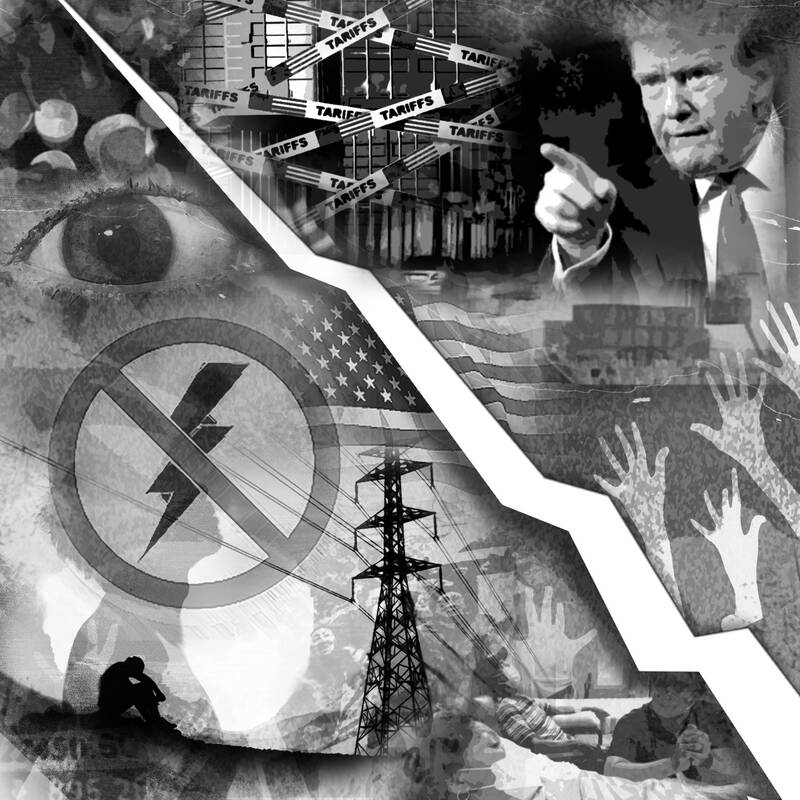
Illustration: Kevin Sheu
“Over the early decades of the 1900s, US ambassadors believed the US had the right to steer Cuban political life,” said Ada Ferrer, a historian whose Cuban memoir Keeper of My Kin is soon to be published. Such involvement was once known as “coercive influence,” Ferrer added.
“No politician has spoken as crudely about it as Trump just did, and no one has used that kind of explicit language in almost a century,” she said. “Trump says aloud the things for which historians used to have to uncover evidence,” she added.
Many on the island were struggling with more immediate concerns: spoiled food, stifling heat, sleepless children. Others were appalled, nonetheless.
Gretel, a musician and mother in the Havana suburb of La Lisa, had struggled through the night trying to ward off mosquitoes from biting her children. Late last year, nearly a third of the population was infected during an outbreak of the mosquito-borne illness chikungunya, which causes brutal joint pain that can last for months.
On Tuesday morning, Gretel was still without power and fuming at the US president’s comments. “It is the same tone as he is using with Iran, with Venezuela. Surprisingly, Americans do not see what it is. It is like that scene in The Great Dictator where Charlie Chaplin’s dancing around saying, ‘I can do this, I can do that, I can do anything,’” she said.
After the success of the mission to abduct former Venezuelan president Nicolas Maduro, one of Cuba’s greatest allies in the region, Trump has steadily ratcheted up the pressure on the territory, signing an executive order to impose tariffs on any country that sends oil to the Caribbean island.
The result has been disastrous for ordinary Cubans. There are few cars on the roads, most of the airlines serving the island have suspended flights, the Canadian company Sherritt International has shuttered nickel mining operations, state offices have closed, and schools have partly suspended classes.
The lack of fuel has also exacerbated the rolling blackouts. Cuba’s archaic power network has been partially collapsing regularly since October 2024, and the country has already seen three national collapses in the past four months, with a knock-on effect on the water supply. This weekend, the power cuts sparked a rare violent protest.
By lunchtime on Tuesday, the country’s grid operator said power had been restored to the west and center of the 1,250km-long island, with about 30 percent of Havana’s homes reconnected.
“It must be done gradually to avoid setbacks,” said Lazaro Guerra, the electricity director of the Ministry of Energy and Mines, adding, “Because systems, when very weak, are more susceptible to failure.”
That may be what the US administration is counting on.
Cuba recently admitted it had been in discussions with Washington, and it now seems to be showing a willingness to make some economic changes in an attempt to appease the US.
Shortly before Trump’s announcement, Cuban Deputy Prime Minister Oscar Perez-Oliva Fraga, a member of the Castro family, said Cuba was open to expatriate Cubans and foreign companies doing business on the island.
“Cuba is open to having a fluid commercial relationship with US companies and also with Cubans residing in the United States and their descendants,” he told NBC. “We are not just talking about small enterprise, but also the possibility of being able to participate in key sectors of our development.”
This led to a waspish reply from John S. Kavulich, the president of the often sympathetic US-Cuba Trade and Economic Council, suggesting Cuba’s authorities had long been dragging their heels when it came to overhauls. “The government of the Republic of Cuba is only now authorizing what could have been implemented four years ago. They refused,” Kavulich said.
On Tuesday, US Secretary of State Marco Rubio said the proposed economic changes did not go far enough — and hinted at further US pressure to shatter Havana’s 67-year-old political system.
“What they announced yesterday is not dramatic enough. It’s not going to fix it. So we’ve got some big decisions to make,” Rubio said. The New York Times reported on Monday that US negotiators were demanding the resignation of the Cuban president, Miguel Diaz-Canel.
The comments from Washington suggest Trump’s patience is running out, and Cubans were wondering if this time the state would manage to get the system up and running again.
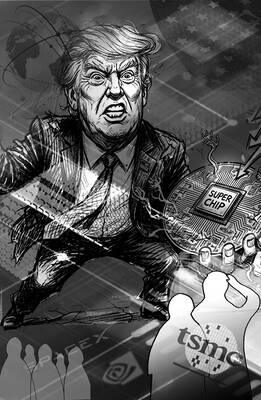
The White House’s decision to take a 9.9 percent stake in Intel Corp is looking like very shrewd business indeed. Since the government bought in at US$20.47 a share last August, the US chipmaker’s surging stock price has delivered the US a US$43 billion return. One of the reasons the investment has so far proved so sound is that the White House has made sure of it. According to The Wall Street Journal, Howard personally pushed deals on Intel’s behalf with some of the most lucrative clients imaginable. They include Nvidia Corp, the company at the heart of the AI
The Ministry of the Interior, working with the navy and coast guard, is organizing Taiwan’s first joint exercise simulating escort tankers carrying liquefied natural gas (LNG) and oil through a Chinese blockade. The drills simulate fuel transport along three maritime corridors leading toward Japan, the Philippines and the US. Deputy Minister of the Interior Sawyer Mars (馬士元) said that a blockade of the Taiwan Strait would amount to “almost a 100 percent blockade of the regional energy supply.” Minister of National Defense Wellington Koo said planning to counter a blockade is standard practice in Taipei. While the exercise is limited in
A single photograph can cut through a lot of noise, but it can also be used to misrepresent the truth. At the very least, it can concentrate the mind on something that requires further investigation. On Monday last week, Ma Ying-jeou Foundation CEO Tai Hsia-ling (戴遐齡) and former National Security Council secretary-general King Pu-tsung (金溥聰) held a news conference in which they showed a photograph of former foundation CEO Hsiao Hsu-tsen (蕭旭岑), now Chinese Nationalist Party (KMT) deputy chairman. In the image Hsiao is seated next to Xiamen Taiwan Businessmen Association chairman Han Ying-huan (韓螢煥). The two men were holding
In a Taiwanese university classroom, a lecturer asks in English: “Can anyone give me an example from Taiwan?” Students look down. No one answers. After class, one student writes on the course platform in Mandarin: “I understood the concept, but I didn’t know how to answer in English.” That moment highlights a key issue in Taiwan’s English-medium instruction (EMI) reform: It is not just about more English-taught courses, but whether students can learn, participate and belong. EMI expansion is part of the Bilingual 2030 policy and the Ministry of Education’s BEST Program, aiming to improve English ability, support EMI teaching


 RSS
RSS