


The US and Israeli strikes on Iran have drawn global attention, with most commentary focused on escalation risks and energy markets — but this misses the more consequential development.
For China, this is not simply a regional conflict. It is a real-time strategic experiment — a rare opportunity to observe how the US performs under simultaneous military, economic and political strain.
First, the war reveals how Washington manages trade-offs under pressure. As energy prices fluctuate and inflation concerns resurface, US policymakers face a familiar dilemma: how to sustain external military commitments while containing domestic economic costs. For Beijing, the key question is not whether the US can act, but whether it could remain strategically consistent when those costs begin to accumulate. Consistency under pressure is the real test of power.
Second, the conflict exposes the limits of the US’ military capacity. High-intensity operations require sustained use of precision munitions, intelligence coordination and long-range strike capabilities — all of which are finite. China is observing not only battlefield effectiveness, but the rate of resource consumption and, crucially, what remains available for other theaters.
Third, the war tests political endurance. As conflicts drag on, their effects are transmitted through domestic channels: rising energy prices, higher living costs and shifting public opinion. Whether political support holds under such pressure is central to assessing the sustainability of the US’ global engagement. From Beijing’s perspective, this is not about public sentiment alone, but about the durability of political will.
Iran’s ability to absorb sustained pressure and maintain regime stability sends a different signal — one that authoritarian systems are inclined to internalize. Resilience under external shock reinforces the perceived value of centralized authority, internal discipline and preemptive security control.
Taken together, the conflict becomes more than a regional crisis. It is a signal-generating environment — one in which China can evaluate US decisionmaking, military limits and political stamina in real time.
These observations would not remain theoretical.
For Taiwan, the critical issue is not only whether US attention is divided, but how China interprets what it sees. If Beijing concludes that Washington’s resources are stretched, domestic constraints are tightening and political will is conditional, it might begin to reassess the risks of acting elsewhere.
The danger lies not only in shifts in capability, but in changes in perception.
History suggests that conflicts are rarely triggered by clear superiority. They are triggered by miscalculation — when one side believes the strategic environment is more favorable than it actually is. Wars elsewhere could produce simplified or misleading signals, increasing the risk of overconfidence.
For Taiwan, the priority is not to simply monitor developments, but to prevent the emergence of any perceived “window of opportunity.” That requires bolstering resilience across multiple domains: military preparedness, energy security, economic stability and social cohesion.
Deterrence, in this context, is not just about capability. It is about denying confidence.
At a time when geopolitical pressure and economic strain are converging, internal division is not merely a political issue — it is a strategic liability. Fragmentation weakens not only governance, but also credibility. It reinforces precisely the kind of narrative Beijing is already constructing.
Bonnie Yushih Liao is an assistant professor in Tamkang University’s Department of Diplomacy and International Relations.
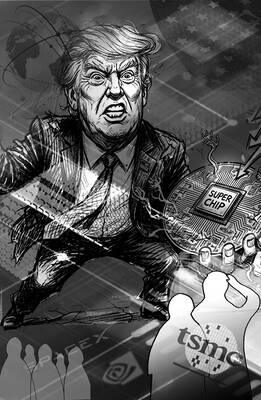
The White House’s decision to take a 9.9 percent stake in Intel Corp is looking like very shrewd business indeed. Since the government bought in at US$20.47 a share last August, the US chipmaker’s surging stock price has delivered the US a US$43 billion return. One of the reasons the investment has so far proved so sound is that the White House has made sure of it. According to The Wall Street Journal, Howard personally pushed deals on Intel’s behalf with some of the most lucrative clients imaginable. They include Nvidia Corp, the company at the heart of the AI
The Ministry of the Interior, working with the navy and coast guard, is organizing Taiwan’s first joint exercise simulating escort tankers carrying liquefied natural gas (LNG) and oil through a Chinese blockade. The drills simulate fuel transport along three maritime corridors leading toward Japan, the Philippines and the US. Deputy Minister of the Interior Sawyer Mars (馬士元) said that a blockade of the Taiwan Strait would amount to “almost a 100 percent blockade of the regional energy supply.” Minister of National Defense Wellington Koo said planning to counter a blockade is standard practice in Taipei. While the exercise is limited in
A single photograph can cut through a lot of noise, but it can also be used to misrepresent the truth. At the very least, it can concentrate the mind on something that requires further investigation. On Monday last week, Ma Ying-jeou Foundation CEO Tai Hsia-ling (戴遐齡) and former National Security Council secretary-general King Pu-tsung (金溥聰) held a news conference in which they showed a photograph of former foundation CEO Hsiao Hsu-tsen (蕭旭岑), now Chinese Nationalist Party (KMT) deputy chairman. In the image Hsiao is seated next to Xiamen Taiwan Businessmen Association chairman Han Ying-huan (韓螢煥). The two men were holding
In a Taiwanese university classroom, a lecturer asks in English: “Can anyone give me an example from Taiwan?” Students look down. No one answers. After class, one student writes on the course platform in Mandarin: “I understood the concept, but I didn’t know how to answer in English.” That moment highlights a key issue in Taiwan’s English-medium instruction (EMI) reform: It is not just about more English-taught courses, but whether students can learn, participate and belong. EMI expansion is part of the Bilingual 2030 policy and the Ministry of Education’s BEST Program, aiming to improve English ability, support EMI teaching


 RSS
RSS