


The global technological order is rapidly restructuring and the world is entering a new era of technological geopolitics.
Over the past 30 years, the core logic of globalization was efficiency and cost, but after the escalation of US-China technological competition and supply chain disruptions caused by the Russia-Ukraine war, many countries have begun placing security and resilience at the center of their economic policies.
The EU’s strategies of “derisking” and “technological sovereignty” are concrete manifestations of this new trend. In this context, Taiwan is facing a new strategic opportunity.
First, the EU is searching for reliable technology partners. Taiwan’s key position in the global semiconductor and electronics supply chain makes it an important partner for Europe in its efforts to advance technological autonomy.
Second, as the EU’s Indo-Pacific strategy gradually takes shape, European policymakers increasingly recognize that security in the Taiwan Strait is closely linked to Europe’s economic interests. Taiwan’s semiconductor industry, which is indispensable to the global supply chain, gives Taiwan–Europe cooperation significant strategic importance.
Among the major EU countries, France plays a critical role in technology policy and industrial strategy. France has long possessed deep strengths in basic science and advanced technologies, including quantum technology, materials science, aerospace engineering and energy technology.
The French government has launched the “France 2030” plan, with a total investment of about 54 billion euros (US$62.3 billion), to heavily invest in future industries such as semiconductors, artificial intelligence, quantum technology and green energy. The goal is to rebuild Europe’s position in the global technological competition.
From an industrial perspective, Taiwan and France are highly complementary. Taiwan has world-class mass production capabilities in semiconductor manufacturing and the electronics supply chain, while France has strong advantages in fundamental research, aerospace technology and materials science.
Through a cooperation between French research and development, and Taiwanese manufacturing, both nations could not only jointly expand into the European market, but also build a more competitive cooperative framework within the global technology industry.
Europe’s technological sovereignty strategy mainly focuses on two fields.
The first is the semiconductor supply chain. Europe is developing capabilities in chip materials, design and advanced packaging, while also bolstering high-performance computing and artificial intelligence infrastructure.
The second is quantum technology. With the support of institutions such as the French National Center for Scientific Research and the French Alternative Energies and Atomic Energy Commission, France has built a strong foundation for quantum research.
The breakthrough in quantum entanglement by physicist Alain Aspect, winner of the 2022 Nobel Prize in Physics, further highlights France’s world-leading position in quantum science.
Taiwan-France cooperation should not remain limited to academic exchanges. It should deepen into industrial collaboration, including establishing bilateral industry cooperation platforms, promoting joint research and development funds, and encouraging two-way corporate investment.
Against the backdrop of intensifying US-China competition, if Taiwan uses France as a gateway to Europe’s technological system by combining its manufacturing efficiency with the other’s research strengths, they could build a more resilient network of technological cooperation.
This would not only be a new opportunity for Taiwan-France cooperation, but could also become an important pillar in the restructuring of the global technological order.
Wea Chi-lin is a professor at National Taiwan University’s Graduate Institute of Business Administration.
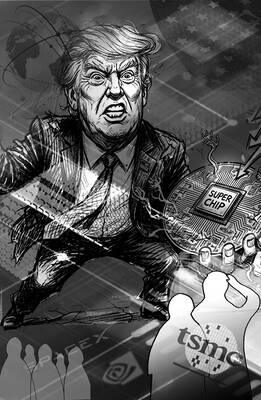
The White House’s decision to take a 9.9 percent stake in Intel Corp is looking like very shrewd business indeed. Since the government bought in at US$20.47 a share last August, the US chipmaker’s surging stock price has delivered the US a US$43 billion return. One of the reasons the investment has so far proved so sound is that the White House has made sure of it. According to The Wall Street Journal, Howard personally pushed deals on Intel’s behalf with some of the most lucrative clients imaginable. They include Nvidia Corp, the company at the heart of the AI

KMT Chairwoman Cheng Li-wun’s (鄭麗文) recent visit to Beijing and her upcoming visit to Washington will serve as a high-level test of her diplomatic mettle. In Beijing, Cheng was received with symbolic gestures, a warm reception, and high-level access. In Washington, she will receive far less pomp and far sharper questions about the KMT’s vision for the future of Taiwan. Her challenge will be to persuade Washington that the KMT’s engagement with China can coexist with strong deterrence. Cheng’s April 7-12 visit to mainland China coincided with an intense period of conflict in Iran. Despite the strategic significance of Cheng’s trip,

The closure of the Strait of Hormuz has sent the vast Asian chemicals industry into a tailspin. Deprived of the likes of Qatari natural gas and Saudi Arabian oil, the region’s fertilizer and plastics plants are slowing production or even shutting down. Everywhere except China, that is. In petrochemicals, China is unique. As well as a traditional industry that uses oil and gas as feedstock, it has parallel output that relies on its abundant domestic coal. Unsurprisingly, India and other regional powers want to copy and paste the Chinese method. This would not be easy — or climate friendly. The
Indonesian President Prabowo Subianto says he knows how to fix the problems facing Indonesia. Yet his economic mismanagement and authoritarian tendencies are steering the nation toward a familiar mix of currency instability and political chaos. The world’s fourth-most populous nation risks reversing the hard-won democratic and business reforms that came after the Asian Financial Crisis in 1997. At that time, the rupiah collapsed and the political upheaval that followed forced former president Haji Mohamed Suharto from power. Prabowo’s administration is ignoring similar warning signs. That disconnect was apparent in a national address on Wednesday, when Prabowo projected the swagger that has


 RSS
RSS