


Across two online worlds that are normally splintered, over the past few months there has been a mirroring of sorts. On TikTok and Instagram, young people are diving into the joys of Chinese culture — from drinking hot water to playing mahjong — all under the banner of “Chinamaxxing.”
However, on the Chinese Internet, the US is losing its decades-long grip on soft power and is instead being replaced by a darker trend: The kill line.
The kill line is a dangerous place to be. In gaming, the term refers to the point at which a player’s strength is so depleted that one more blow could lead to total wipeout. In China, the term refers to the risks that come with daily life in the US.
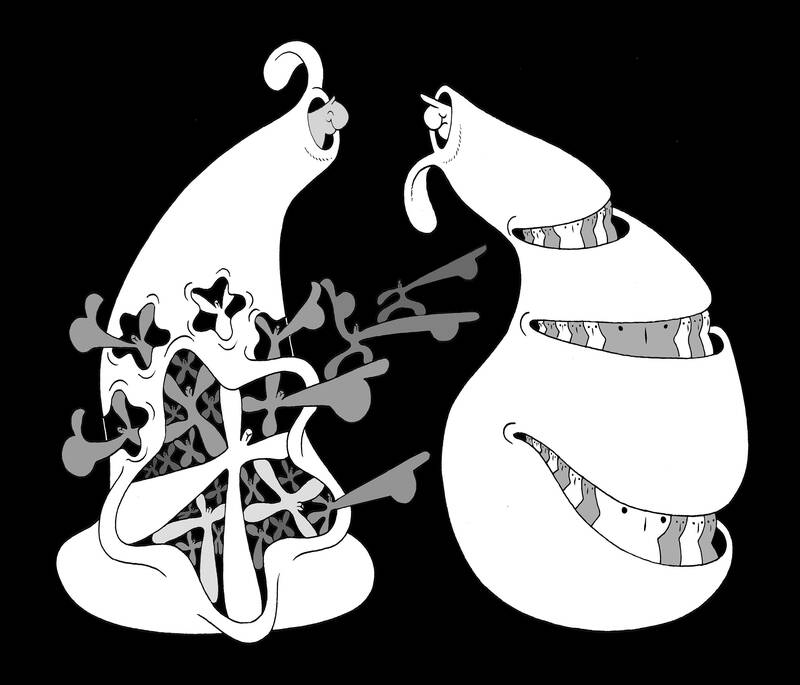
Illustration: Mountain People
In the past few months, Chinese media have been flooded with discussion of the so-called “kill line” in US society. The social media posts, news articles, podcasts and blogs describe a vision of the US as a dystopian capitalist hell. One video shared by a state-run account on RedNote shows a homeless man talking about how he used to earn a six-figure salary. (The post claims that the video comes from the US and that the man earned US$450,000; in fact the clip is taken from an old video about homelessness on the streets of London).
Another case that has gone viral is that of Tylor Chase, a former Nickelodeon star who was recently spotted homeless on the streets of California.
One Chinese news presenter said: “Tylor’s fate confirms the existence of a ‘kill line’ in American society where the middle class plummets into the underclass... This ‘kill line’ exposes America’s dual nature: The winners achieve ultimate success, while the losers fall into an abyss from which there is no return.”
In total, hashtags related to the US “kill line” have been viewed more than 600 million times on Sina Weibo, a Chinese social media platform.
Chinese propaganda has long cast the West as a land of poverty and depravity. On one day in 1968, during the early years of the Cultural Revolution, the Chinese Communist Party’s (CCP) official newspaper, the People’s Daily, published no less than three articles describing the US as some version of hell, blighted by widespread famine and an elite class of billionaire “bloodsuckers.”
One described the US simply as: “A paradise for the rich, a hell for the poor.”
However, regular people tended nonetheless to view the US as a land of opportunity and prosperity, especially after China started opening up in the 1980s and there was a greater flow of information between the two countries.
Late last year, that changed.
The latest trend started in November last year, when a Chinese student living in Seattle posted a five-hour stream to the Chinese video-sharing Web site BiliBili. In the video, which has since attracted more than 3 million views, he describes seeing hungry children at Halloween and the harsh realities of life for disadvantaged people in the world’s biggest economy. Soon, the term “kill line” took on a life of its own.
In January, the CCP’s official theoretical journal, Qiushi, published a commentary stating that the kill line “reveals the structural economic fragility of American society.”
A few weeks later, a Chinese state media journalist at an event in Davos, Switzerland, asked US Secretary of the Treasury Scott Bessent repeatedly about the so-called kill line.
Bessent, confused, talked up the economic policy of US President Donald Trump’s administration before saying: “I don’t understand the question.”
“For quite a long time we know that China has been looking up to the US, regardless of the official rhetoric,” said Wang Hao-lan (王浩嵐), a research associate at the Asia society in New York.
However, a host of events — from the 2008 economic crisis to the election of Trump to the US’ handling of the COVID-19 pandemic — has turned that admiration into a curiosity about the “turmoil” in the country, Wang said.
Ren Yi (任意), an influential nationalist commentator who blogs under the name Chairman Rabbit (兔主席), said that the re-election of Trump and the US-China trade war are the most important reasons for plummeting regard for the US among Chinese.
“Chinese people are much more critical of the US now. Their attitude toward America has been shifting constantly, which is closely linked to the changing balance of power between the two nations,” Ren said.
While China does have poverty problems, social and cultural factors mean that people are unlikely to end up on the streets, he said.
“In China, you can always get support from both close and extended family, you always have someone to help you,” he said.
Chinese looking at the problems in the US “don’t understand it,” he added.
Homelessness in the US is a growing problem. In 2024, there were more than 771,000 people experiencing homelessness, an 18 percent increase on the previous year and a record high, according to the National Alliance to End Homelessness, a non-profit organization based in Washington.
In China, the problem is harder to quantify because the internal passport system, called the hukou (戶口), counts people based on where they are registered — usually at birth — rather than where they live. Millions of domestic migrants live in crowded and unsanitary accommodation on the fringes of big cities, often floating between dormitories depending on their jobs, but they would not be officially counted as homeless.
Severe destitution is hidden from public view, while the government’s success at eradicating extreme poverty — a milestone that Chinese President Xi Jinping (習近平) said was reached in 2021 — is frequently promoted in the official narrative.
Many Chinese see some truth in the idea that the possibility of a total social catastrophe is more likely in the US than China, but while Internet users in China are gawking at the idea of a US riven by poverty and chaos, for their American counterparts it is quite the opposite. With “Chinamaxxing,” American teenagers are reveling in traditional Chinese lifestyle hacks such as drinking hot water or wearing slippers indoors.
The trend’s slogan? “You’ve met me at a very Chinese time in my life.”
The Chinese government is lapping this up. Beijing is on a tourism drive, relaxing visa requirements for visitors from many European countries. Influencers willing to tell a rosy story about the most appealing aspects of life in China — while skirting over more sensitive topics like human rights and political oppression — have been welcomed with open arms.
Meanwhile, in the US, a country which, unlike China, for the most part allows journalists to freely report on the worst aspects of society as well as the best, its government’s most thuggish behavior is being broadcast to audiences of millions, damaging its global reputation.
Some commentators see the kill line meme as being a way for Chinese to vent about, or distract from, their own frustrations at home. Nearly one in five young people aged 16 to 24 are unemployed, according to official statistics, with some economists estimating that the true level could be much higher. Low wages and sluggish growth have given rise to an era of economic pessimism that the government is keen to combat. Promoting the supposed “kill line” in the US could be one helpful distraction.
“China currently has various social problems of its own, but by publicizing that the West is also doing poorly — or even suggesting that the West is worse than China — creates an image that provides people with a sense of psychological comfort,” said Wang Qingmin, a Chinese writer who lives in Germany. “Someone who might have originally been critical of the Chinese government may, after seeing these problems in Western society, shift toward a more positive attitude.”
Some people “find positive energy by observing the misery of people in the US,” Ren said.
Commentators who have tried to draw a more explicit link between the kill line meme and China’s domestic problems have been swiftly censored.
In an essay that was later deleted, legal blogger Li Yuchen (李宇琛) wrote that US-bashing nationalism had become a lucrative niche for influencers.
“It doesn’t solve any of your problems — your stocks won’t recover, your mortgage won’t decrease by a single penny,” Li wrote. Such content is like “a cheap dose of ‘patriotic aphrodisiac.’”
Henry Gao, a professor at Singapore Management University’s Yong Pung How School of Law, said the official promotion of the so-called US “kill line” suggests that the Chinese government is trying to deflect from economic problems at home.
“This is a recurring pattern in China, where attention is often diverted toward perceived issues in other countries whenever significant internal challenges arise — with the United States typically being the first target,” Gao said.
In the event of a war with China, Taiwan has some surprisingly tough defenses that could make it as difficult to tackle as a porcupine: A shoreline dotted with swamps, rocks and concrete barriers; conscription for all adult men; highways and airports that are built to double as hardened combat facilities. This porcupine has a soft underbelly, though, and the war in Iran is exposing it: energy. About 39,000 ships dock at Taiwan’s ports each year, more than the 30,000 that transit the Strait of Hormuz. About one-fifth of their inbound tonnage is coal, oil, refined fuels and liquefied natural gas (LNG),
On Monday, the day before Chinese Nationalist Party (KMT) Chairwoman Cheng Li-wun (鄭麗文) departed on her visit to China, the party released a promotional video titled “Only with peace can we ‘lie flat’” to highlight its desire to have peace across the Taiwan Strait. However, its use of the expression “lie flat” (tang ping, 躺平) drew sarcastic comments, with critics saying it sounded as if the party was “bowing down” to the Chinese Communist Party (CCP). Amid the controversy over the opposition parties blocking proposed defense budgets, Cheng departed for China after receiving an invitation from the CCP, with a meeting with
To counter the CCP’s escalating threats, Taiwan must build a national consensus and demonstrate the capability and the will to fight. The Chinese Communist Party (CCP) often leans on a seductive mantra to soften its threats, such as “Chinese do not kill Chinese.” The slogan is designed to frame territorial conquest (annexation) as a domestic family matter. A look at the historical ledger reveals a different truth. For the CCP, being labeled “family” has never been a guarantee of safety; it has been the primary prerequisite for state-sanctioned slaughter. From the forced starvation of 150,000 civilians at the Siege of Changchun
The two major opposition parties, the Chinese Nationalist Party (KMT) and the Taiwan People’s Party (TPP), jointly announced on Tuesday last week that former TPP lawmaker Chang Chi-kai (張啟楷) would be their joint candidate for Chiayi mayor, following polling conducted earlier this month. It is the first case of blue-white (KMT-TPP) cooperation in selecting a joint candidate under an agreement signed by their chairpersons last month. KMT and TPP supporters have blamed their 2024 presidential election loss on failing to decide on a joint candidate, which ended in a dramatic breakdown with participants pointing fingers, calling polls unfair, sobbing and walking


 RSS
RSS