


The war in Iran was always going to creep up on India, the world’s second-largest destination for oil exiting the Strait of Hormuz. Surprisingly, the biggest immediate impact has been on dosa and dal makhana. State-owned refiners are forced to eat their losses to keep trucks and tractors moving, but commercial kitchens are starting to crater under a severe shortage of liquefied petroleum gas (LPG).
In the 1973 energy shock, India’s industry leaned on coal, but its homes relied on the erratic availability of liquid fuels. LPG cylinders were a rationed luxury, and all middle-class families had kerosene stoves. The situation has flipped now: Buses, taxis and kitchens have switched to some form of gas to curb pollution. However, unlike oil, which can be stored in rock caverns, gas requires super-cooled tanks or pressurized vessels. India’s storage buffer is thin, and therein lies the germ of the current crisis.
Under the Essential Commodities Act, the government has prioritized household cylinders, but commercial supplies have seized up. Restaurants are unable to serve foods requiring continuous high-energy cooking.
In the southern city of Hyderabad, the seasonal Ramadan delicacy of haleem — a meat-and-grain porridge requiring hours of slow cooking — is still on the menu because it is prepared in traditional wood-fired kilns. However, even there, kitchens are struggling to fry the onions that garnish the dish.
The crisis extends beyond eateries. Huli Spirits, a jaggery rum microdistillery in Karnataka, home to India’s Silicon Valley of Bengaluru, has decided to halt production. After paying US$9,000 a month just for a license, a shutdown is a gut punch.
“All our effort to procure gas has gone in vain,” founder Aruna Urs wrote to authorities last week.
Retrofitting for coal would take three months, a taller chimney and new environmental permits — a niche start-up like his cannot afford any of it, Urs said.
BENEFITS
India’s push for a more gas-based economy is centered on liquefied natural gas (LNG). The country is not alone in this. Across South Asia — India, Pakistan, Bangladesh — energy companies have rolled out a US$107 billion bet on imported LNG. India is pursuing the world’s second-largest terminal capacity expansion and the third-largest gas pipeline buildout, Global Energy Monitor said.
Pressing buses, autorickshaws and urban condominiums toward burning the methane contained in LNG was supposed to be a halfway house. India has been making remarkable progress in harvesting solar energy. The idea was to eventually shift demand to renewable sources, reducing emissions and reining in a historical dependence on the Middle East.
A side benefit was that it would free up local LPG output for use by the less affluent. However, there was a catch. The production — basically propane and butane released during the refining of crude oil — did not keep pace with the new demand that was created by giving subsidized cylinders to 100 million new connections. That campaign is widely believed to have buttressed Indian Prime Minister Narendra Modi’s popularity, especially in rural areas, where women voters were the most exposed to toxic fumes from burning coal, wood or cow-dung cakes.
As a result, almost 65 percent of India’s cooking fuel today is directly imported in large vessels, and 90 percent of that traverses the Strait of Hormuz. The government household supplies are stable, and it is only misinformation that is leading to “panic booking and hoarding.” Still, people are not taking chances; sales of electric cookers are soaring.
Meanwhile, public facilities like 22 LPG-operated crematoriums across Pune, a large city in India’s Maharashtra state, have closed indefinitely, forcing a switch to electric in case families do not want the traditional Hindu option of wooden pyres, which lead to the felling of 50 million to 60 million trees every year nationwide. The municipal authority has said it is following the Ministry of Petroleum and Natural Gas’ orders to conserve gas for household use.
PAINFUL MEMORIES
More pain looms for the food economy. Fertilizer plants are suspending production of urea, a critical crop nutrient, as Qatari LNG supplies stall, Bloomberg News reported on Wednesday last week. Still, a smaller harvest is tomorrow’s problem; today’s headache is urban dislocation. If migrant workers or students cannot find affordable meals in cities, they might head back to their villages, reviving painful memories of the COVID-19 exodus.
Hopefully, it would not come to that. New Delhi is reportedly in talks with Tehran for safe passage of tankers, though it remains unclear if such movement is feasible from an insurance perspective.
A US reprieve for India to buy Russian oil — without reprising last August’s 25 percent punitive tariffs — could keep traffic moving and tractors plowing. A plan to import LPG from the US is also under way. While that should please US President Donald Trump, the geography is punishing: A ship from Qatar reaches Gujarat in four days; a ship from the US Gulf Coast, dodging Red Sea tensions via the Cape of Good Hope, takes a month.
India’s gas transformation was supposed to help modernize the economy, at least until more environmentally ambitious plans like green hydrogen could become practical solutions. Instead, the war has exposed the most-populous nation as a vulnerable commuter on the world’s energy highway. India is keeping the home fires burning by cannibalizing the very industries that provide much-needed employment to a restive youth. With the dough for the everyday dosa getting cold in the pan, how will India ever pitch itself to artificial intelligence hyperscalers as a hot destination for their next energy-hungry data centers?
Andy Mukherjee is a Bloomberg Opinion columnist covering industrial companies and financial services in Asia. Previously, he worked for Reuters, the Straits Times and Bloomberg News. This column reflects the personal views of the author and does not necessarily reflect the opinion of the editorial board or Bloomberg LP and its owners.
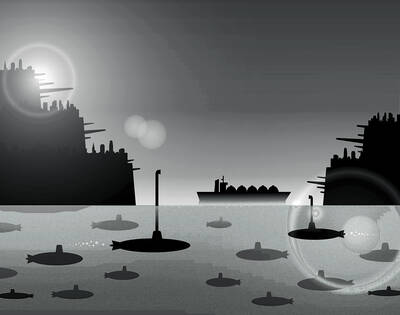
In the event of a war with China, Taiwan has some surprisingly tough defenses that could make it as difficult to tackle as a porcupine: A shoreline dotted with swamps, rocks and concrete barriers; conscription for all adult men; highways and airports that are built to double as hardened combat facilities. This porcupine has a soft underbelly, though, and the war in Iran is exposing it: energy. About 39,000 ships dock at Taiwan’s ports each year, more than the 30,000 that transit the Strait of Hormuz. About one-fifth of their inbound tonnage is coal, oil, refined fuels and liquefied natural gas (LNG),
On Monday, the day before Chinese Nationalist Party (KMT) Chairwoman Cheng Li-wun (鄭麗文) departed on her visit to China, the party released a promotional video titled “Only with peace can we ‘lie flat’” to highlight its desire to have peace across the Taiwan Strait. However, its use of the expression “lie flat” (tang ping, 躺平) drew sarcastic comments, with critics saying it sounded as if the party was “bowing down” to the Chinese Communist Party (CCP). Amid the controversy over the opposition parties blocking proposed defense budgets, Cheng departed for China after receiving an invitation from the CCP, with a meeting with
To counter the CCP’s escalating threats, Taiwan must build a national consensus and demonstrate the capability and the will to fight. The Chinese Communist Party (CCP) often leans on a seductive mantra to soften its threats, such as “Chinese do not kill Chinese.” The slogan is designed to frame territorial conquest (annexation) as a domestic family matter. A look at the historical ledger reveals a different truth. For the CCP, being labeled “family” has never been a guarantee of safety; it has been the primary prerequisite for state-sanctioned slaughter. From the forced starvation of 150,000 civilians at the Siege of Changchun
The two major opposition parties, the Chinese Nationalist Party (KMT) and the Taiwan People’s Party (TPP), jointly announced on Tuesday last week that former TPP lawmaker Chang Chi-kai (張啟楷) would be their joint candidate for Chiayi mayor, following polling conducted earlier this month. It is the first case of blue-white (KMT-TPP) cooperation in selecting a joint candidate under an agreement signed by their chairpersons last month. KMT and TPP supporters have blamed their 2024 presidential election loss on failing to decide on a joint candidate, which ended in a dramatic breakdown with participants pointing fingers, calling polls unfair, sobbing and walking


 RSS
RSS