


Ever since Fidel Castro’s forces overthrew Fulgencio Batista’s regime in 1959, Cuba has served as a revolutionary paradigm for Latin American leftists — and the US’ Achilles’ heel in the region. While the regime’s oft-predicted demise has failed to materialize, that might change now that US President Donald Trump has seized control of Venezuela’s fossil-fuel industry, enabling his administration to establish an effective oil blockade of Cuba.
Although Trump recently eased restrictions on private oil sales to Cuba, his pressure campaign has plunged the country into crisis, resulting in dire humanitarian conditions and significantly increasing the risk of uncontrolled migration by boat to the US and Mexico.
Florida, the closest US state to Cuba, could probably handle an exodus on a scale larger than that of the 1980 Mariel boatlift, when around 125,000 Cubans reached Miami after Castro briefly lifted the ban on emigration. However, this might cause a political uproar, especially given Trump’s anti-immigrant agenda. Mexico’s Yucatan peninsula, another major destination for Cuban migrants, lacks the resources to receive and care for those fleeing the nation, as has become evident in recent years.
To alleviate Cubans’ suffering and prevent a new migrant crisis, urgent and innovative measures are required. Instead of threatening a “friendly takeover,” the US government should position itself as a potential trade partner. This would require lifting the trade embargo, which former US president Barack Obama tried to do, though partisan divisions doomed the effort.
The timing is right for such an approach. With a mandatory joint review of the US-Mexico-Canada Agreement (USMCA) scheduled for later this year, its members should consider inviting Cuba to join. Tourism is the nation’s main source of revenue, and more than half of its annual visitors come from these three countries. Moreover, Cuban leaders have indicated their eagerness for investment. These factors, coupled with the risk of societal breakdown, might be enough to compel Cuba to launch a transition to a market-based economy with a predictable legal framework.
Such a shift is not unheard of. Consider the EU’s integration of post-communist countries. The prospect of EU membership created huge incentives for internal change. Of course, market liberalization triggered shocks, but most of these countries are far better off for taking the reform medicine, with Poland emerging as one of the EU’s best-performing economies in recent years. Expansion was beneficial not only for the European market but also for regional security.
Compared to Europe, the US shares stronger cultural affinities, including three primary languages (English, Spanish and French) and, despite the wars fought in the 19th century, a common sense of belonging to a new world that had shaken off the shackles of colonialism.
Moreover, the implementation in 1994 of the North American Free Trade Agreement (NAFTA) advanced cohesion and improved lives in all three countries. Trump, who sought to terminate NAFTA in his first term before realizing that doing so would be political suicide, replaced it in 2020 with the USMCA, which tightened the rules of origin for merchandise trade.
As a result, Mexico became the top US trading partner, with Canada close behind, and the three countries are even more integrated today than before Trump first took office, putting them in a stronger position to compete with China. This remains the case despite Trump’s belligerent rhetoric against the US’ neighbors and imposition of high import tariffs in his second term. In fact, Mexico and Canada have fared relatively well following the introduction of tariffs, because USMCA-compliant goods are exempt.
The Trump administration is facing several challenges: Prices remain high ahead of the midterm elections, and the US-Israeli war in Iran threatens to exacerbate the electorate’s affordability concerns. Adding Cuba to the USMCA would create a larger market, improve access to critical minerals, which are being mined in Cuba by Canadian companies, and secure Cuba’s transition to a market economy without resorting to force.
Just as former US president Richard Nixon’s strident anti-communist views gave him political cover to open relations with the People’s Republic of China, Trump’s far-right credentials make him well placed to risk reconciliation with Cuba. As the son of Cuban immigrants and a hardliner, US Secretary of State Marco Rubio is also uniquely positioned to achieve this outcome.
However, Trump and Rubio must choose the most effective and least painful route: regional integration. Cubans have endured enough suffering, including the pain of exile and family separation. It might seem improbable, but a new and peaceful Cuban revolution is possible.
Roberta Lajous, a career Mexican diplomat, is a former Mexican ambassador to Cuba (2002-2005) and the author of Historia minima de las relaciones exteriores de Mexico (El Colegio de Mexico, 2012) and La politica exterior del porfiriato (1876-1911) (El Colegio de Mexico, 2010).
Copyright: Project Syndicate
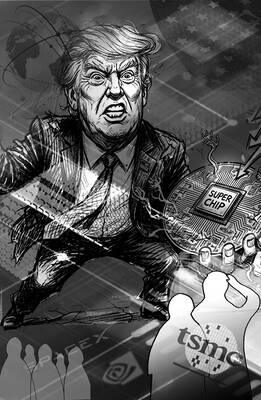
The White House’s decision to take a 9.9 percent stake in Intel Corp is looking like very shrewd business indeed. Since the government bought in at US$20.47 a share last August, the US chipmaker’s surging stock price has delivered the US a US$43 billion return. One of the reasons the investment has so far proved so sound is that the White House has made sure of it. According to The Wall Street Journal, Howard personally pushed deals on Intel’s behalf with some of the most lucrative clients imaginable. They include Nvidia Corp, the company at the heart of the AI
The Ministry of the Interior, working with the navy and coast guard, is organizing Taiwan’s first joint exercise simulating escort tankers carrying liquefied natural gas (LNG) and oil through a Chinese blockade. The drills simulate fuel transport along three maritime corridors leading toward Japan, the Philippines and the US. Deputy Minister of the Interior Sawyer Mars (馬士元) said that a blockade of the Taiwan Strait would amount to “almost a 100 percent blockade of the regional energy supply.” Minister of National Defense Wellington Koo said planning to counter a blockade is standard practice in Taipei. While the exercise is limited in
A single photograph can cut through a lot of noise, but it can also be used to misrepresent the truth. At the very least, it can concentrate the mind on something that requires further investigation. On Monday last week, Ma Ying-jeou Foundation CEO Tai Hsia-ling (戴遐齡) and former National Security Council secretary-general King Pu-tsung (金溥聰) held a news conference in which they showed a photograph of former foundation CEO Hsiao Hsu-tsen (蕭旭岑), now Chinese Nationalist Party (KMT) deputy chairman. In the image Hsiao is seated next to Xiamen Taiwan Businessmen Association chairman Han Ying-huan (韓螢煥). The two men were holding
I first met Professor Ray Jiing (井迎瑞) as a film and documentary student at Shih Hsin University’s (SHU) Department of Radio Television and Film in 1988. The following year, he went on to become the director of the Chinese Taipei Film Archive — forerunner of the Taiwan Film and Audiovisual Institute (TFAI). Over his eight-year tenure, Jiing rescued and restored over 200 classic Taiwanese films. In 1997, he established the Graduate Institute of Studies in Documentary and Film Archiving at Tainan National University of the Arts (TNNUA), and I joined the program in his third cohort of students. Beyond a


 RSS
RSS