


Philippine Coast Guard spokesman Jay Tarriela on March 1 was promoted from commodore to rear admiral from Philippine President Ferdinand Marcos Jr. The promotion is a striking testament to how Beijing’s intimidation tactics on its current main target in the South China Sea have backfired. It is also yet another example that Taiwan can look to when it comes to responding to Chinese scare campaigns.
Tarriela has been consistent in his approach since Manila launched its transparency initiative in early 2023 to counter Chinese “gray zone” tactics around its western waters. As the face of the West Philippine Sea Transparency Office, Tarriela holds news conferences to expose aggressive China Coast Guard encroachments into the Philippines territorial waters to harass humanitarian resupply missions and fishers. He also employs a cost-effective social media approach, publicizing such hostilities in real time.
Tarriela is well aware of the power of global media. He invites local and foreign correspondents on coast guard vessels to witness and film firsthand how China Coast Guard missions use high-power water cannons that often knock crew and personnel off ships and gangster-like activity in which Chinese forces chase, ram and damage Philippine vessels. The largest success in Tarriela’s approach is showing the world the hypocrisy of China’s “Sea of Peace, Friendship and Cooperation” concept in ASEAN.
At an interview with Tarriela in mid-2024, I witnessed the effectiveness of his approach in calling out Chinese aggression. It is a departure from previous diplomatic protests that often went unanswered or were dealt with behind closed doors. With the public well aware and frequently reminded of near daily hostility at their borders, it provides the administration with enhanced legitimacy when responding to China.
It is also the reason Tarriela was able to push back against China summoning the Philippine ambassador in Beijing and the Chinese embassy in Manila’s protest in January in an attempt to silence him along with a number of sitting senators who have been vocal about Chinese maritime aggression.
Tarriela called the embassy’s actions blatant disrespect against Philippine elected officials on their own soil. It is in line with ensuring that their waters remain free for future generations, a response I heard firsthand from Tarriela on why he chooses to be so public and visible in calling out China.
US operations in Iran and Venezuela this year are another promising development that helps boost deterrence. Philippine security expert Renato Cruz de Castro — a former Ministry of Foreign Affairs Taiwan Fellow at National Chengchi University and a distinguished professor in De La Salle University’s Department of International Studies — believes the operations show that the US is capable and willing to use force if its vital interests and the interests of its allies are threatened.
Given that Taiwan and the Philippines are both close US security partners, it would most certainly give Chinese President Xi Jinping (習近平) cause to carefully consider his options. As of Tuesday last week, there have been no Chinese air incursions for three days around Taiwan.
Perhaps constantly ensuring the public is aware of external threats posed through visible campaigns and reminding the aggressor of the consequences of military aggression is a successful formula in managing Chinese threats. What is clear is that Taipei and Manila face common intimidation campaigns coming out of Beijing, and both understand the value of coordinating counter approaches. Tarriela met with President William Lai (賴清德) and other senior officials at a maritime forum last summer in Taipei. It only makes sense that such efforts continue and expand.
Rath Wang is a senior policy fellow at Safe Spaces, a consulting firm based in Taipei and Washington focusing on Taiwan’s politics, media, civil society and key issues influencing Taiwan’s future. He is a producer and host of political talk shows and podcasts and has worked on political campaigns and advocacies in Taiwan, Japan and the US. He can be reached at rathwang@safespacesllc.com.
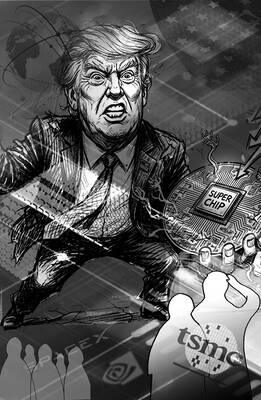
The White House’s decision to take a 9.9 percent stake in Intel Corp is looking like very shrewd business indeed. Since the government bought in at US$20.47 a share last August, the US chipmaker’s surging stock price has delivered the US a US$43 billion return. One of the reasons the investment has so far proved so sound is that the White House has made sure of it. According to The Wall Street Journal, Howard personally pushed deals on Intel’s behalf with some of the most lucrative clients imaginable. They include Nvidia Corp, the company at the heart of the AI
The Ministry of the Interior, working with the navy and coast guard, is organizing Taiwan’s first joint exercise simulating escort tankers carrying liquefied natural gas (LNG) and oil through a Chinese blockade. The drills simulate fuel transport along three maritime corridors leading toward Japan, the Philippines and the US. Deputy Minister of the Interior Sawyer Mars (馬士元) said that a blockade of the Taiwan Strait would amount to “almost a 100 percent blockade of the regional energy supply.” Minister of National Defense Wellington Koo said planning to counter a blockade is standard practice in Taipei. While the exercise is limited in
A single photograph can cut through a lot of noise, but it can also be used to misrepresent the truth. At the very least, it can concentrate the mind on something that requires further investigation. On Monday last week, Ma Ying-jeou Foundation CEO Tai Hsia-ling (戴遐齡) and former National Security Council secretary-general King Pu-tsung (金溥聰) held a news conference in which they showed a photograph of former foundation CEO Hsiao Hsu-tsen (蕭旭岑), now Chinese Nationalist Party (KMT) deputy chairman. In the image Hsiao is seated next to Xiamen Taiwan Businessmen Association chairman Han Ying-huan (韓螢煥). The two men were holding
In a Taiwanese university classroom, a lecturer asks in English: “Can anyone give me an example from Taiwan?” Students look down. No one answers. After class, one student writes on the course platform in Mandarin: “I understood the concept, but I didn’t know how to answer in English.” That moment highlights a key issue in Taiwan’s English-medium instruction (EMI) reform: It is not just about more English-taught courses, but whether students can learn, participate and belong. EMI expansion is part of the Bilingual 2030 policy and the Ministry of Education’s BEST Program, aiming to improve English ability, support EMI teaching


 RSS
RSS