


A world where we can cook up artificial intelligence (AI) videos in seconds from the apps on our phones might seem remote from the physical realities of warfare in the sea lanes of the Persian Gulf. In fact, they are closely intertwined.
That is because the building blocks of the technology industry are deeply dependent on petroleum flowing through the Strait of Hormuz, where the US government on Tuesday vowed to protect shipping threatened by retaliation from Iran after US and Israeli attacks over the week.
More than half of the DRAM and NAND chips that provide electronic devices with their short and long-term memory are manufactured in South Korea. About 70 percent of the advanced processing chips found in smartphones, PCs and data centers are made in Taiwan. Those two countries, in turn, are among the most dependent on liquefied natural gas (LNG) exports from Qatar.
It is a dangerous vulnerability, made worse by the two countries’ reluctant crawl toward renewables. Qatar’s Ras Laffan gas plant, which supplies about one-fifth of the world’s LNG, halted output on Monday last week and later declared force majeure, a legal justification for ceasing supplies during emergencies.
QatarEnergy cited military attacks on the facility. About 90 percent of the LNG produced in Qatar and the United Arab Emirates (UAE) heads to Asia.
That sparked a rapid selloff in energy-exposed Asian stock markets on Wednesday. South Korea’s KOSPI, where memory producers Samsung Electronics Co and SK Hynix Inc make up about 40 percent of the weighting, fell by 12 percent, its biggest single-day drop. Taiwan’s TAIEX, where Taiwan Semiconductor Manufacturing Co alone accounts for 45 percent of the benchmark, slumped 4.4 percent.
That is a recognition of their unique exposure. China and India might be the biggest buyers of Qatari LNG, but they have not given it nearly the same importance in their grids, with gas having a generation share of just 3 percent or so. Japan uses LNG to produce about one-third of its electricity, but Qatar and the UAE together comprise only about 5 percent of imports. Taiwan and South Korea, with their mix of gas-dependent grids and Gulf-dependent import strategies, look most vulnerable.
Right now, both countries are scrambling to secure supplies. Unlike the EU, whose stockpiles could cover about a third of annual consumption, their storage capacity is minimal: Enough to cover less than two months of imports in South Korea, and under a month in Taiwan. Once ships currently en route have disgorged their cargoes early next month, any ongoing disruption at the Strait of Hormuz is going to quickly bite into power supply. That would be a problem for electricity-hungry foundries churning out the billions of chips powering our electronic devices.
There are ways to soften the blow. LNG is available on the spot market, but at a hefty price premium that might become even steeper if the crisis at Hormuz continues. The key Asian contract is still trading at about one-sixth of the levels it hit after the Russian invasion of Ukraine in 2022.
Australia and the US, which vie with Qatar for the title of top LNG exporter, tend to be more flexible in the conditions they attach to their sales, and might see an opportunity to make spot sales and take market share. Japan, which is still comfortably supplied from other sources and sees itself as a promoter of LNG globally, might want to help out, as Bloomberg Opinion columnist Javier Blas has written.
The situation is still a wake-up call. Much of the world has used the years since the invasion of Ukraine to start reducing its vulnerability to fuel shipped from volatile corners of the globe: Consider Europe’s push for wind and solar, China’s renewables-and-coal drive, and even the US’ increasing self-sufficiency in petroleum. The democracies of Northeast Asia, vital nodes in our high-tech modern societies, have gone in the opposite direction.
An uninterrupted flow of imported energy is more important to them than ever. And yet, policy is still moving in the wrong direction. Taiwan closed down the last of its nuclear power plants in May last year, and in November the same year passed a law that would make large-scale photovoltaic farms almost impossible to build. South Korea is only gradually unpicking similar regulations. A solar-siting rule overturned last month had previously restricted such facilities to less than 1 percent of the land area in many counties.
Misinformation-fueled nimbyism has largely banned onshore wind from both countries, despite excellent conditions for the technology. Endless permitting delays and rules restricting use of imported equipment have left offshore wind languishing, too. On a planet where clean energy is cheaper than fossil power almost everywhere, a thicket of misguided regulation has left it uniquely expensive in Northeast Asia.
Countries tend to neglect the vulnerabilities in their energy policies until geopolitical emergencies force their hand. The 1973 oil crisis pushed developed nations toward nuclear, coal and domestic petroleum. The 2022 Ukraine invasion accelerated Europe’s embrace of renewables.
The current emergency is showing us just how much Asia’s developed democracies, and the world, still depend on one volatile ocean strait in the Middle East. It is time Taiwan and South Korea stepped up efforts to fix that weakness.
David Fickling is a Bloomberg Opinion columnist covering climate change and energy. Previously, he worked for Bloomberg News, the Wall Street Journal and the Financial Times. This column reflects the personal views of the author and does not necessarily reflect the opinion of the editorial board or Bloomberg LP and its owners.
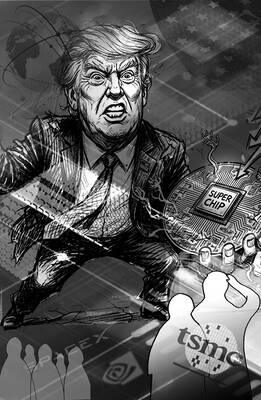
The White House’s decision to take a 9.9 percent stake in Intel Corp is looking like very shrewd business indeed. Since the government bought in at US$20.47 a share last August, the US chipmaker’s surging stock price has delivered the US a US$43 billion return. One of the reasons the investment has so far proved so sound is that the White House has made sure of it. According to The Wall Street Journal, Howard personally pushed deals on Intel’s behalf with some of the most lucrative clients imaginable. They include Nvidia Corp, the company at the heart of the AI
The Ministry of the Interior, working with the navy and coast guard, is organizing Taiwan’s first joint exercise simulating escort tankers carrying liquefied natural gas (LNG) and oil through a Chinese blockade. The drills simulate fuel transport along three maritime corridors leading toward Japan, the Philippines and the US. Deputy Minister of the Interior Sawyer Mars (馬士元) said that a blockade of the Taiwan Strait would amount to “almost a 100 percent blockade of the regional energy supply.” Minister of National Defense Wellington Koo said planning to counter a blockade is standard practice in Taipei. While the exercise is limited in
A single photograph can cut through a lot of noise, but it can also be used to misrepresent the truth. At the very least, it can concentrate the mind on something that requires further investigation. On Monday last week, Ma Ying-jeou Foundation CEO Tai Hsia-ling (戴遐齡) and former National Security Council secretary-general King Pu-tsung (金溥聰) held a news conference in which they showed a photograph of former foundation CEO Hsiao Hsu-tsen (蕭旭岑), now Chinese Nationalist Party (KMT) deputy chairman. In the image Hsiao is seated next to Xiamen Taiwan Businessmen Association chairman Han Ying-huan (韓螢煥). The two men were holding
I first met Professor Ray Jiing (井迎瑞) as a film and documentary student at Shih Hsin University’s (SHU) Department of Radio Television and Film in 1988. The following year, he went on to become the director of the Chinese Taipei Film Archive — forerunner of the Taiwan Film and Audiovisual Institute (TFAI). Over his eight-year tenure, Jiing rescued and restored over 200 classic Taiwanese films. In 1997, he established the Graduate Institute of Studies in Documentary and Film Archiving at Tainan National University of the Arts (TNNUA), and I joined the program in his third cohort of students. Beyond a


 RSS
RSS