


Since Pakistan declared “open war” on the Taliban regime in Kabul last week, it has sent waves of jets over its disputed border with Afghanistan. It continued to do so even as Iran, which neighbors both countries, was attacked by the US and Israel, and retaliated with drone and missile strikes across the region.
It takes a particular kind of self-assuredness to push an already unstable situation to the brink, but when it comes to its neighbors, Pakistan’s military has never run short of confidence.
They should know better. Two live conflicts in the same broken, mountainous arc mean risks have more than doubled. Frontiers are already porous there, crossed by smuggling routes, refugee trails and militant hideouts. A descent into chaos would offer armed groups an inviting landscape that is controlled by nobody. As they have done so often before, threats born here could spill out onto the world. And, once again, Pakistan would be on the frontline of a global threat.
Pakistan began by saying that it was carrying out “intelligence-based, selective operations,” but that does not quite match its subsequent actions. Pakistani Minister of Information Attaullah Tarar insisted that more than 300 Taliban officials had been killed in strikes on Kabul and two other cities. Meanwhile, the Afghans claimed that more than 50 enemy soldiers had died along the border.
Pakistan’s “establishment” — the catch-all term for its military-led deep state, which hoards the real power — has clearly lost patience with its one-time partners. For more than a decade, they were the most assiduous propagators of the “good Taliban” theory: That the Islamist movement included harmless Pashtun nationalists who would just turn to governance if the evil West left them alone.
When then-US president Joe Biden abandoned Afghanistan in 2021, Pakistan’s generals were overjoyed. For more than five decades their primary security strategy had been to nurture Islamic extremists. They kept at it, although not even once had it turned out well for them. As black-turbaned men drove their flat-bed trucks into Kabul, it seemed to them that their big gamble had finally paid off.
It has not, for reasons that were entirely predictable. For one, Pashtun nationalists would always have problems with a border that slices their heartland in two. In addition, it is fundamentally unlikely that the Taliban, “good” or otherwise, would have cracked down on their co-ideologues who believe in doing to Islamabad what they have done to Pakistan.
As a consequence, Tareek al Taliban Pakistan’s (TPP) ambition and audacity has only grown over the past three years. Early last month, a suicide bomber targeted a Shiite mosque in the capital, killing 31 people. Conflict data platform ACLED counted 600 TTP attacks in the 12 months to October last year and argued that the group is now “positioning itself as an alternative center of power” in the tribal borderlands.
Some in the West would be tempted to see this as the generals’ chickens coming home to roost. The Pakistani state has mobilized against the Taliban over the past week with as much energy as it expended hampering NATO’s campaign in Afghanistan in the two decades after 2002.
However, the administration in Washington is much more favorably inclined to its new friends in Pakistan. It has stressed the country’s right to defend itself.
Meanwhile, the generals have named their attack “Operation Righteous Fury,” which chimes with the US’ Operation Epic Fury in Iran.
Islamabad is not yet willing to indulge in a bit of self-reflection. It has blamed the upsurge in terrorism on the ingratitude of its erstwhile proteges, as well as on Indian meddling. What is certain is that the army made a strategic error that it would have to find a better way to live with than regular airstrikes on the Taliban. Unlike the US, it cannot withdraw from the neighborhood.
Although, it does have other instruments in its arsenal and is using some of them — for example, a blockade of trade into landlocked Afghanistan. With Iran at war with the US and Israel to its west, and a closed border to its east, Kabul might be forced to rely on highways going north that travel through dangerously rebellious parts of the country.
It is unclear what outcome the generals hope to precipitate with this offensive. Regime change is presumably impossible without a full-scale invasion of Afghanistan and that has never gone well for anyone. Negotiations have been ongoing for years, but trust on both sides has broken down. And Islamabad clearly is not winning hearts and minds in Kabul.
What it has done is reunite Pakistan’s political class in support of the army, including the recalcitrant Pakistan Tehreek-e-Insaaf (PTI). That party’s jailed leader, former Pakistani prime minister Imran Khan, is himself a Pashtun and made his name in politics by grandstanding against NATO airstrikes on the Taliban. The PTI, which is in power in the Pashtun-majority province of Khyber-Pakhtunkhwa, refused to back strikes on the Taliban last year; but has been forced to join a broad national consensus in favor of the Afghanistan war.
It has also meant that the broader region is even more unstable. The theocrats in Tehran and Kabul at least kept a lid on the presence of the Islamic State group in the region, which poses a major threat to Central and South Asia. If those two centers of power are simultaneously fighting for their life, what comes after might be even worse.
Mihir Sharma is a Bloomberg Opinion columnist and a senior fellow at the Observer Research Foundation in New Delhi. This column reflects the personal views of the author and does not necessarily reflect the opinion of the editorial board or Bloomberg LP and its owners.
A gap appears to be emerging between Washington’s foreign policy elites and the broader American public on how the United States should respond to China’s rise. From my vantage working at a think tank in Washington, DC, and through regular travel around the United States, I increasingly experience two distinct discussions. This divergence — between America’s elite hawkishness and public caution — may become one of the least appreciated and most consequential external factors influencing Taiwan’s security environment in the years ahead. Within the American policy community, the dominant view of China has grown unmistakably tough. Many members of Congress, as
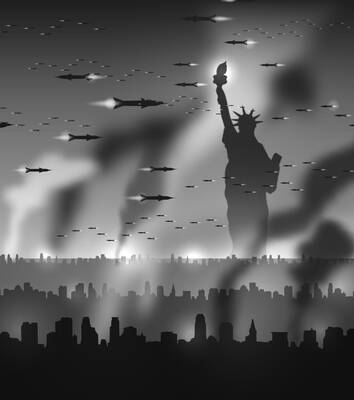
After declaring Iran’s military “gone,” US President Donald Trump appealed to the UK, France, Japan and South Korea — as well as China, Iran’s strategic partner — to send minesweepers and naval forces to reopen the Strait of Hormuz. When allies balked, the request turned into a warning: NATO would face “a very bad” future if it refused. The prevailing wisdom is that Trump faces a credibility problem: having spent years insulting allies, he finds they would not rally when he needs them. That is true, but superficial, as though a structural collapse could be caused by wounded feelings. Something
Former Taipei mayor and Taiwan People’s Party (TPP) founding chairman Ko Wen-je (柯文哲) was sentenced to 17 years in prison on Thursday, making headlines across major media. However, another case linked to the TPP — the indictment of Chinese immigrant Xu Chunying (徐春鶯) for alleged violations of the Anti-Infiltration Act (反滲透法) on Tuesday — has also stirred up heated discussions. Born in Shanghai, Xu became a resident of Taiwan through marriage in 1993. Currently the director of the Taiwan New Immigrant Development Association, she was elected to serve as legislator-at-large for the TPP in 2023, but was later charged with involvement
Out of 64 participating universities in this year’s Stars Program — through which schools directly recommend their top students to universities for admission — only 19 filled their admissions quotas. There were 922 vacancies, down more than 200 from last year; top universities had 37 unfilled places, 40 fewer than last year. The original purpose of the Stars Program was to expand admissions to a wider range of students. However, certain departments at elite universities that failed to meet their admissions quotas are not improving. Vacancies at top universities are linked to students’ program preferences on their applications, but inappropriate admission


 RSS
RSS