


The scandal surrounding the convicted pedophile Jeffrey Epstein has dominated headlines around the world since the US Department of Justice released millions of files on the case federal prosecutors were preparing when he died in custody in 2019. Nearly a decade after the #MeToo movement, the affair has rightly returned the spotlight to the still under-reported abuse of women by men who feel that their wealth and power allow them to act with impunity. All this underscores the need to strengthen the protection of women’s rights.
However, as policymakers in other countries work to address gender inequality, conditions for women and girls in Taliban-ruled Afghanistan continue to deteriorate, systematically destroying half the population’s hopes and ambitions by prohibiting them from education and employment. Worse still, Taliban officials have been allowed to act with little international condemnation.
Since the group’s return to power in 2021, campaigners have hoped that Muslim-majority countries would be able to pressure or persuade Afghanistan’s Kandahar-based clerical rulers to change their position. After all, Islamic teaching in fact promotes girls’ education and women’s employment. So far, those efforts have also failed.
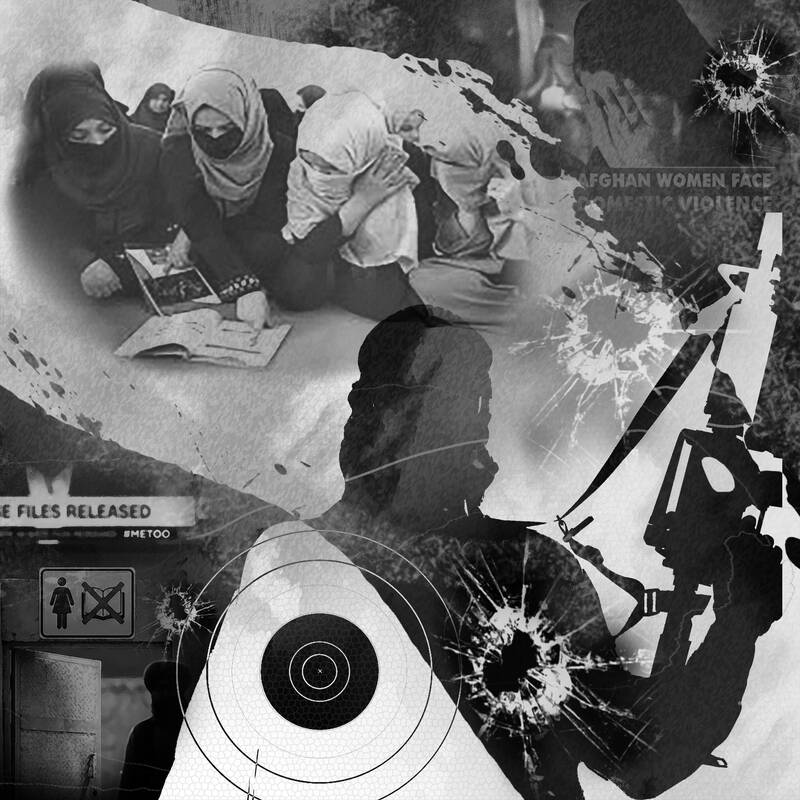
Illustration: Kevin Sheu
The Taliban regime, no longer content with merely excluding girls and women from schools and workplaces, has ramped up its misogyny with efforts to erase women’s visibility from public life. The enactment in January of a new criminal procedure code heralds the loss of basic legal protections and further entrenchment of repression and discrimination against women and girls. It is for those reasons that many observers now talk of the Taliban’s crimes as equivalent to gender apartheid.
The new code fails to criminalize many forms of physical, psychological and sexual violence against women. For example, it treats domestic abuse as a crime only in narrow circumstances, such as when a man leaves wounds, bruising or other visible injuries on his wife. Even then, the maximum punishment appears to be 15-day jail sentence. This reflects the code’s broader shift toward placing a heavy burden of proof on abused women. That is why much of the scant coverage of the new legal framework has described it as “legalizing domestic violence.”
At the same time, Afghanistan’s education ministry has let it be known that girls are to be permanently excluded from secondary education. As the Taliban’s war on women continues to plumb new lows, it is time to recognize, commend, and provide support — financial and otherwise — to the organizations inside Afghanistan that, against the odds, continue to stand up for women’s rights and gender equality.
Thanks to the efforts of some of these groups, thousands of Afghan teenage girls now study in secret, often in underground classrooms. Free classes are offered in a range of subjects, from physics and biology to literature and journalism. Humanitarian aid has been crucial in helping to fund such initiatives.
Consider LEARN Afghan, an innovative non-governmental organization that teaches about 2,500 girls in person in 19 unofficial schools across 18 provinces. Moreover, tens of thousands of Afghan girls have been able to continue their studies through its offline learning platforms and remote education initiatives. What began as a response to the Taliban’s education ban has grown into one of the largest women-led underground education movements in the world.
LEARN’s annual report for last year shows how its courses have helped many Afghan girls gain confidence in their abilities and given them the determination to continue learning, even if it means studying abroad. The organization’s underground schools, sustained by the belief that the right to education is non-negotiable, have allowed young women to dream of professional lives as teachers, doctors, lawyers or whatever they choose.
So impressive is LEARN’s work that Education Cannot Wait (ECW), the global fund dedicated to education in emergencies and for displaced communities, now supports it. While the US has regrettably withdrawn its support from ECW (I am a former chair), the organization’s European funders continue to ensure that as many Afghan girls as possible are supported by LEARN and other unofficial schools, online programs and refugee-education initiatives.
However, continuing to stand up for gender equality in the face of repressive regimes requires resources. To that end, ECW will hold a replenishment conference in November. A new tranche of funding will be indispensable to educating girls in some of the world’s most vulnerable places.
As Pashtana Durrani, founder and executive director of LEARN, put it: “When girls are given the chance to learn, they do more than survive. They lead, they build and they carry their communities forward.”
No country, least of all Afghanistan, can prosper without harnessing the talents of all its people. When girls and women are given the tools they need to realize their potential, everyone benefits.
Gordon Brown, a former prime minister of the UK, is WHO ambassador for Global Health Financing.
Copyright: Project Syndicate
A gap appears to be emerging between Washington’s foreign policy elites and the broader American public on how the United States should respond to China’s rise. From my vantage working at a think tank in Washington, DC, and through regular travel around the United States, I increasingly experience two distinct discussions. This divergence — between America’s elite hawkishness and public caution — may become one of the least appreciated and most consequential external factors influencing Taiwan’s security environment in the years ahead. Within the American policy community, the dominant view of China has grown unmistakably tough. Many members of Congress, as

After declaring Iran’s military “gone,” US President Donald Trump appealed to the UK, France, Japan and South Korea — as well as China, Iran’s strategic partner — to send minesweepers and naval forces to reopen the Strait of Hormuz. When allies balked, the request turned into a warning: NATO would face “a very bad” future if it refused. The prevailing wisdom is that Trump faces a credibility problem: having spent years insulting allies, he finds they would not rally when he needs them. That is true, but superficial, as though a structural collapse could be caused by wounded feelings. Something
Former Taipei mayor and Taiwan People’s Party (TPP) founding chairman Ko Wen-je (柯文哲) was sentenced to 17 years in prison on Thursday, making headlines across major media. However, another case linked to the TPP — the indictment of Chinese immigrant Xu Chunying (徐春鶯) for alleged violations of the Anti-Infiltration Act (反滲透法) on Tuesday — has also stirred up heated discussions. Born in Shanghai, Xu became a resident of Taiwan through marriage in 1993. Currently the director of the Taiwan New Immigrant Development Association, she was elected to serve as legislator-at-large for the TPP in 2023, but was later charged with involvement
Out of 64 participating universities in this year’s Stars Program — through which schools directly recommend their top students to universities for admission — only 19 filled their admissions quotas. There were 922 vacancies, down more than 200 from last year; top universities had 37 unfilled places, 40 fewer than last year. The original purpose of the Stars Program was to expand admissions to a wider range of students. However, certain departments at elite universities that failed to meet their admissions quotas are not improving. Vacancies at top universities are linked to students’ program preferences on their applications, but inappropriate admission


 RSS
RSS