


Whenever the Ministry of Health and Welfare releases a salary survey of nursing staff claiming annual salaries of NT$700,000 to NT$800,000 (US$22,097 to US$25,254), nurses across Taiwan roll their eyes. The enormity of the gap between official data and reality is not a simple statistics error, but a kind of gaslighting. The message to those in the wards is clear: If you do not have money, it is because you have not worked enough night shifts and you have not pushed yourself, which is why you have not received the performance bonus.
What is the reality of nursing care in Taiwan? It is jogging down ward corridors while holding your bladder, wolfing down a few cold mouthfuls of food to save time on lunch breaks and looking at your savings account after work, asking why you took on this stress.
In Taiwan, the NT$32,000 to NT$36,000 base salaries of full-time nurses are comparable to that of a management trainee in a chain restaurant. The so-called “high salaries” touted by the ministry are earned entirely by working graveyard shifts, which require sacrificing family life and ignoring biological clocks. Once the health of such nurses collapses and they can no longer work night shifts, their salaries drop back to square one.
This is not a professional bonus; it is trading years of your life for cash.
Even more concerning is that while hospital operators constantly bemoan being short of funds, their financial statements tell a different story. In 2023, Linkou Chang Gung Memorial Hospital reported an annual surplus of NT$5.6 billion, while China Medical University reported NT$3 billion. These so-called “non-profit” medical foundations invest the surpluses in new buildings, expensive new equipment and expanded operations.
In their capital-driven calculations, physical assets can appreciate in value, while nursing staff is a cost to be minimized. When hospitals generate hundreds of millions in surpluses yet fail to ensure that nurses’ salaries keep up with inflation, it is not an exaggeration to call it a structural program of enriching the well-off at the expense of the poor. In the face of such exploitation, the government’s role should be that of final arbitrator. Clearly, it has chosen to side with capital.
The ministry has not dared to confront the issue directly and disrupt the hospitals’ profit structure as it could have done, for instance by mandating that nursing fees go to the nurses themselves, or legislating for a minimum nurse-patient ratio of three to one. Instead, they have opted for a far more roundabout and damaging route: introducing foreign nursing staff and intern nurses who are yet to even pass the national exam for nursing personnel.
The government has allotted NT$2.5 billion for such endeavors, preferring to turn to cheaper labor rather than ask hospitals to dedicate a share of their profits to improving the conditions and salaries of nurses.
To frontline staff, this is not just a policy error, but an abasement. It sends the message loud and clear that, in the government’s eyes, nurses are nothing more than replaceable units on the assembly line. With foreign nurses lacking language skills entering the workforce, communication gaps and oversight responsibilities eventually fall back on on the shoulders of already overworked nurses, making systems that are already stretched thin even more chaotic.
We have witnessed successive waves of nurses fleeing the profession, switching to careers in cosmetic surgery, insurance or even selling coffee. It is not for a lack of passion for their work, but because the system has made staying nearly unbearable.
Taiwan’s “miracle” of a healthcare program has long been built on the blood, sweat and tears of nursing staff. To maintain cheap healthcare and the stable profits of hospital conglomerates, the government has tacitly condoned this chronic persecution of the nursing profession. If its policies continue to ignore the systemic greed at large and use foreign labor to plug gaps, then the collapse of the entire system is only a matter of time.
Treating nurses as disposable, at the end of the day, comes at the expense of each and every Taiwanese in need of medical care.
Able is a graphic designer.
Translated by Gilda Knox Streader
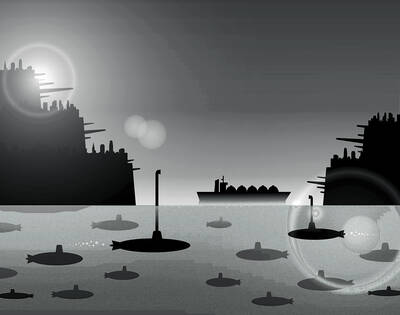
In the event of a war with China, Taiwan has some surprisingly tough defenses that could make it as difficult to tackle as a porcupine: A shoreline dotted with swamps, rocks and concrete barriers; conscription for all adult men; highways and airports that are built to double as hardened combat facilities. This porcupine has a soft underbelly, though, and the war in Iran is exposing it: energy. About 39,000 ships dock at Taiwan’s ports each year, more than the 30,000 that transit the Strait of Hormuz. About one-fifth of their inbound tonnage is coal, oil, refined fuels and liquefied natural gas (LNG),
On Monday, the day before Chinese Nationalist Party (KMT) Chairwoman Cheng Li-wun (鄭麗文) departed on her visit to China, the party released a promotional video titled “Only with peace can we ‘lie flat’” to highlight its desire to have peace across the Taiwan Strait. However, its use of the expression “lie flat” (tang ping, 躺平) drew sarcastic comments, with critics saying it sounded as if the party was “bowing down” to the Chinese Communist Party (CCP). Amid the controversy over the opposition parties blocking proposed defense budgets, Cheng departed for China after receiving an invitation from the CCP, with a meeting with
To counter the CCP’s escalating threats, Taiwan must build a national consensus and demonstrate the capability and the will to fight. The Chinese Communist Party (CCP) often leans on a seductive mantra to soften its threats, such as “Chinese do not kill Chinese.” The slogan is designed to frame territorial conquest (annexation) as a domestic family matter. A look at the historical ledger reveals a different truth. For the CCP, being labeled “family” has never been a guarantee of safety; it has been the primary prerequisite for state-sanctioned slaughter. From the forced starvation of 150,000 civilians at the Siege of Changchun
The two major opposition parties, the Chinese Nationalist Party (KMT) and the Taiwan People’s Party (TPP), jointly announced on Tuesday last week that former TPP lawmaker Chang Chi-kai (張啟楷) would be their joint candidate for Chiayi mayor, following polling conducted earlier this month. It is the first case of blue-white (KMT-TPP) cooperation in selecting a joint candidate under an agreement signed by their chairpersons last month. KMT and TPP supporters have blamed their 2024 presidential election loss on failing to decide on a joint candidate, which ended in a dramatic breakdown with participants pointing fingers, calling polls unfair, sobbing and walking


 RSS
RSS