


There is much that can be said about the US’ decision to attack Iran — and about what could result from the joint US and Israeli strikes against military and political targets throughout the country. Unfortunately, little of it is reassuring.
First and foremost, this is a war of choice. The US had other policy options available. Diplomacy appeared to hold promise as a means to prevent Iran from developing nuclear weapons. Increased economic pressure had the potential over time to precipitate regime change.
Moreover, this is a preventive war, not a pre-emptive one. Iran posed no imminent threat to vital US interests. Iran was not on the verge of becoming a nuclear weapons state or using what weapons it did have against the US. At most, the threat posed by Iran was a gathering one.
This distinction is important. A world in which countries believed they have the right to undertake preventive strikes against those they judge to be threats would be a world of frequent conflict. That is why such actions have no standing under international law.
US President Donald Trump has chosen an objective — regime change — that is political rather than military, but while military force can destroy and kill, on its own, it cannot bring about regime change, which requires the regime to collapse. It is possible that the US attack would trigger defections from Iran’s political leadership and armed forces, but this cannot be counted on. Hamas and Gaza are a reminder that regimes can absorb incredible punishment yet cling to power. Even when the clerics fall from power — Iranian Supreme Leader Ayatollah Ali Khamenei has been killed — the security forces are arguably best positioned to take their place.
In any case, using military force to kill select leaders as a means of triggering regime change — a tactic often called decapitation — is unlikely to succeed in Iran, where the leadership has institutionalized itself since taking power about a half-century ago. Moreover, the leadership has had time to improve succession planning over the past few weeks as the possibility of war increased.
During its January incursion into Venezuela, the Trump administration limited itself to replacing one leader (all but ignoring the internal opposition), while in much of the world, it has avoided pressing for democracy. However, in the case of Iran, Trump has called for regime change — but without preparing the ground for it. The political opposition is not united or functioning as a government in waiting, which means that it is unable to accept defections, much less provide security.
History suggests that regime change requires a physical, on-the-ground presence. This is the lesson of Germany and Japan after World War II, and Panama, Iraq and Afghanistan more recently. Even with a ground presence, such efforts often come up short. In Iran, occupation is inconceivable, given the country’s size and ability to resist.
All of which is to say that the Trump administration has chosen to accomplish the most ambitious of foreign-policy goals with limited means. It seems to have rejected a war of choice with narrower goals, such as degrading known Iranian nuclear and ballistic missile capabilities, even though it could credibly claim to have achieved these ends. If there is a recent parallel to what is taking place in Iran, it is Libya, where just more than a decade ago Western forces ousted the leadership using air power, but then withdrew, leaving the country in chaos.
In the Iranian case, it appears that assembling a massive military presence — what Trump called an armada — ended up putting pressure on the administration to act, because US forces could not be maintained in a high state of readiness on location indefinitely. As a result, the means of policy (military force) might well have played a large role in determining the ends of policy, namely, the decision to attack. This is obviously the reverse of how policy should be decided.
Taking a step back, the US has opted yet again to make a massive strategic commitment in the Middle East. This is at odds with the Trump administration’s own National Security Strategy and with the reality that the greatest challenges to US interests are to be found in Europe and the Indo-Pacific region. Here the parallel is to the 2003 Iraq War, another preventive war of choice in the region that cost the US enormously.
The American people are unprepared for this war. Nor is Trump’s political base, as it would unsettle markets, cause a spike in energy prices, and could go on for some time. The US’ allies are unhappy as well, as Iran has already attacked several neighboring countries and could take steps that damage their economies. Trump did not use his State of the Union speech on Tuesday last week to make the case for attacking Iran, and much of his statement in the immediate aftermath of Saturday’s attack emphasized past actions by Iran rather than new or emerging threats.
It is possible that last year’s cost-free bombing of three Iranian nuclear sites and the January intervention in Venezuela made Trump and those around him highly confident that they could achieve ambitious ends with limited means at a low cost. He might also have been tempted to achieve something historic in Iran — regime change — that eluded his predecessors. He might still succeed, but as a rule, regime change is easier called for than successfully carried out. While it takes only one side to begin a war, it takes two to end it. Iran now has a vote in how big this conflict becomes and how long it continues.
Richard Haass, president emeritus of the Council on Foreign Relations, is a senior counselor at Centerview Partners, distinguished university scholar at New York University and the author of the weekly Substack newsletter Home & Away. Copyright: Project Syndicate

A gap appears to be emerging between Washington’s foreign policy elites and the broader American public on how the United States should respond to China’s rise. From my vantage working at a think tank in Washington, DC, and through regular travel around the United States, I increasingly experience two distinct discussions. This divergence — between America’s elite hawkishness and public caution — may become one of the least appreciated and most consequential external factors influencing Taiwan’s security environment in the years ahead. Within the American policy community, the dominant view of China has grown unmistakably tough. Many members of Congress, as
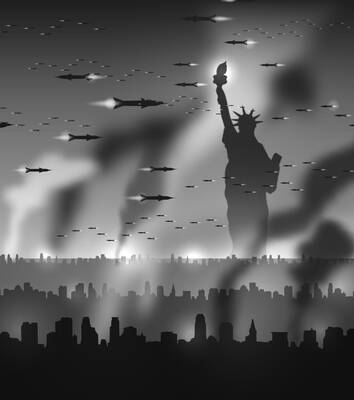
After declaring Iran’s military “gone,” US President Donald Trump appealed to the UK, France, Japan and South Korea — as well as China, Iran’s strategic partner — to send minesweepers and naval forces to reopen the Strait of Hormuz. When allies balked, the request turned into a warning: NATO would face “a very bad” future if it refused. The prevailing wisdom is that Trump faces a credibility problem: having spent years insulting allies, he finds they would not rally when he needs them. That is true, but superficial, as though a structural collapse could be caused by wounded feelings. Something
Former Taipei mayor and Taiwan People’s Party (TPP) founding chairman Ko Wen-je (柯文哲) was sentenced to 17 years in prison on Thursday, making headlines across major media. However, another case linked to the TPP — the indictment of Chinese immigrant Xu Chunying (徐春鶯) for alleged violations of the Anti-Infiltration Act (反滲透法) on Tuesday — has also stirred up heated discussions. Born in Shanghai, Xu became a resident of Taiwan through marriage in 1993. Currently the director of the Taiwan New Immigrant Development Association, she was elected to serve as legislator-at-large for the TPP in 2023, but was later charged with involvement
Out of 64 participating universities in this year’s Stars Program — through which schools directly recommend their top students to universities for admission — only 19 filled their admissions quotas. There were 922 vacancies, down more than 200 from last year; top universities had 37 unfilled places, 40 fewer than last year. The original purpose of the Stars Program was to expand admissions to a wider range of students. However, certain departments at elite universities that failed to meet their admissions quotas are not improving. Vacancies at top universities are linked to students’ program preferences on their applications, but inappropriate admission


 RSS
RSS