


A friend wrote to me last week to tell me that my name appeared in the Epstein files.
“But it’s for a good cause,” he wrote, “nothing sinister.”
In 2012, shortly after my friend and colleague Marie Colvin was killed in Homs, Syria, I met with the now-disgraced Norwegian diplomat Terje Rod-Larsen. Rod-Larsen was a renowned fixer who had negotiated the 1993 Oslo accords.
Colvin had been killed by government shelling on Feb. 22, 2012. The fighting between former Syrian president Bashar al-Assad’s government forces and the Free Syrian Army was so fierce that retrieving her corpse was nearly impossible.
Rod-Larsen had made so-called peace between the Palestinians and Israelis. Perhaps, I thought, he could find a way to bring Marie’s body home. Unbeknown to me, Rod-Larsen forwarded my request to Jeffrey Epstein. Epstein was not a household name in those days, but one can only assume Rod-Larsen knew about his alleged Mossad connections. In the end, nothing came of it that I know of.
It was strange to be reminded of her in that way. Colvin was a Sunday Times reporter who was relentless in her pursuit of a story. Her focus was always on the civilian cost of war, and she paid the price for her firsthand reporting with emotional and physical trauma. In Sri Lanka, she lost an eye. In Syria, she lost her life.
I worked in the same war zones she did. I knew what the broken neighborhoods of Homs, Daraya and Aleppo looked like. We were journalists, and our words reached a crucial audience. We wanted to shift policy. We calculated that the risk was worth getting evidence that might actually make a difference.
Years after her death, a US court found that Marie had not been the victim of a random shelling. She had been targeted by al-Assad’s forces. We were not just observers taking careful notes — we were targets.
It has been 14 years since Marie’s death, and journalism is an entirely different landscape. It is not just the empty newsrooms, or that artificial intelligence is replacing careful analysis. Today, the risk is the manipulation and masking of the truth.
In Gaza, international reporters are banned. The local Palestinian reporters have paid a terrible price to bring the story to us — at least 248 of them have been killed by Israeli forces. Last year, Palestinians in Gaza accounted for more than half of all journalists killed globally. Then, according to +972 Magazine, once a Palestinian journalist is killed, “the legitimization cell” within the Israel Defense Forces begins its dirty work. It is tasked with linking the dead journalist to Hamas to bolster Israel’s image in the international media. That is even if he or she had nothing to do with Hamas.
Reporters Without Borders said that last year was the deadliest year ever for reporters.
“Journalists do not just die. They are killed. This is where hate and impunity lie,” it said.
Impunity has become the standard. In Ukraine, Russia targets journalists. Sudan is nearly impossible for professional reporters to operate in. In Mexico — the second-most deadly country for journalists after Palestine — reporters are hunted down by criminal organizations.
At the Munich security conference in Germany, I was on a panel with the Belarusian political scientist Alina Kharysava discussing how disinformation thrives in these vacuums. What is the alternative? How do we fight Israeli or Kremlin propaganda? My response was that evidence does not lie. We must insist on working on the ground if we want truthful narratives.
At The Reckoning Project, we train local journalists to collect legally binding testimonies from survivors of atrocity crimes that would later be verified and used in court. We build prosecutors’ dossiers, but we also use some testimonies to counter disinformation. This destroys the arguments that, for example, “Bucha did not happen” or “There was no siege in Mariupol.”
In Sudan, it is the same story. Despite the satellite imagery, there are no mass graves in El Fasher. There is no mass sexual violence, no attacks by the Rapid Support Forces (RSF). It is the civilians who brought harm on to themselves, according to RSF propaganda.
Israelis still insist that there is no starvation in Gaza, or that six-year-old Hind Rajab did not die from an Israeli bullet. This is despite the methodical investigations led by the non-governmental organization Forensic Architecture, which used sonic investigations, kinetic analysis and satellite imagery to prove otherwise.
One message is clear: Access is power.
When reporters cannot enter a war zone independently, governments and armed groups shape their own story by default. Images emerge, but they do not have the texture and corroboration that experienced correspondents such as Marie could provide. Satellite imagery, geospatial analysis, metadata, all of the fancy tools of open-source intelligence are brilliant — but they do not take the place of gathering human intelligence.
When we do not have access, the public is forced to choose sides. They join tribes rather than understand facts. Polarization then divides society. We know what happens next.
Once, journalists’ work could affect policy decisions. Reporting the biblical exodus of refugees in Kosovo in 1999 led directly to NATO’s 78-day bombing campaign against Serbia. However, when access is denied, bloggers, influencers and conspiracy theorists can turn anything into their version of the truth.
When independent witnesses are absent, accountability disappears.
Marie Colvin died, because she was in the heart of the battle acting as a witness. All of us in this space should look back at her death as a reminder of how urgent it is to preserve the truth. When borders are closed, disinformation thrives. Narratives are manufactured and twisted.
When there are no witnesses, lies can too often dictate reality.
Janine di Giovanni is a war correspondent and the executive director of The Reckoning Project, a war crimes unit in Ukraine, Sudan and Gaza. She is the author of The Morning They Came for Us: Dispatches from Syria.
A gap appears to be emerging between Washington’s foreign policy elites and the broader American public on how the United States should respond to China’s rise. From my vantage working at a think tank in Washington, DC, and through regular travel around the United States, I increasingly experience two distinct discussions. This divergence — between America’s elite hawkishness and public caution — may become one of the least appreciated and most consequential external factors influencing Taiwan’s security environment in the years ahead. Within the American policy community, the dominant view of China has grown unmistakably tough. Many members of Congress, as
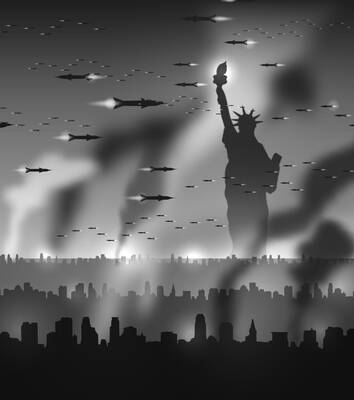
After declaring Iran’s military “gone,” US President Donald Trump appealed to the UK, France, Japan and South Korea — as well as China, Iran’s strategic partner — to send minesweepers and naval forces to reopen the Strait of Hormuz. When allies balked, the request turned into a warning: NATO would face “a very bad” future if it refused. The prevailing wisdom is that Trump faces a credibility problem: having spent years insulting allies, he finds they would not rally when he needs them. That is true, but superficial, as though a structural collapse could be caused by wounded feelings. Something
Former Taipei mayor and Taiwan People’s Party (TPP) founding chairman Ko Wen-je (柯文哲) was sentenced to 17 years in prison on Thursday, making headlines across major media. However, another case linked to the TPP — the indictment of Chinese immigrant Xu Chunying (徐春鶯) for alleged violations of the Anti-Infiltration Act (反滲透法) on Tuesday — has also stirred up heated discussions. Born in Shanghai, Xu became a resident of Taiwan through marriage in 1993. Currently the director of the Taiwan New Immigrant Development Association, she was elected to serve as legislator-at-large for the TPP in 2023, but was later charged with involvement
Out of 64 participating universities in this year’s Stars Program — through which schools directly recommend their top students to universities for admission — only 19 filled their admissions quotas. There were 922 vacancies, down more than 200 from last year; top universities had 37 unfilled places, 40 fewer than last year. The original purpose of the Stars Program was to expand admissions to a wider range of students. However, certain departments at elite universities that failed to meet their admissions quotas are not improving. Vacancies at top universities are linked to students’ program preferences on their applications, but inappropriate admission


 RSS
RSS