


India is fast becoming one of the world’s biggest artificial intelligence (AI) user bases. The question now is how it can turn that scale into superpower status rather than just training Silicon Valley for free.
That is a tall order for a country largely caught flat-footed by the boom, but let us start with the basics: The three main building blocks of AI are talent, compute (including high-end chips and infrastructure) and data. India does not lack engineers, but it does not have foundational research training at scale or enough advanced processors at public labs and universities. What it does have, in abundance, is data. It should start treating this like a strategic asset rather than leaking it out as a free export.
It is a key reason US big tech is making a blitz for the market. With roughly 1 billion people online and a massive, mobile-first population, India generates a torrent of messages, voice notes, digital payments — and increasingly the kind of human feedback that makes AI systems better — on a daily basis. The world’s most-populous country is the second-biggest user base of OpenAI’s ChatGPT and Anthropic PBC’s Claude after the US, while accounting for just a fraction of these platforms’ revenue. The dynamic exposes how much more the market matters for training purposes right now than making money.
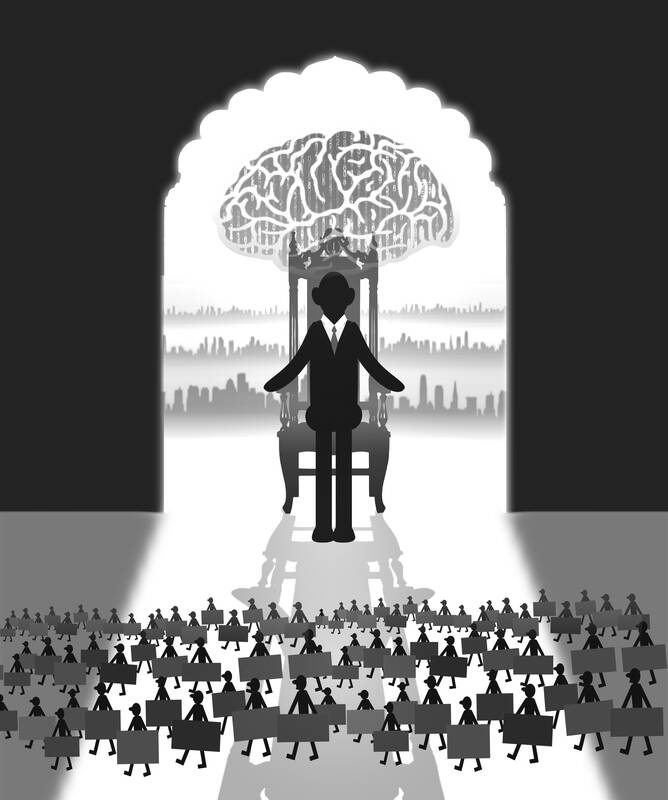
Illustration: Yusha
These free-to-use services and promotions bombarding Indian consumers come with a cost. It is part of a strategic Silicon Valley land grab for Indian languages, voices and behaviors that would make foreign systems smarter first. The South Asian nation risks repeating a familiar historical pattern of exporting the raw materials for pennies then buying back the imported models at a premium. Meanwhile, it would be left to absorb the jobs shock and social impacts at home.
India’s linguistic diversity also raises the stakes. The country has more than 20 official languages and dozens more that are unofficial. If models are not trained on enough local speech and cultural contexts, they would misunderstand users and become unreliable in classrooms, clinics, courts and even customer support settings. Closing this language gap sits at the heart of Indian Prime Minister Narendra Modi’s promise to democratize AI and make its impacts real for everyone from farmers to small-business owners, rather than just English-speaking elites.
At the same time, the AI future that the likes of Meta Platforms Inc or OpenAI are selling — marked by personal agents and voice-powered ambient devices — would not work in India unless they can listen and speak local languages, and get the nuances right.
Some start-ups, including Andreessen Horowitz-backed Poseidon AI and big tech-supported nonprofit efforts are already trying to crowd-source and create local language datasets. New Delhi should be paying far more attention, not just because data-labeling and collection practices have adopted a global reputation of being exploitative, but also because these efforts could anchor a domestic ecosystem. India cannot demand “AI for all” while outsourcing the work of building the linguistic foundation. However, if done well, these datasets can become infrastructure for its AI economy.
The same logic applies beyond language. India should push hard for the creation of specialized, high-impact and localized datasets in sectors such as healthcare or finance. AI can improve diagnostics and personalized care, but the most valuable data for accomplishing this still lies in largely inaccessible hospital systems. On the sidelines of the AI Impact Summit, I attended a dialogue convened by nonprofit coalition iSpirit, in which local entrepreneurs laid out a framework to let researchers tap this more sensitive data securely. Privacy fears are real and should be taken seriously, but accessing this data could also mean saving lives. Unlocking and organizing it is the hard, unglamorous work that takes Modi’s branding of “AI for good” beyond just slogans.
Ultimately, India’s data reckoning should be about who controls this strategic input to AI and who captures the value from it.
The answer is not to wall off user outputs from the world. It is about finding creative solutions and leveraging them to set rules that reflect what is actually being extracted. If its peoples’ data is a key ingredient for building advanced AI, the Indian government should demand more than apps and marketing in return.
It can ask for partnerships that build capacity, including public compute commitments, access to high-end chips, serious training pipelines for AI researchers and collaborations that go beyond token commitments. New Delhi should also set norms that treat local datasets as a public good and consider revenue-sharing models that maintain the upsides at home. Transparency is crucially important. Policymakers should require foreign model builders to disclose the kind of data that shaped their systems, and how they have been evaluated for harms and biases in Indian contexts.
More than building foundation models, setting equitable data policies is where India has the biggest opportunity to truly lead the “global south” in the AI era. Otherwise, it risks becoming an open mine and fueling systems that automate local jobs, concentrate power abroad and deepen dependencies.
Catherine Thorbecke is a Bloomberg Opinion columnist covering Asia tech. Previously she was a tech reporter at CNN and ABC News. This column reflects the personal views of the author and does not necessarily reflect the opinion of the editorial board or Bloomberg LP and its owners.
When Chinese President Xi Jinping (習近平) sits down with US President Donald Trump in Beijing on Thursday next week, Xi is unlikely to demand a dramatic public betrayal of Taiwan. He does not need to. Beijing’s preferred victory is smaller, quieter and in some ways far more dangerous: a subtle shift in American wording that appears technical, but carries major strategic meaning. The ask is simple: replace the longstanding US formulation that Washington “does not support Taiwan independence” with a harder one — that Washington “opposes” Taiwan independence. One word changes; a deterrence structure built over decades begins to shift.
The cancelation this week of President William Lai’s (賴清德) state visit to Eswatini, after the Seychelles, Madagascar and Mauritius revoked overflight permits under Chinese pressure, is one more measure of Taiwan’s shrinking executive diplomatic space. Another channel that deserves attention keeps growing while the first contracts. For several years now, Taipei has been one of Europe’s busiest legislative destinations. Where presidents and foreign ministers cannot land, parliamentarians do — and they do it in rising numbers. The Italian parliament opened the year with its largest bipartisan delegation to Taiwan to date: six Italian deputies and one senator, drawn from six
Recently, Taipei’s streets have been plagued by the bizarre sight of rats running rampant and the city government’s countermeasures have devolved into an anti-intellectual farce. The Taipei Parks and Street Lights Office has attempted to eradicate rats by filling their burrows with polyurethane foam, seeming to believe that rats could not simply dig another path out. Meanwhile, as the nation’s capital slowly deteriorates into a rat hive, the Taipei Department of Environmental Protection has proudly pointed to the increase in the number of poisoned rats reported in February and March as a sign of success. When confronted with public concerns over young
Taipei is facing a severe rat infestation, and the city government is reportedly considering large-scale use of rodenticides as its primary control measure. However, this move could trigger an ecological disaster, including mass deaths of birds of prey. In the past, black kites, relatives of eagles, took more than three decades to return to the skies above the Taipei Basin. Taiwan’s black kite population was nearly wiped out by the combined effects of habitat destruction, pesticides and rodenticides. By 1992, fewer than 200 black kites remained on the island. Fortunately, thanks to more than 30 years of collective effort to preserve their remaining


 RSS
RSS