


It is a scene from a futuristic nightmare: A robot dog thrashes and lunges toward me, held back only by a metal chain that hits the floor with a heavy thud each time it pounces. The harder it fights, the more it snarls itself in the links, a machine trapped by its own struggle. Beside it, an identical quadruped from Hangzhou Yushu Technology Co (Unitree Robotics) lies motionless, like a dead friend.
It was not a lab accident. It was an art exhibit on the 45th floor of the swanky Toranomon Hills Station Tower in Tokyo. Despite the brute force of the metal animal hurling itself at onlookers, the biggest reaction in the room was simple: “Free him.”
Why do we feel sympathy for a chained robot that appears ready to attack us?
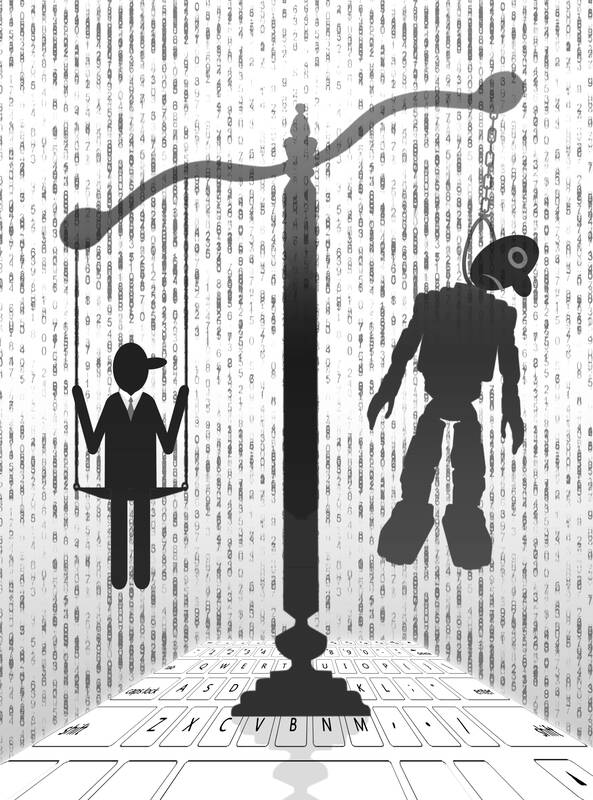
Illustration: Yusha
“Although it already has sufficient athletic ability and lethal power, this artificial beast is barely under control by a single ‘chain of ethics,’” Takayuki Todo, the multimedia artist behind the piece, writes on his Web site.
The question his exhibit asks is unnerving: When it locks eyes with us, do we start treating it like a “living other”?
Todo told Agence France-Presse that he is being attacked online as a “robot abuser.” He even visited Unitree’s offices in China last year to excuse himself for how he treated its device, Todo added.
Video of the exhibit did not just ricochet around Tokyo’s art scene; it went viral far beyond Japan, especially among artificial intelligence (AI) safety circles. There is a reason it struck such a nerve. The exhibit is not just about a robot dog, it is about what is coming next.
So-called “physical AI” has been prophesied by the likes of Nvidia Corp CEO Jensen Huang (黃仁勳) as the next wave. China, in particular, has intensified its efforts on humanoids and quadrupeds, pushing them out of stage demos and toward real deployment.
Analysts expect the nation’s humanoid robot sales to soar 133 percent this year as production prices fall. Asia’s demographic crunch has tech leaders and policymakers envisaging robots not just as tools, but as the answer to labor shortages, elder care holes and for companionship. That future is closer than we think.
Researchers have been studying human-robot interaction for years, but it is often artists who drive the debates around uncomfortable questions. In 2021, an art collective armed Boston Dynamics Inc’s quadruped robot, Spot, with a paintball gun and gave random Internet users the ability to control it. They aimed to show how the devices could potentially be weaponized for destruction. The company was not pleased.
Todo’s exhibit begs the question of what turns a bundle of computer parts into something people feel obligated to spare. One study found it is remarkably simple: The best way for an AI system to trigger “moral reactions” in people is to give it a humanlike form and program it to seem like it has good intentions.
I have long argued that I do not want my humanoids or quadrupeds to have a “personality” at all. The devices that would make the biggest difference would be the ones that focus on efficiency rather than companionship, but it turns out people do not actually seem to like “robotic” traits, even in robots.
A University of Chicago-led team last year gave service robots, presented as restaurant greeters, three different personalities: baseline, highly neurotic and highly extroverted. They found that the neurotic and extroverted bots “significantly enhanced” human participants’ emotional states. People ultimately rated the high-extroversion personality as the most enjoyable to interact with, and the findings suggested that sprinkling in a bit of neuroticism make a hunk of metal feel more relatable.
Researchers in the Netherlands looked specifically at quadrupeds and found that people felt safer around robot dogs with “submissive,” rather than “dominant,” personalities. They induced a sense of ease simply through stature, positioning and movement patterns.
It gets worse (or, depending on the business model, better). As we reflexively feel for robots, researchers have found that they mimic empathy right back to us. AI is perceived to be more compassionate than human experts. The risk is not merely that we would love robots, but that we would trust them. A computer can be cute, apologetic, even “submissive,” while still operating on incentives you cannot see.
Watching a machine strain against a chain and seeing people empathize with its yearning to be free is a preview of one of the most quietly consequential shifts in AI. As robots move from stage demos to sidewalks, hospitals and homes, the hardest governance problems might not be what these systems can do. It would be how they make us feel, and how easily designers, companies and authorities can use that to soften fear and disarm skepticism.
Maybe the danger is not the dog breaking free, but us letting it off the chain.
Catherine Thorbecke is a Bloomberg Opinion columnist covering Asia tech. Previously she was a tech reporter at CNN and ABC News. This column reflects the personal views of the author and does not necessarily reflect the opinion of the editorial board or Bloomberg LP and its owners.
When Chinese President Xi Jinping (習近平) sits down with US President Donald Trump in Beijing on Thursday next week, Xi is unlikely to demand a dramatic public betrayal of Taiwan. He does not need to. Beijing’s preferred victory is smaller, quieter and in some ways far more dangerous: a subtle shift in American wording that appears technical, but carries major strategic meaning. The ask is simple: replace the longstanding US formulation that Washington “does not support Taiwan independence” with a harder one — that Washington “opposes” Taiwan independence. One word changes; a deterrence structure built over decades begins to shift.
The cancelation this week of President William Lai’s (賴清德) state visit to Eswatini, after the Seychelles, Madagascar and Mauritius revoked overflight permits under Chinese pressure, is one more measure of Taiwan’s shrinking executive diplomatic space. Another channel that deserves attention keeps growing while the first contracts. For several years now, Taipei has been one of Europe’s busiest legislative destinations. Where presidents and foreign ministers cannot land, parliamentarians do — and they do it in rising numbers. The Italian parliament opened the year with its largest bipartisan delegation to Taiwan to date: six Italian deputies and one senator, drawn from six
Recently, Taipei’s streets have been plagued by the bizarre sight of rats running rampant and the city government’s countermeasures have devolved into an anti-intellectual farce. The Taipei Parks and Street Lights Office has attempted to eradicate rats by filling their burrows with polyurethane foam, seeming to believe that rats could not simply dig another path out. Meanwhile, as the nation’s capital slowly deteriorates into a rat hive, the Taipei Department of Environmental Protection has proudly pointed to the increase in the number of poisoned rats reported in February and March as a sign of success. When confronted with public concerns over young
Taipei is facing a severe rat infestation, and the city government is reportedly considering large-scale use of rodenticides as its primary control measure. However, this move could trigger an ecological disaster, including mass deaths of birds of prey. In the past, black kites, relatives of eagles, took more than three decades to return to the skies above the Taipei Basin. Taiwan’s black kite population was nearly wiped out by the combined effects of habitat destruction, pesticides and rodenticides. By 1992, fewer than 200 black kites remained on the island. Fortunately, thanks to more than 30 years of collective effort to preserve their remaining


 RSS
RSS