


The period film Murder of the Century (世紀血案), based on the Lin (林) family murders set for release next year, seems to make no secret of its intentions. Screenshots of an unverified script suggest the movie aims to distort and rewrite the story of the shocking, unsolved murders of then-imprisoned provincial councilor and democracy advocate Lin I-hsiung’s (林義雄) mother and twin daughters on Feb. 28, 1980, during the White Terror period.
It whitewashes the enormity of the crimes committed by the Chinese Nationalist Party (KMT) regime.
In a cruel disregard for their grief, 84-year-old Lin and his family were not consulted before the film was made.
The movie is a foreshadowing of the Chinese Communist Party’s (CCP) designs on Taiwan. Glossing over the dark history of Taiwan under the authoritarian regime of the KMT and in a show of “blue-red” collaboration, it paves the way for a new authoritarian regime — under the CCP.
Authoritarian governments rely on state violence to maintain control, instilling fear in their citizens, while maintaining a “clean” appearance. Beneath Murder of the Century’s cinematic veil, there is a foreboding sense of an authoritarian return.
Once again, an authoritarian regime from China looms large in Taiwan. “Red” at heart, but clad in “blue” and “white,” it waits for a chance to reimpose its terror.
The killings at Lin’s home occurred during the daytime when it was under continuous government surveillance. Who else but the KMT could have ordered the killings?
The leaked script regurgitates rumors spouted by the authorities that independence advocates were to blame for the murders. At the time, J. Bruce Jacobs, the late US-born Australian academic who specialized in Taiwan studies, and former legislative speaker You Si-kun (游錫?) were implicated in the killings.
The script goes as far as to insinuate that late historian and democracy advocate Su Beng (史明) was involved, an entirely unsubstantiated idea that goes beyond even what Hsu Mei-lin (徐梅鄰), then-Taiwan Garrison Command spokesman dared to suggest at the time.
If the script is accurate, then the director, Hsu’s grandson, Hsu Kun-hua (徐琨華), has no qualms in crafting such a narrative.
Attempts to manipulate Taiwan’s historical trauma would wage cognitive warfare and incite domestic chaos.
From the start of production to completion, the filmmakers failed to notify Lin and his family, undoubtedly inflicting a kind of secondary trauma.
The film’s investors and production company have significant connections to China, suggesting that the movie’s intention to destabilize Taiwan are self-evident.
The film comes as an omen, signaling the resurgence of the threat of an authoritarian headsman. Its ghost is no longer solely controlled by the KMT’s old elite, but is now manipulated by the CCP as well, with designs to take control of the prevailing narratives of Taiwan’s defining historical events. Under the guise of artistic freedoms, it is laying the groundwork for authoritarian rule should the CCP succeed in taking Taiwan.
Hu Wen-huei is a veteran journalist.
Translated by Gilda Knox Streader
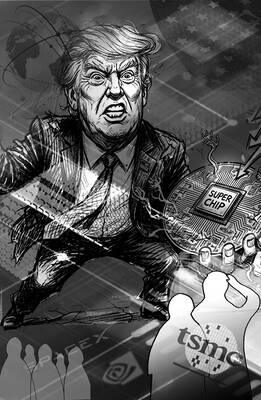
The White House’s decision to take a 9.9 percent stake in Intel Corp is looking like very shrewd business indeed. Since the government bought in at US$20.47 a share last August, the US chipmaker’s surging stock price has delivered the US a US$43 billion return. One of the reasons the investment has so far proved so sound is that the White House has made sure of it. According to The Wall Street Journal, Howard personally pushed deals on Intel’s behalf with some of the most lucrative clients imaginable. They include Nvidia Corp, the company at the heart of the AI
A single photograph can cut through a lot of noise, but it can also be used to misrepresent the truth. At the very least, it can concentrate the mind on something that requires further investigation. On Monday last week, Ma Ying-jeou Foundation CEO Tai Hsia-ling (戴遐齡) and former National Security Council secretary-general King Pu-tsung (金溥聰) held a news conference in which they showed a photograph of former foundation CEO Hsiao Hsu-tsen (蕭旭岑), now Chinese Nationalist Party (KMT) deputy chairman. In the image Hsiao is seated next to Xiamen Taiwan Businessmen Association chairman Han Ying-huan (韓螢煥). The two men were holding
I first met Professor Ray Jiing (井迎瑞) as a film and documentary student at Shih Hsin University’s (SHU) Department of Radio Television and Film in 1988. The following year, he went on to become the director of the Chinese Taipei Film Archive — forerunner of the Taiwan Film and Audiovisual Institute (TFAI). Over his eight-year tenure, Jiing rescued and restored over 200 classic Taiwanese films. In 1997, he established the Graduate Institute of Studies in Documentary and Film Archiving at Tainan National University of the Arts (TNNUA), and I joined the program in his third cohort of students. Beyond a
President William Lai Ching-te’s (賴清德) May 20 second-anniversary address was not just a routine policy review; it was damage control. US President Donald Trump’s remarks — that he did not want to see anyone move toward independence and that the delivery of a major Taiwan arms package could depend on the progress of US-China relations — unsettled Taiwan’s public and created an opening for opposition parties to question whether Taiwan was being treated as a bargaining chip in Washington’s dealings with Beijing. Lai’s speech was designed to close that opening. The address covered the expected ground: sovereignty, cross-strait relations, defense spending,


 RSS
RSS